- Your cart is empty
- Continue Shopping


How to Use an Oxygen Concentrator at Home: Setup, Flow Rate, Cleaning and Safety
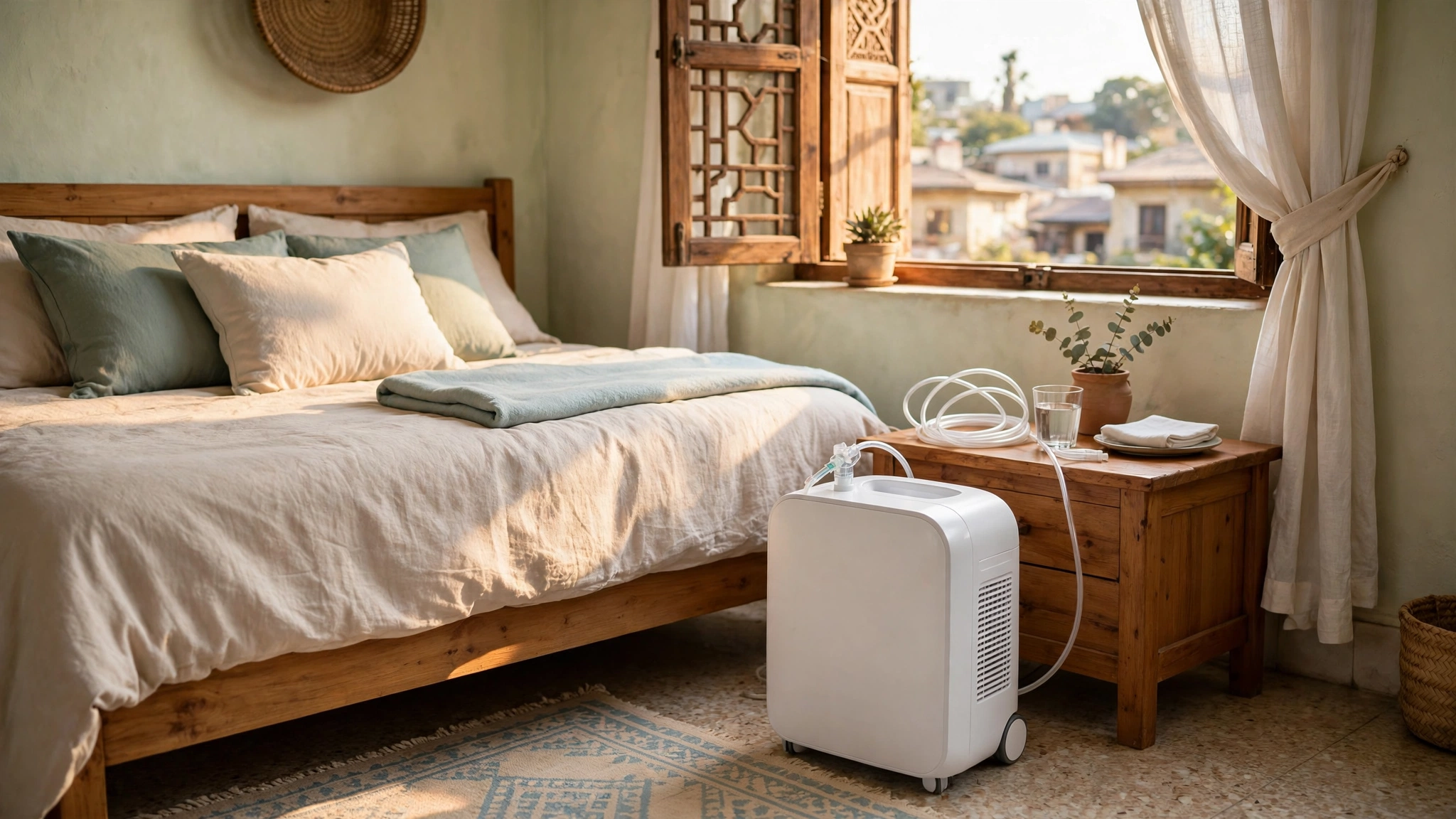
Quick Answer
An oxygen concentrator pulls in room air, removes the nitrogen and delivers concentrated oxygen through a nasal cannula. Switch it on, wait for it to reach full purity, set the flow rate your doctor prescribed, and put the cannula on. Use only the prescribed flow rate, clean the filter every week, and keep flames and smoking far away from the machine.
What an Oxygen Concentrator Does and Who Needs One
An oxygen concentrator is a medical device that takes in ordinary room air and delivers concentrated oxygen to the patient. Room air is about 21 percent oxygen and 78 percent nitrogen. Inside the machine, zeolite molecular sieves trap the nitrogen and leave the oxygen behind, in a process called pressure swing adsorption. A healthy home concentrator delivers about 90 to 96 percent pure oxygen, and the medical standard is 93 percent plus or minus 3 percent.
Unlike a cylinder, a concentrator stores no compressed oxygen. It makes oxygen continuously from the air around it for as long as it has power, so there is nothing to refill. That is why concentrators are the standard device for long term oxygen therapy at home worldwide, according to the American Thoracic Society clinical practice guideline. Home medical oxygen concentrators were invented in the early 1970s and became the most common way of delivering home oxygen after the late 1970s.
Doctors prescribe home oxygen for people whose lungs cannot keep enough oxygen in the blood on their own. Common reasons include COPD, pulmonary fibrosis, severe asthma, heart failure and recovery after a serious chest illness. Oxygen is a prescribed drug. Your doctor decides the flow rate and how many hours a day you should use it, and you should not change either one without advice. For long term oxygen therapy, the NHS advises using oxygen for a minimum of 15 hours a day, and up to 24 hours a day.
| Flow rate | Who it is usually prescribed for | Which concentrator size fits |
| 1 to 2 litres per minute | Mild to moderate oxygen needs, often for part of the day | A 5 litre home concentrator covers this easily |
| 3 to 5 litres per minute | Moderate needs, including most long term oxygen therapy patients | A 5 litre home concentrator at its full range |
| 6 to 8 litres per minute | Higher needs, often after a hospital stay | A 10 litre home concentrator |
| 9 to 10 litres per minute | High needs, usually under close medical supervision | A 10 litre home concentrator only |
The flow rate table above is a general guide, not a prescription. Your doctor sets your flow rate after measuring your blood oxygen, and the number on your prescription is the only one that matters for you. If you need help choosing between sizes, our guide on how to choose the best oxygen concentrator for home use in Pakistan walks through the seven points that matter most.
The Parts of a Home Oxygen Concentrator
A home concentrator looks like a small cabinet on wheels, and every model has the same basic parts. Knowing them helps you use the machine well and spot a problem early. The air intake filter sits at the back or side and stops dust getting into the machine. The compressor pulls room air in. The zeolite sieve beds separate the nitrogen from the oxygen. The flow meter shows the flow rate in litres per minute, and the flow control knob sets it. The oxygen outlet is where the tubing connects.
The nasal cannula is the soft plastic tube that carries oxygen to your nose. It has two small prongs that sit just inside the nostrils, tubing that loops over the ears, and a slider under the chin. Many home units also have a humidifier bottle, a small plastic bottle that adds moisture to the oxygen so the nose and throat do not dry out. You can read more about the flow setting in oxygen concentrator flow rate explained.
Most home machines also have indicator lights and an alarm. A green light usually means the oxygen purity is normal. A yellow light means caution, often purity between 82 and 87 percent. A red light means a serious problem, and the machine usually sounds an alarm with it. The alarm is there to protect you, and we explain what each beep means and what to check first in the alarms section later in this article.
Setting Up Your Concentrator for the First Time
Place the concentrator in a well ventilated spot with space around it, away from walls and curtains, and do not block its vents. Poor ventilation makes the machine run hot, and heat is one of the common causes of alarms. Plug it directly into a wall outlet, not an extension cord or power strip. A home concentrator uses about 400 to 600 watts, so a small UPS cannot run it.
Check the air intake filter before the first use. It should be clean and fully dry. If it is dirty, rinse it under warm water with mild soap and let it air dry completely before putting it back. Never run the machine without a filter, and never put a damp filter back.
If your unit has a humidifier bottle, fill it with distilled water only, between the minimum and maximum lines on the bottle. Tap water minerals can clog the machine, and tap water can carry germs into the lungs. Connect the tubing to the oxygen outlet, or to the bottle outlet if a bottle is fitted, and make sure every connection is firm. Loose tubing is a common cause of low flow alarms.
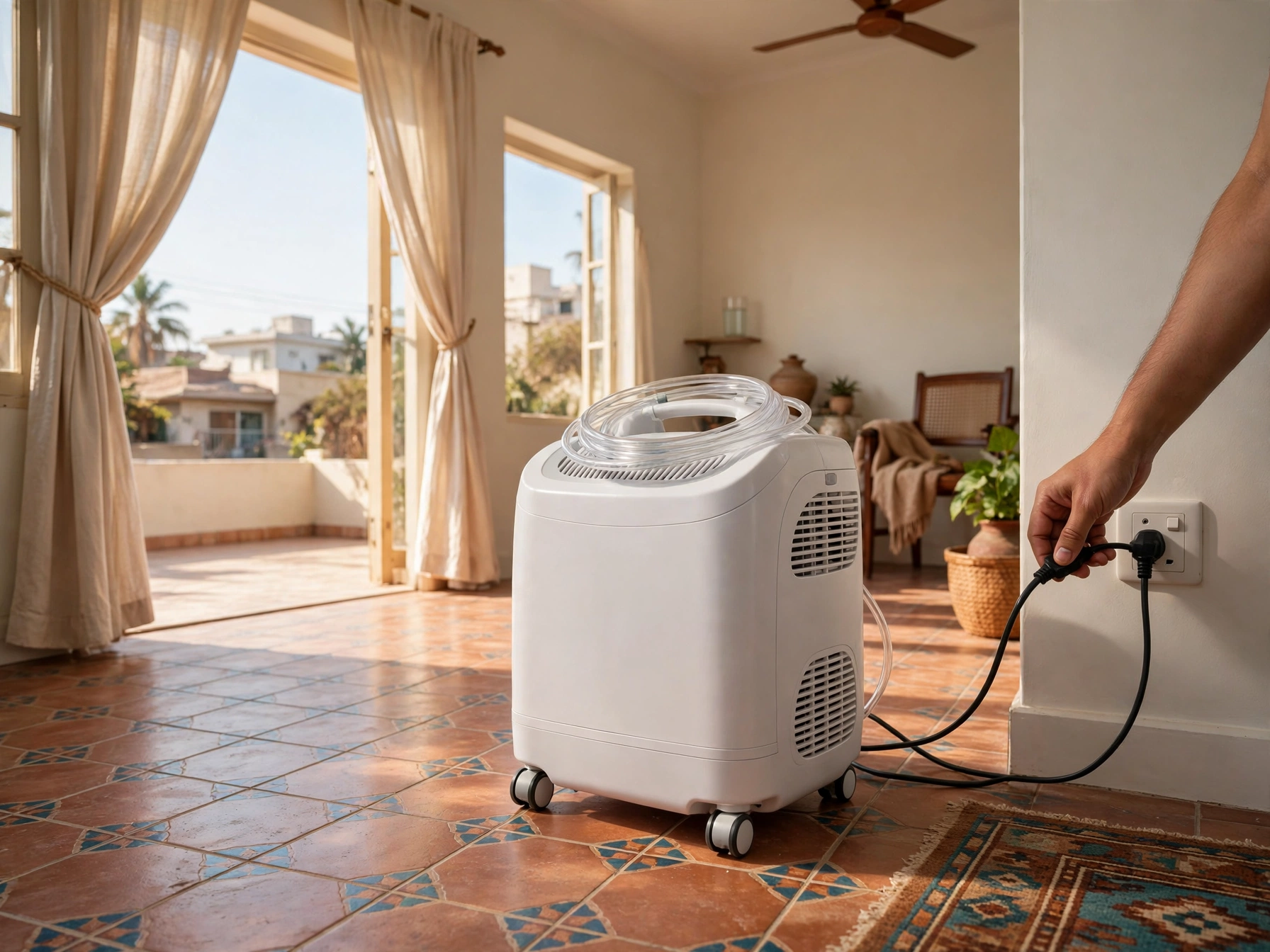
| Step | What to do | Why it matters |
| 1. Position | Put the machine in a ventilated spot with space on all sides | Stops the machine overheating and keeps oxygen purity up |
| 2. Power | Plug directly into a wall outlet | Extension cords can overheat and cut the power |
| 3. Filter | Check the intake filter is clean and dry | A blocked filter lowers oxygen purity and triggers alarms |
| 4. Water | Fill the humidifier bottle with distilled water to between the lines | Moist oxygen is gentler on the nose and throat |
| 5. Tubing | Connect the tubing firmly to the outlet or bottle | Loose tubing leaks oxygen and lowers the flow |
| 6. Flow rate | Set the prescribed litres per minute on the flow meter | The prescribed rate is the safe rate for you |
Keep a backup oxygen cylinder in the home, and test it regularly. The NHS supplies a backup cylinder for emergency use only with long term oxygen therapy. Tell your local fire department and your power company that someone in the home uses oxygen, so outages are notified in advance and power is restored faster.
Step by Step: How to Use an Oxygen Concentrator Every Day
Switch the machine on and wait for it to reach full oxygen purity. Warning lights may show for 10 to 15 minutes at start up, which is normal. On some machines the yellow low oxygen light stays on during this warm up, and the green normal light comes on only when purity is full.
Set the prescribed flow rate on the flow meter. Do not turn it up because you feel breathless, and do not turn it down to save electricity. Changing the flow rate without a proper assessment can be dangerous, and your doctor set the rate for a reason.
Put the cannula on. Place the two prongs just inside the nostrils, loop the tubing over the ears, and adjust the slider under the chin so it sits snugly without pulling. The prongs should point up into the nose, not outwards. Breathe normally through your nose. If you breathe through your mouth most of the time, tell your doctor, because a cannula works best with nose breathing.
When you are finished, take the cannula off and switch the machine off before unplugging it. If you use the concentrator for many hours a day, keep the tubing untangled and check it for kinks each time you sit down. A kinked tube is one of the most common reasons a concentrator alarms, and it takes seconds to straighten.
| Concentrator | Oxygen cylinder |
| Makes oxygen from room air, nothing to refill | Stores compressed oxygen, needs refilling or swapping |
| Needs electricity to run | Needs no power, works in a power cut |
| Runs for as long as it has power | Runs until the cylinder is empty |
| Heavier and stays in one room | Portable cylinders can be carried outside |
| Best for daily home use | Best as a backup and for short trips |
A concentrator and a cylinder are not rivals. Most home oxygen users have both: the concentrator for daily use and a cylinder as backup for power cuts. If you are choosing between a home unit and a portable one, our comparison of a home oxygen concentrator vs portable oxygen concentrator explains the trade offs, and our guide to oxygen concentrator continuous 24 hour use covers running a machine around the clock.
Flow Rate (LPM): What It Means and Why You Must Not Change It
LPM means litres per minute. It is the amount of oxygen the machine delivers every minute, and it is the number your doctor prescribes. A standard home unit delivers 1 to 5 litres per minute continuous flow, and 10 litre units exist for higher needs.
The flow rate is set after your doctor measures your blood oxygen, usually with a pulse oximeter and sometimes with a blood gas test. The prescribed rate is the lowest rate that keeps your oxygen in the safe range. Turning the rate up does not give you extra benefit, and it can be harmful. Too much oxygen can raise carbon dioxide in the blood, especially in people with COPD, and that can make breathing worse, not better.
Turning the rate down is just as risky. If your oxygen falls too low, your organs do not get what they need, and you may feel more breathless, confused or tired. If you feel breathless on your prescribed rate, do not adjust the knob. Sit down, rest, and call your doctor or oxygen team. Headaches, a faster than normal pulse, disorientation or confusion while using oxygen must be reported to your home oxygen team as soon as possible.
Oxygen Concentrators We Stock
Two Yuwell home concentrators for daily use, plus a humidifier bottle for moist, comfortable oxygen.


Cleaning, Filters and Replacing the Cannula and Tubing
Clean equipment keeps the oxygen pure and the machine healthy. Dirty filters and tubing are the most common preventable cause of low purity alarms, and cleaning takes only a few minutes a week.
Wash the nasal cannula prongs with soap and water once or twice a week. The American Lung Association recommends washing the cannula once a week. Replace the cannula every 2 to 4 weeks under normal daily use, and immediately after a cold or chest infection.
Clean the intake particle filter weekly. Remove it, rinse it under warm water with mild soap, and let it air dry completely before putting it back. Replace the filter every 6 to 12 months, or sooner if it is torn or discoloured.
Replace oxygen tubing every 1 to 3 months, or sooner if it is cracked, kinked or discoloured. Wipe the outside of the concentrator cabinet once a week with a damp cloth. Change the water in the humidifier bottle every day, completely, and do not just top it up. Clean the bottle every three days with warm water and mild dish soap, then soak it briefly in a vinegar and water solution, rinse well and let it air dry.
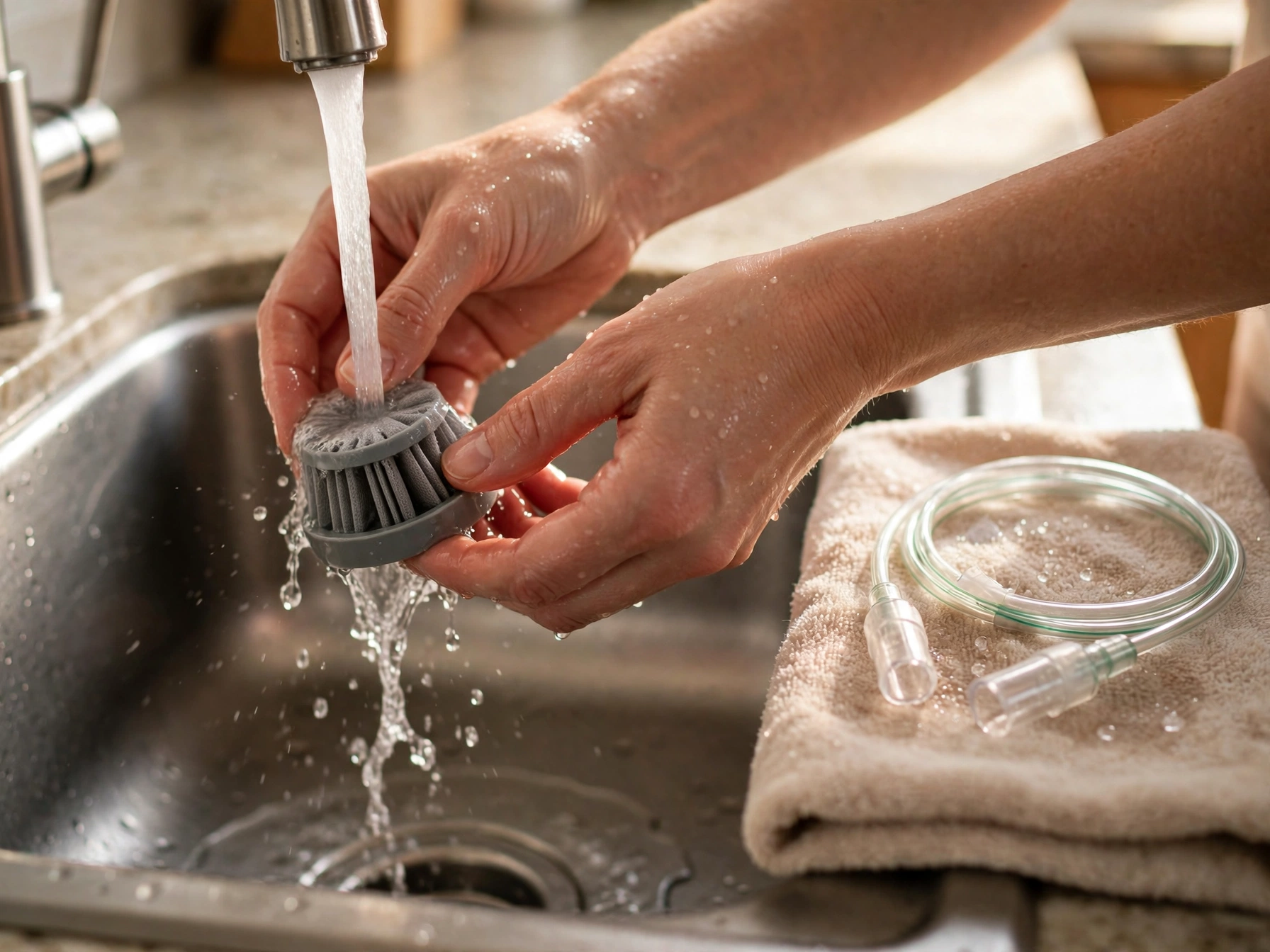
| Part | How often to clean | When to replace |
| Intake particle filter | Rinse weekly, air dry fully | Every 6 to 12 months, or sooner if torn or discoloured |
| Nasal cannula | Wash prongs once or twice a week | Every 2 to 4 weeks, and after a cold or chest infection |
| Oxygen tubing | Check for kinks and dirt daily | Every 1 to 3 months, or sooner if cracked or discoloured |
| Humidifier bottle | Change water daily, wash every 3 days | When cracked, cloudy, or the lid will not seal |
| Outside cabinet | Wipe once a week with a damp cloth | Not applicable |
Alarms, Power Cuts and Backup Oxygen
Concentrators have an audible alarm for power failure, low oxygen concentration and pressure faults. Many units alarm when outlet oxygen concentration drops below about 80 percent. During the first minutes after switch on, the low concentration alarm is switched off because the machine has not yet reached full purity.
If an alarm sounds, check the power cord and plug first, then check the filter is clean and dry, then check the tubing for kinks. If the alarm does not clear, switch to your backup oxygen and call your supplier. If the machine keeps alarming, do not keep using it. Contact the supplier and use the backup cylinder until the machine is checked.
| Alarm or light | What it usually means | What to do first |
| Yellow light at start up | Machine is warming up to full purity | Wait 10 to 15 minutes for the green light |
| Yellow light that stays on | Oxygen purity is low, often 82 to 87 percent | Check the filter, tubing and space around the machine |
| Red light with alarm | Oxygen purity below about 80 percent, or a serious fault | Switch to backup oxygen and call the supplier |
| Power failure alarm | No power to the machine | Check the plug, socket and breaker, then use the backup cylinder |
| No flow alarm | Tubing kinked, blocked or disconnected | Straighten the tubing and check every connection |
After a power cut, wait 5 minutes before switching the machine back on, and never switch it on, off and on again quickly, because that can trip the circuit breaker. In Pakistan, load shedding is a real part of daily life, so keep the backup cylinder filled and within reach, and know how to switch to it without help. A home concentrator uses about 400 to 600 watts, so a small UPS cannot run it.
Safety Rules, Travel Tips and Common Mistakes
Oxygen itself does not burn, but it makes other things catch fire more easily and burn hotter and faster. That one fact drives every safety rule for home oxygen.
Never smoke, vape or let anyone else smoke near oxygen equipment. Post “No Smoking” and “No Open Flames” signs inside and outside the home. Keep heat and flame at least 5 feet away from where the oxygen unit is used or stored. The NHS advice is stricter, at least 2 to 3 metres from open fires.
Never use petroleum, oil or paraffin based products such as Vaseline while using oxygen. Use only water based products. Do not use aerosol sprays such as air freshener or hairspray near the unit, and do not cook over a gas flame while wearing oxygen. Keep a working fire extinguisher nearby.
Portable oxygen concentrators are approved by the FAA for use on commercial airlines, but check in advance whether your exact brand and model is allowed on your airline. Charge the portable battery the night before a day out, because battery life falls as the setting rises. Pulse dose portable concentrators are usually not used while sleeping, because they may not detect the sleeping patient’s breathing. Larger portables with a continuous flow mode are considered safe for night use, including with a CPAP machine.
The most common mistakes are simple ones: changing the flow rate without advice, using tap water in the humidifier bottle, putting a damp filter back, blocking the vents with curtains, and running the machine without a backup cylinder. Avoid those five and most problems never happen. If you are comparing oxygen therapy with other breathing support, our guide on oxygen concentrator vs ventilator and oxygen concentrator vs CPAP vs BiPAP explains when each device is used.
| Stationary concentrator | Portable concentrator |
| Continuous flow, 1 to 10 litres per minute | Often pulse dose only, equivalent of 1 to 5 litres per minute |
| Runs on mains power, 400 to 600 watts | Runs on a rechargeable battery |
| Stays in one room at home | Carried outside and on planes |
| Best for daily home use | Best for travel and short trips out |
Frequently Asked Questions
How many hours a day should I use my oxygen concentrator?
Use it for as long as your doctor prescribed. For long term oxygen therapy the NHS advises a minimum of 15 hours a day, and up to 24 hours a day.
Can I change the flow rate if I feel breathless?
No. Do not change the flow rate unless your doctor or oxygen team tells you to. Changing it without assessment can be dangerous. Sit down, rest, and call your doctor if you feel breathless on your prescribed rate.
Can I use tap water in the humidifier bottle?
No. Use distilled water only, filled between the minimum and maximum lines. Tap water minerals can clog the machine, and tap water can carry germs into the lungs.
What should I do if the concentrator alarm keeps sounding?
Check the plug and power, check the filter is clean and dry, and check the tubing for kinks. If the alarm does not clear, switch to your backup oxygen and call your supplier.
Can I travel on a plane with my oxygen concentrator?
Portable concentrators are approved by the FAA for commercial airlines, but check with the airline first whether your exact model is allowed, and charge the battery fully before you travel.
