- Your cart is empty
- Continue Shopping


Why Does an Oxygen Concentrator Beep? Alarms, Lights and What to Check First
Quick Answer
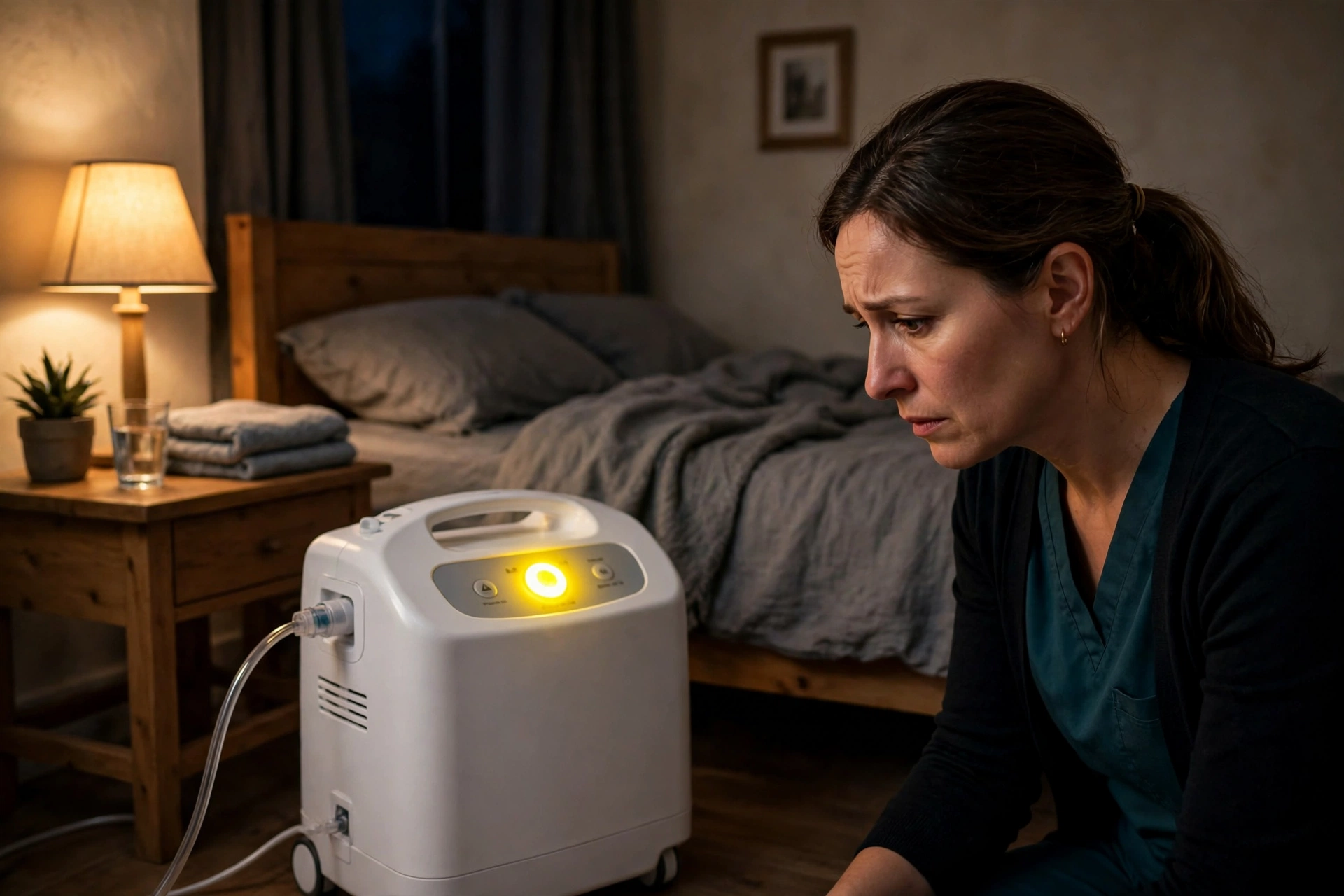
An oxygen concentrator beeps to warn you that something needs attention. The most common causes are low oxygen purity, no power, a kinked tube or a blocked filter. Check the patient first, then the plug, the flow setting, the tubing and the filter. If the red light stays on or the alarm does not clear, switch to backup oxygen and call your supplier.
Why Your Oxygen Concentrator Beeps, and Why the Beep Is a Warning, Not a Fault by Itself
A beep from an oxygen concentrator is a warning, not a fault by itself. The machine is telling you that something has changed and needs your attention, and most alarms have a simple cause you can fix in a minute. The trick is to stay calm, check the patient first, and then work through the checks in order. Panic helps nobody, and switching the machine off and on again in a hurry can make things worse.
Every concentrator has alarms for the same few problems: oxygen purity falling too low, power failure, low battery on a portable unit, no flow through the tubing, high temperature, high or low pressure, and a system fault. The exact beep pattern and light colour differ by brand and model, so there is no single universal beep code table. Your manual for your exact model is the final word, and this article gives you the patterns that apply across most home machines.
One more thing to know before you start: a short beep when you switch the machine on is normal. That is the start up self test. All lights come on briefly and the alarm sounds briefly. On DeVilbiss machines the yellow low oxygen light stays on during warm up, which can take up to 15 minutes, and Inogen says to let the machine run for at least 2 minutes before use. If the beeping continues after warm up, treat it as a real alarm.
The Common Alarms at a Glance
The table below covers the alarms you are most likely to meet on a home concentrator. Read it once now, so you know what to look for when a beep wakes you at night. The 82 percent purity line is the key number across brands. UNICEF technical specifications for medical oxygen concentrators say the machine should sound an alarm when oxygen purity falls below 82 percent. A healthy home concentrator delivers about 90 to 96 percent oxygen.
| Alarm type | Signal | What it usually means | First thing to check | Call a technician if |
| Low oxygen purity | Yellow light, then red light with alarm | Purity below 82 percent | Filter, tubing, vents | Red light stays on after a restart |
| Power failure | Alarm sounds, lights go out | No power to the machine | Plug, socket, breaker | Machine will not start at all |
| Low battery | Beeping with a low battery light | Less than 10 minutes of battery left | Charger and battery | Battery will not charge |
| No flow or low flow | Beeping, flow ball drops | Tubing kinked, blocked or loose | Tubing and cannula | Flow stays low with clear tubing |
| High temperature | Beeping with a hot cabinet | Vents blocked or room too hot | Space around the machine | Machine shuts down from heat |
| High or low pressure | Alarm with an error code such as E1 or E2 | Pressure or cycle fault inside | Restart after 5 minutes off | Code returns after restart |
| System fault | All lights on with a continuous alarm | Internal part has failed | Switch off and use backup oxygen | Always, this is a service fault |

| Light colour | What it means on most home machines | How urgent it is | What to do |
| Green | Oxygen purity is normal | Not urgent | Use the machine as normal |
| Yellow | Caution, often purity between 82 and 87 percent | Check soon | Check the filter, tubing and space around the machine |
| Red | Serious problem, often purity below 82 percent | Urgent | Switch to backup oxygen and call the supplier |
| No light, alarm sounding | Machine has no power | Urgent | Check the plug and socket, then use the backup cylinder |
Light colours differ by brand, so treat the table above as a general guide. On Yuwell 8F-5A models, oxygen above 82 percent shows a green light, 50 to 82 percent shows green plus yellow and the manual says to call the supplier immediately, and below 50 percent shows a red light with a continuous alarm, the panel shows LO, and the unit shuts down. On the Drive DeVilbiss 525DS, the yellow low oxygen light comes on when purity is between 82 and 87 percent, and the red service required light comes on when purity falls below 82 percent or an internal part fails.
Low Oxygen Purity Alarm: The Serious One
The low oxygen purity alarm is the one to take most seriously, because it means the patient may not be getting the oxygen they need. The alarm line is 82 percent on most machines, and the level below it is where the machine warns you.
Purity falls for a few common reasons. Running a machine above its maximum flow rate can push purity below the 82 percent alarm line. A dirty or damp filter chokes the air intake. Blocked vents make the machine run hot, and heat lowers purity. A kinked cannula or a loose humidifier bottle can also drop the flow and the purity with it.
On Philips Respironics EverFlo machines with an oxygen percentage indicator, the alarm levels are low oxygen at 82 percent and very low oxygen at 70 percent. On Inogen One G3 portables, the oxygen low alert means the machine has produced oxygen below 82 percent for 10 minutes, and the manual says to contact the equipment provider if it continues.
If the yellow light comes on, check the filter first. Pull it out, rinse it if it is dirty, let it air dry completely, and put it back. Check the tubing for kinks and check that the machine has space around it. If the yellow light clears, the problem was the filter or the airflow. If the red light comes on, or the yellow light stays on after those checks, switch to your backup oxygen and call your supplier. Do not keep using a machine that cannot hold its purity.
| Brand and model | Beep pattern | Meaning |
| Philips EverFlo | Continuous alarm with all 3 LEDs on | System malfunction, switch off and use backup oxygen |
| Philips EverFlo | Yellow LED blinking with periodic beeping | High oxygen flow, turn the flow down to the prescribed level |
| Yuwell 8F-5A | Interval beeps with yellow light | Low pressure alarm |
| Yuwell 8F-5A | Continuous alarm with red light, display shows LO | Very low oxygen, below 50 percent, unit shuts down |
| Yuwell 8F-5A | Display shows E1 or E2 | Low or high pressure or cycle failure |
| Inogen One G3 | Double beep with solid yellow light | Low priority alert |
| Inogen One G3 | Three beeps every 25 seconds, flashing yellow | Medium priority, such as no breath detected |
| Inogen One G3 | Five beeps every 10 seconds, flashing red | High priority alert |
| DeVilbiss 525DS | Intermittent audible signal with yellow or red light | Low oxygen or service required |
Beep patterns differ by brand and model, so use this table to narrow the cause down, then check your own manual for the exact code. The pattern matters less than the action: check the simple causes first, and switch to backup oxygen when the alarm points to a serious fault.
Power Failure and Low Battery Alarms
A power failure alarm means the machine has lost power. Check the plug first, then the socket, then the breaker. In Pakistan, load shedding is the most common cause, and a home concentrator stops making oxygen the moment the power goes. That is why a backup cylinder is not optional. It is part of the treatment.
After a power cut, wait 5 minutes before switching the machine back on, and never switch it on, off and on again quickly, because that can trip the circuit breaker. A home concentrator uses about 400 to 600 watts, so a small UPS cannot run it. Keep the backup cylinder filled, within reach, and test it regularly so you know it works when you need it.
On portable concentrators, a low battery alert sounds when less than 10 minutes of battery remain. The West Suffolk NHS leaflet gives the same 10 minute figure, and says battery charging time is 5 hours. Charge the battery fully before a day out, and remember that battery life falls as the setting rises.
A portable concentrator must not be stored in an enclosed space while in use, because that reduces efficiency and can cause overheating and stop the machine. Keep it in open air with its vents clear, just like a home unit.
No Flow Alarms: Kinked Tubing, Blocked Filter, Loose Humidifier Bottle, Wrong Flow Setting
A no flow alarm means oxygen is not reaching the patient. The cause is almost always outside the machine, in the tubing, the cannula, the filter or the bottle. That is good news, because those are the easiest things to fix.
Check the tubing along its whole length. A kink under a chair leg, a twist where the tube bends around a bed, or a tube squashed under a mattress will all stop the flow. Straighten the tube and check the flow ball on the meter rises again. Check the cannula too. A prong blocked with dried mucus or a cannula crushed in a drawer will do the same thing.
Check the humidifier bottle. A lid that is not tight lets oxygen escape, and a bottle overfilled above the maximum line can push water into the tubing. No bubbles while the concentrator is running, or only a few bubbles with the flow ball floating, can mean a leaking humidifier or a lid that is not tight.
Check the flow setting. Running the machine above its maximum flow rate can push purity below the alarm line, and the EverFlo manual says to turn the flow rate down to the prescribed level and wait at least 2 minutes if a high flow alarm sounds. Our guide on oxygen concentrator flow rate explained covers the litre setting in detail.
High Temperature, High Pressure and System Fault Alarms
A high temperature alarm means the machine is running too hot. The usual cause is blocked vents or a machine pushed against a wall or curtain. The DeVilbiss 525DS must operate between 10C and 40C and below 80 percent humidity. Yuwell manuals say to keep the device at least 10 cm away from walls or heaters, because poor ventilation raises the operating temperature. The CNWL NHS protocol for the VisionAire 5 says to keep at least 20 cm of clearance on all sides. Give the machine room to breathe and the alarm usually clears.
High or low pressure alarms point to a fault in the pressure cycle inside the machine. On Yuwell 7F-5 models, a blinking yellow lamp with an alarm sounding at intervals means a low pressure alarm, and a yellow lamp lit continuously with a continuous alarm means a high pressure alarm. On Yuwell 8F-5A and 8F-5AW models, E1 or E2 on the display with a red light and continuous alarm means a low or high pressure or cycle failure alarm, and E4 means very low oxygen concentration.
A system fault alarm is the one you do not troubleshoot. On the EverFlo, all 3 LEDs on continuously plus a continuous audible alarm means a system malfunction. The manual says to turn the device off at once, connect to a backup oxygen source, and call the home care provider. For a system malfunction, the EverFlo manual says to turn the unit off and wait 5 minutes, then restart. If the condition continues, turn it off, connect to backup oxygen, and call the provider.
What to Check First, Step by Step, and How to Silence or Reset an Alarm
When an alarm sounds, work through the checks in order. Do not skip ahead to the complicated causes, because the simple ones are the most common. The patient comes first, every time.
| Step | Check | How to do it | If it fixes the alarm |
| 1 | Patient | Check the patient is breathing and comfortable | Stay with the patient and call the doctor if they are unwell |
| 2 | Power | Check the plug, socket and breaker | Machine restarts and the alarm clears |
| 3 | Flow setting | Check the flow meter shows the prescribed rate | Turn it back to the prescribed rate and wait 2 minutes |
| 4 | Tubing and cannula | Run your hand along the tubing for kinks and check the prongs | Flow returns and the alarm clears |
| 5 | Humidifier bottle | Check the lid is tight and the water is between the lines | Bubbles return and the alarm clears |
| 6 | Air filter | Pull the filter out and check it is clean and dry | Purity rises and the light turns green |
| 7 | Vents and space | Check the vents are clear and the machine has space around it | Machine cools down and the alarm clears |
| 8 | Restart | Switch off, wait 5 minutes, switch on again | Alarm stays off and the light stays green |
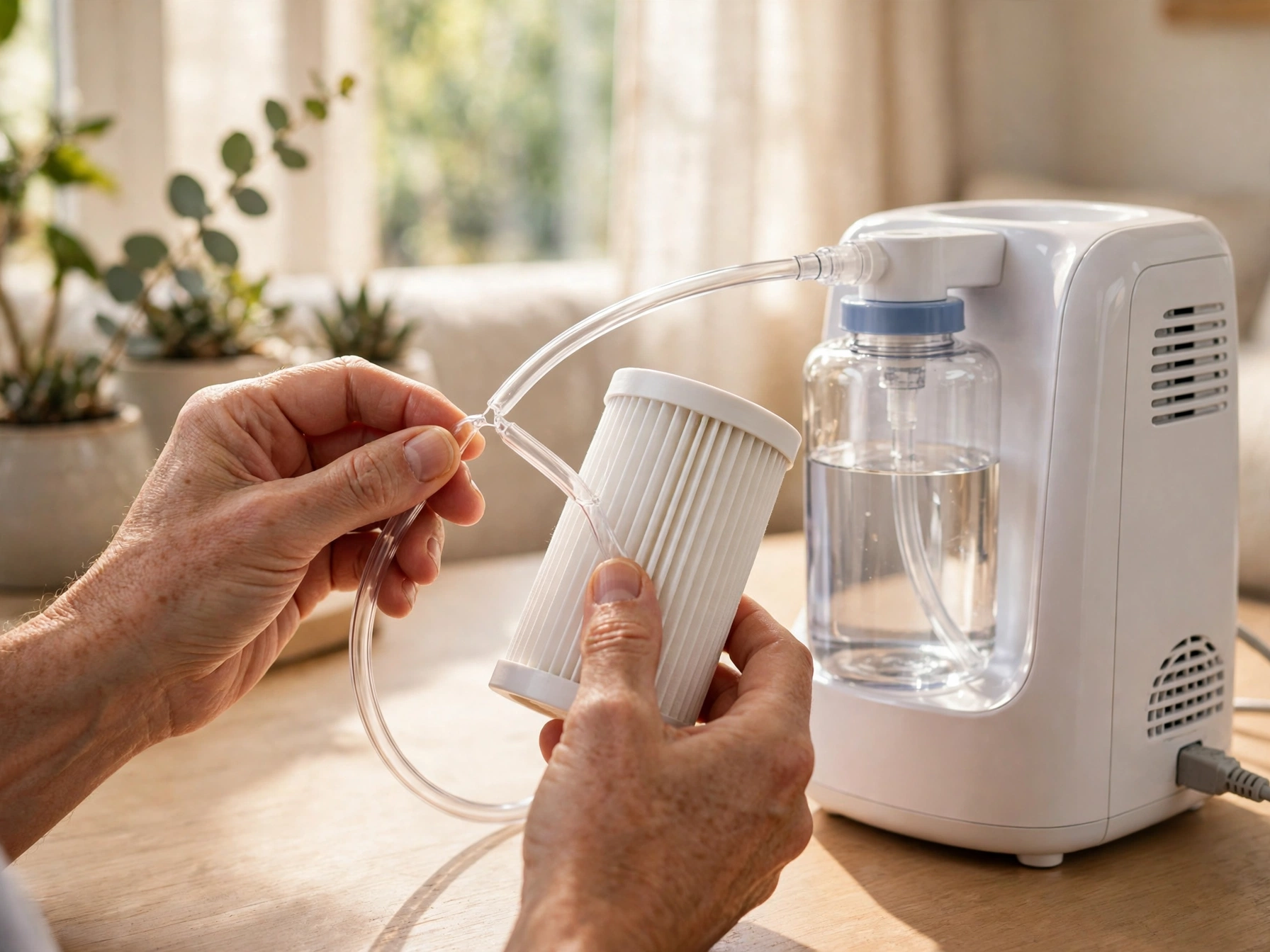
You can silence most alarms for a short time. On the Kings College Hospital NHS guidance, pressing the silence button quiets the alarm for 60 seconds and it sounds again if the cause has not been fixed. Inogen portables have an audible alarm button that toggles the breath detection alert. Silencing never fixes the cause. It only buys you a quiet minute to run the checks. If the alarm comes back, the cause is still there.
If the alarm clears after a restart and the green light stays on, keep using the machine and watch it for the next hour. If the same alarm returns, call the supplier even if the machine seems fine now. A repeating alarm is a warning that a part is starting to fail.
| How often | What to do | Why it matters |
| Daily | Wash the humidifier bottle, wipe the cabinet, check the tubing | Stops germs and keeps the flow clear |
| Weekly | Rinse the cabinet foam filter and let it air dry | A clean filter keeps oxygen purity up |
| Monthly | Check the cannula and tubing condition | Worn tubing leaks and lowers the flow |
| Annually | Replace the HEPA filter and foam filter | Old filters choke the air intake |
| Every 2 to 3 years | Replace the intake filter, per the maker | Keeps the machine running at full purity |
Most alarms are prevented by that simple routine. A clean filter, clear vents, fresh tubing and a bottle that is filled correctly will stop the majority of beeps before they start. If you are choosing a machine, our guide on how to choose the best oxygen concentrator for home use explains what to look for, and our oxygen concentrator price comparison Pakistan 2026 lists current prices.
Oxygen Concentrators We Stock
Home concentrators with built in alarm functions, plus a humidifier bottle, a common alarm cause when it is loose or overfilled.


When to Stop Using It, Switch to Backup Oxygen, and Who to Call
Stop using the concentrator at once and switch to backup oxygen if the red light stays on after a restart, if there is continuous beeping with a red light, if purity stays below 82 percent, or if there is no flow at all. Then call the supplier or technician.
Call the doctor or home oxygen team if the patient is breathless, confused, or cannot keep their oxygen level up. Headaches, a faster than normal pulse rate, disorientation or confusion while using oxygen must be reported to the home oxygen therapy team as soon as possible.
Call the supplier, not the doctor, for machine problems: a repeating alarm, an error code that returns after restart, a machine that will not start, or a filter or part that needs replacing. The supplier knows the model and can send a technician or a replacement.
Keep the supplier number, the doctor number and the backup cylinder in one place, where anyone in the house can find them at night. An alarm at 3 in the morning is not the time to search for a phone number. For continuous use, our guide to oxygen concentrator continuous 24 hour use covers running a machine around the clock, and oxygen concentrator vs ventilator explains when a different machine is needed.
Frequently Asked Questions
Why does my oxygen concentrator beep when I first switch it on?
That is the start up self test. All lights come on briefly and the alarm sounds briefly. On DeVilbiss machines the yellow low oxygen light stays on during warm up, which can take up to 15 minutes, and Inogen says to let the machine run for at least 2 minutes before use. If the beeping continues after warm up, treat it as a real alarm.
What does a yellow light on my oxygen concentrator mean?
On most home machines yellow means caution, usually oxygen purity between 82 and 87 percent. Check the filter, the tubing for kinks, and the space around the machine, then call the supplier if the yellow light stays on. On Yuwell machines, green plus yellow means purity is 50 to 82 percent and the manual says to call the supplier at once.
What should I check first when the alarm sounds?
Check the patient first, then power, then the flow setting, then the tubing and cannula for kinks, then the humidifier bottle seating, then the air filter, then the vents and clearance around the machine. If the alarm continues, switch to backup oxygen and call the supplier.
Can I silence the alarm?
Yes, for a short time only. On the Kings College Hospital NHS guidance, pressing the silence button quiets the alarm for 60 seconds and it sounds again if the cause is not fixed. Silencing never fixes the cause.
When should I stop using the concentrator and switch to backup oxygen?
Stop at once and switch to backup oxygen if the red light stays on after a restart, if there is continuous beeping with a red light, if purity stays below 82 percent, or if there is no flow at all. Then call the supplier or technician, and call the doctor if the patient is breathless or confused.
