- Your cart is empty
- Continue Shopping




CPAP and BiPAP Mask Types: Nasal Pillow, Nasal, Full Face and Hybrid Compared
Quick Answer
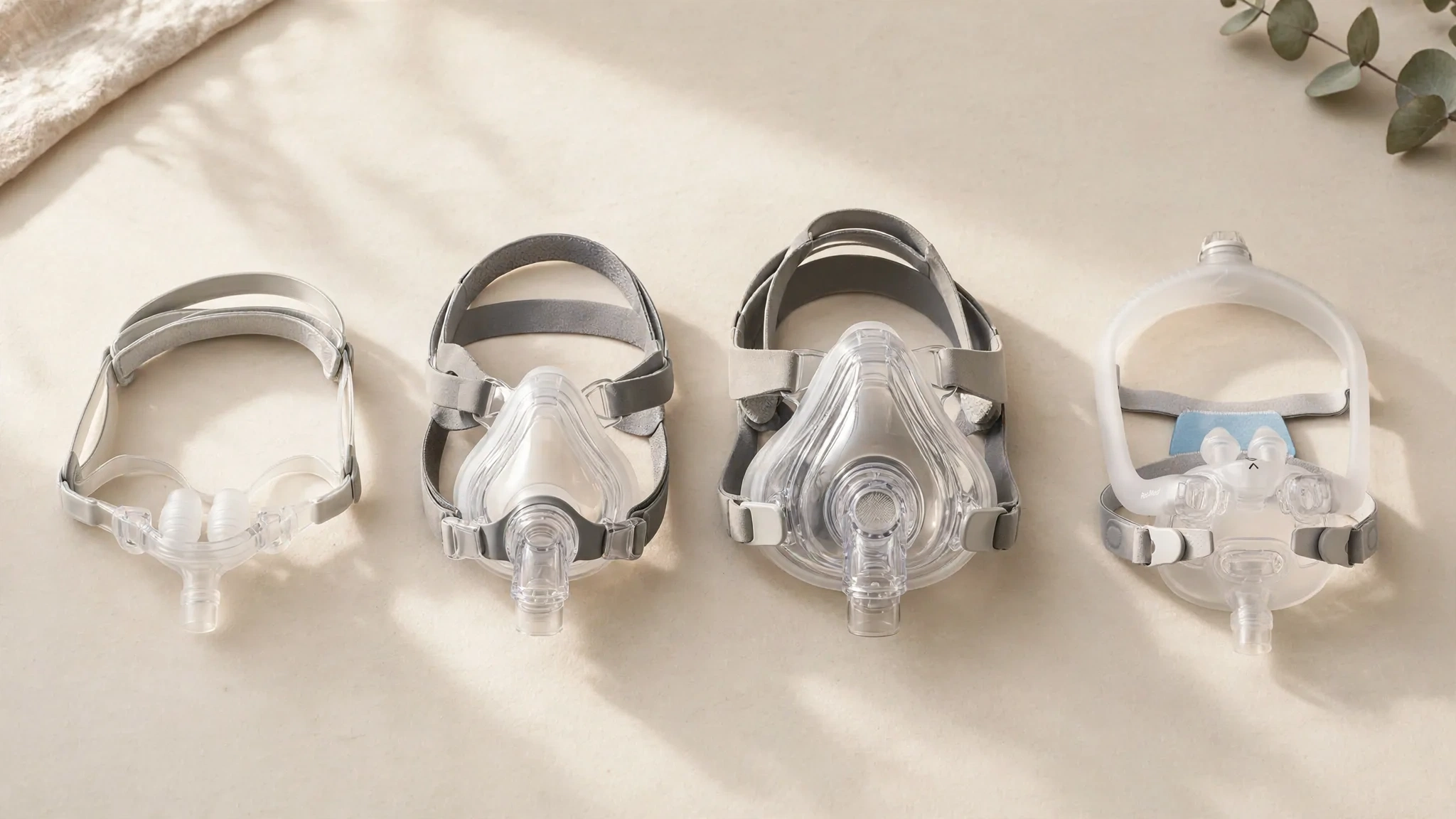
There are four main CPAP and BiPAP mask types: nasal pillow, nasal, full face and hybrid. Nasal pillows touch the face least. Nasal masks cover only the nose. Full face masks cover the nose and mouth and suit mouth breathers. Hybrid masks cover the mouth with an under nose cushion. There is no separate BiPAP mask. The same masks work on both machines.
The 4 Mask Types at a Glance: Nasal Pillow, Nasal, Full Face, Hybrid
The mask is the part of CPAP therapy you feel every night, and it decides whether treatment works or not. A mask that leaks or hurts will end up in a drawer, and the machine cannot help you from a drawer. Choosing the right type is the most important decision after the machine itself.
There are four main types. A nasal pillow mask has two small soft inserts that rest just inside the nostrils. Nothing sits on the bridge of the nose or around the mouth. A nasal mask covers only the nose and blows air up the nose, with the mouth uncovered. A full face mask, also called oronasal, covers both the nose and mouth and blows air into both. A hybrid mask has a mouth portion to stop air escaping from the mouth, plus an under the nose nasal cushion to promote nasal breathing.
| Type | What it covers | How it seals | Best for | Watch out for |
| Nasal pillow | Nostrils only | Two soft inserts inside the nostrils | Nose breathers, claustrophobia, glasses wearers | Needs low to moderate pressure, under 12 cm H2O |
| Nasal mask | Nose only | Cushion over the nose | Nose breathers who want a light mask | Mouth leaks if the mouth opens at night |
| Nasal cradle | Under the nose | Cushion sits under the nose | People who want less face contact than a nasal mask | Can leak if you move around a lot |
| Full face | Nose and mouth | Large cushion over nose and mouth | Mouth breathers, blocked nose, high pressure | More places to leak, can feel bulky |
| Hybrid | Mouth plus under nose | Mouth cushion plus nasal cushion | Mouth breathers who want less bulk than full face | Fewer models, fitting takes care |
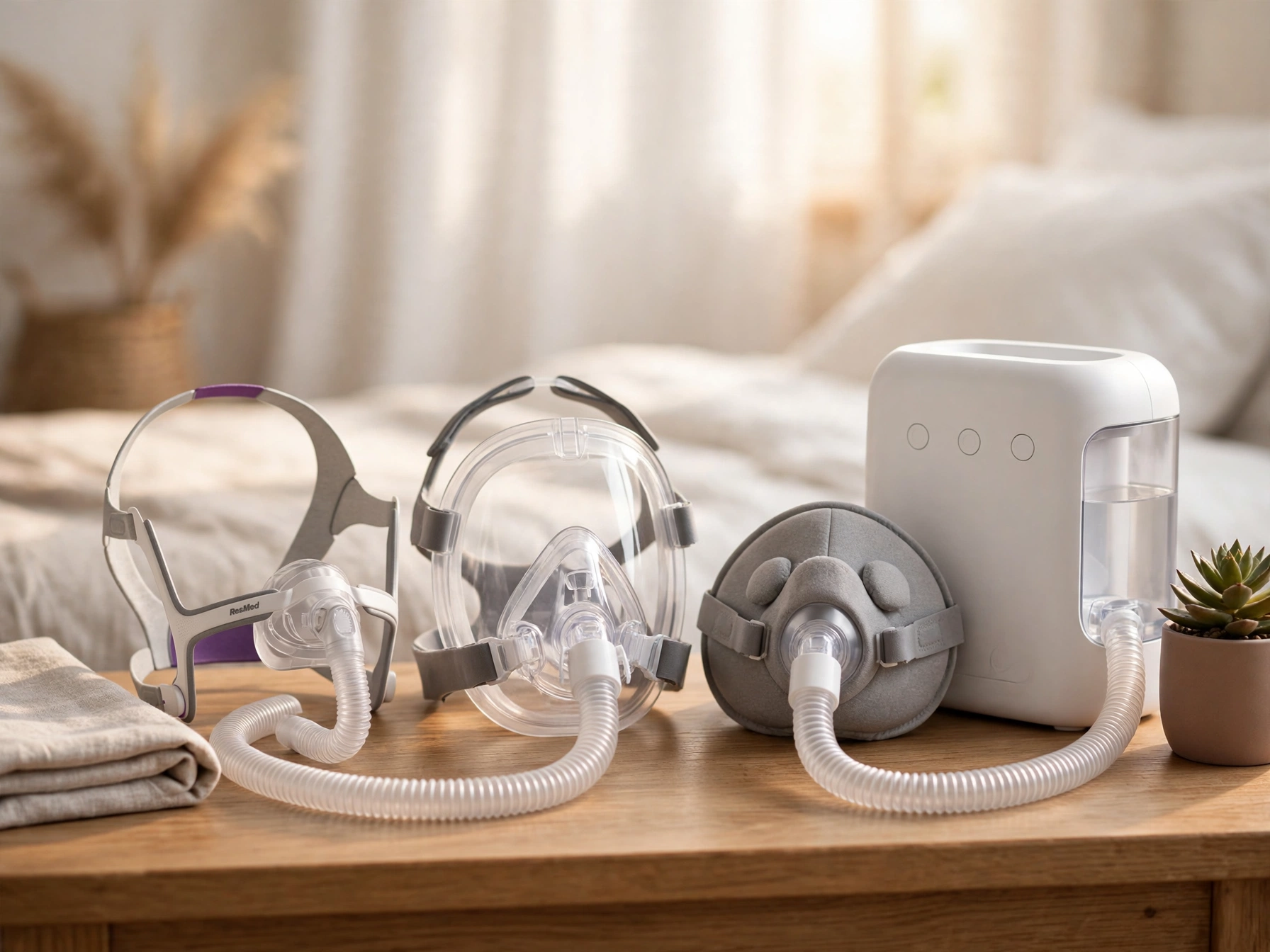
Nasal prongs, or nasal pillows, or a nasal mask is the most common way CPAP is delivered, and nasal pillow masks are considered the least invasive option. The nasal route usually gives the best results and is recommended for most people without nasal obstruction. A full face mask is more likely to leak at the edges and can be uncomfortable, so a nasal mask or cushion is usually tried first.
Full Face Masks: Who They Suit, and Their Limits
A full face mask suits people who breathe through the mouth in sleep and people with allergies or a blocked nose, such as a deviated septum. If your mouth opens at night, air escapes from it instead of holding the airway open, and a full face mask stops that.
Full face masks dominate BiPAP therapy, because BiPAP inspiratory pressures are often higher than typical CPAP pressures, and a seal that holds at low CPAP pressure can leak at BiPAP pressure. They spread the force over a larger, more stable seal and cope with an open mouth.
The limits are real. A full face mask seals over a much larger border than a nasal pillow mask, so it has more places to leak when the user moves or sleeps on the side. It pushes the lower jaw slightly backward during sleep, which narrows the airway behind the tongue and often forces machines to need 2 to 4 cm H2O higher pressure to prevent apneas. Nasal masks leave the jaw unconstrained.
Full face masks suit side sleepers whose faces press into pillows, because the larger seal is less prone to collapse from positional pressure. But for a person who has difficulty breathing through the nose on most nights, a full face mask may be the best first choice, even with its limits.
| Your situation | Best mask choice | Why |
| Mouth breather | Full face, or hybrid | Covers the mouth so air cannot escape |
| Nose breather | Nasal pillow or nasal mask | Lightest option, best results for most people |
| Side sleeper | Full face or nasal pillow | Large seal resists pillow pressure, or pillows sit inside the nostrils |
| Back sleeper | Nasal mask or nasal pillow | Less bulk, fewer leak points |
| Claustrophobia | Nasal pillow or nasal cushion | Touches the face least |
| Glasses wearer | Nasal pillow or nasal mask | Nothing sits on the bridge of the nose |
| Blocked nose | Full face | Air reaches you through the mouth too |
| High pressure need | Full face | Large seal holds at high pressure |
| Facial hair | Nasal pillow | Tiny seal area, less affected by a beard, per supplier advice |
Nasal Masks and Nasal Cradle Masks: The Middle Ground
A nasal mask covers only the nose and blows air up the nose, with the mouth uncovered. It suits people who do not breathe through the mouth at night, and its smaller design is useful for reading or watching television in bed.
A nasal cradle, or cushion, mask sits underneath the nose rather than covering it. It gives the same nasal airflow with less face contact, but it can leak if the user moves around a lot. It is a good middle ground between a nasal pillow and a full nasal mask.
If a person mouth breathes in sleep, the usual advice is to try a nasal mask with a chin strap, heated humidification, or mouth tape first, before moving to a bulkier full face mask. A chin strap keeps the mouth closed, and heated humidification eases the dryness that makes the mouth open.
For people who may feel claustrophobic, the least bulky option is the best choice. Nasal cushion and pillow options are often good and well liked for people who do not need high pressure settings.
Nasal Pillow Masks: Minimal Contact and Who They Suit Best
Nasal pillow masks are the least invasive option. Two small soft inserts rest just inside the nostrils, and nothing sits on the bridge of the nose or around the mouth. People who feel closed in by a larger mask often do well with pillows.
Nasal pillow masks generally work best at lower pressure ranges, under 12 cm H2O, while full face masks often perform better at moderate to higher pressures. CPAP pressure is usually somewhere between 4 and 20 cm H2O. If your prescription is more than 20 cm H2O, look for a mask with a heavy duty seal.
Nasal pillow masks suit users who sleep in varied positions, because the pillows sit inside the nostrils and positional shifts matter less. They also suit people with facial hair, because the seal area is tiny. That last point is widely advised by CPAP suppliers, but we did not verify it against a named clinical source, so treat it as supplier advice.
The honest gap on our own store: no nasal pillow mask product was found live on the site. All live masks are full face, nasal, or total face types. If you need nasal pillows, ask us and we can source one, but we do not list a price for a product we do not stock.
Hybrid Masks: Mouth Cover Plus Under Nose Cushion
A hybrid mask is the newest of the four types. It has a mouth portion to stop air escaping from the mouth, plus an under the nose nasal cushion to promote nasal breathing. It gives mouth breathers a less bulky option than a full face mask.
Hybrids suit people who breathe through the mouth but dislike the size and weight of a full face mask. The mouth cushion is smaller than a full face cushion, so there is less to leak and less pressing on the face. The nasal cushion underneath keeps the nose route open.
Fitting takes care, because two seals have to work at once. The mouth cushion and the nasal cushion both need the right size, and the headgear has to hold both in place. If you try a hybrid, fit it lying down with the machine running, and give it a few nights before deciding.
CPAP vs BiPAP: Do You Need a Different Mask?
There is no separate BiPAP mask. The same masks are used for CPAP and BiPAP therapy, and most CPAP masks can be used with BiPAP machines. The real difference is the machine: CPAP gives one steady pressure, BiPAP gives two pressures, higher on inhale and lower on exhale.
The mask choice changes only because the pressures change. BiPAP inspiratory pressures are often higher than typical CPAP pressures, and a seal that holds at low CPAP pressure can leak at BiPAP pressure. That is why full face masks dominate BiPAP therapy and nasal pillows are least common on BiPAP.
If you switch from CPAP to BiPAP, try your current mask first. If it leaks at the higher inhale pressure, move to a full face mask or a mask with a stronger seal. You do not need a new mask type by rule. You need one that holds its seal at your pressures.
| Point | CPAP | BiPAP |
| Mask types used | Nasal pillow, nasal, full face, hybrid | Same masks, no separate BiPAP mask |
| Pressure | One steady pressure, usually 4 to 20 cm H2O | Two pressures, higher on inhale, lower on exhale |
| Most common choice | Nasal mask or nasal pillow | Full face mask |
| When nasal pillows work | At lower pressure, under 12 cm H2O | Rarely, because inhale pressure is higher |
| Seal strength needed | Standard seal | Stronger seal, heavy duty above 20 cm H2O |
For the full comparison of the machines themselves, read our guide on CPAP vs BiPAP, and for the basics, what is CPAP. If you want options beyond machines, see sleep apnea treatment without CPAP.
Sizing, Fitting, and Fixing Leaks Step by Step
Fit the mask lying down, at therapy pressure, with the machine running. Loosen all straps first, place the mask, turn the machine on, lie in the normal sleep position, tighten each strap a little at a time and evenly on both sides, and stop as soon as the leak quiets. Then lift the cushion slightly to let it inflate and let it settle.
Over tightening is the most common fitting mistake. Pulling straps too hard flattens the cushion, creates red marks, and actually opens gaps. The two finger rule helps: straps should be loose enough to slide two fingers underneath. Check fit lying down with airflow on, not just sitting upright in front of a mirror.
Most manufacturers, including ResMed and Philips Respironics, provide sizing guides with their masks, often printable templates to measure facial dimensions at home. Up to 40 percent of CPAP patients are wearing the wrong cushion size simply because it came pre-installed on the device. That is a clinic claim, not a peer reviewed figure, so use it only with that wording. ResMed data from a survey of 151 former CPAP users in January 2014 found that 45 percent reported difficulty achieving a tight mask seal as a reason for stopping use.
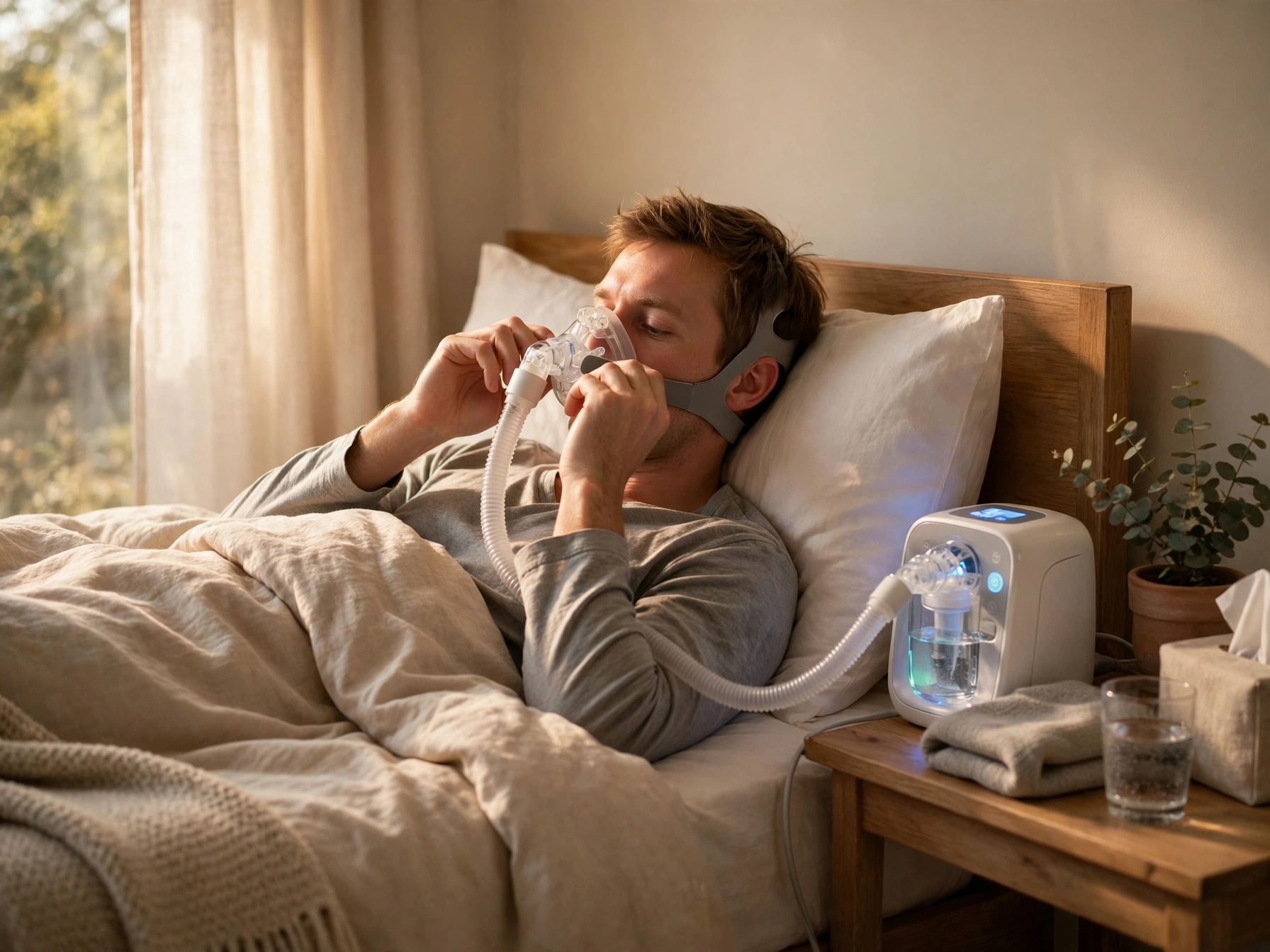
A leak is air escaping around the cushion seal, from the mouth with a nasal mask, or from a loose tubing connection. It is different from the intentional vent holes, which are supposed to release air to flush out exhaled carbon dioxide. Do not block the vent holes.
The three main leak causes are wrong size or wrong style, loose or uneven straps, and a dirty or greasy cushion. Skin oils break the seal. With a nasal mask or nasal pillow, an open mouth lets air escape from the mouth instead of holding the airway open. A chin strap or a full face mask fixes this. Side sleepers can use a CPAP pillow with cutouts or a swivel elbow to protect the seal. Air blowing into the eyes usually means the cushion sits too high on the bridge of the nose or is the wrong size. Lower the mask slightly and check the cushion is not folded.
| Symptom | Likely cause | Fix |
| Steady high leak every night | Wrong size or wrong style | Re-measure and try another size or type |
| Air in the eyes | Cushion too high or wrong size | Lower the mask slightly, check the cushion is not folded |
| Leak when lying on the side | Pillow pressing the seal | Use a CPAP pillow with cutouts or a swivel elbow |
| Mouth leak | Mouth opens during sleep | Chin strap, or switch to a full face mask |
| Leak after months of good use | Worn cushion or stretched headgear | Replace the cushion and check the headgear |
| Water in the mask | Condensation, called rainout | Lower the humidifier, warm the room, use a heated tube |
Cleaning, Replacement Schedule, and Common Mistakes
Wipe the cushion daily, or rinse it in warm water. Once a week, take the mask apart and hand wash the silicone parts in warm water with a small amount of mild, unscented soap. Hand wash headgear weekly, rinse well, and lay flat to dry. Do not wring it out or hang it, and never iron it.
Use only mild detergent. Avoid bleach, alcohol, drying in direct sunlight, and ozone or UV sanitizing devices. Once a week, disconnect the tubing and wash the inside by submerging it in warm soapy water. Replace tubing if there is cracking, discolouration, or mould that will not wash out. Wash the cushion each morning with mild soap and warm water, and skip alcohol wipes.
| Part | Clean how often | How to clean | Replace every | Signs to replace sooner |
| Cushion or pillows | Daily wipe, weekly wash | Warm water, mild unscented soap | Every month | Leaks, slick or yellowed silicone |
| Mask frame | Weekly | Warm soapy water | Every 3 months | Cracks or loose fittings |
| Headgear | Weekly | Hand wash, lay flat to dry | Every 6 months | Stretched straps or weak Velcro |
| Tubing | Weekly | Submerge in warm soapy water | Every 3 months | Cracks, stiffness, musty smell |
| Humidifier chamber | Daily | Wash with warm soapy water | Every 6 months | Scale, cracks, or smell |
| Machine filter | Check weekly | Rinse if washable, per the manual | Every month | Torn or discoloured |
The replacement schedule above follows ResMed US guidance, as reported by Sleepay and CPAP Clarity. General guides give wider ranges: cushions every 1 to 3 months, headgear every 3 to 6 months, tubing every 3 to 6 months, humidifier chamber every 6 to 12 months. ResMed Australia guidance puts silicone cushions at 6 months and memory foam cushions at 1 month. The intervals differ by source and by country, so this article gives the ResMed US figures as the main schedule and notes the longer intervals. The machine itself lasts about 5 years.
CPAP therapy is highly effective for sleep apnea, but 8 percent of people stop use after the first night and 50 percent within the first year. Mask leak problems and feelings of claustrophobia are listed among the adverse effects. A mask that fits, a cushion that is clean, and parts replaced on time are what keep people using the machine.
CPAP and BiPAP Masks We Stock
Full face and nasal masks for adult sleep therapy. No nasal pillow mask is currently stocked on this store.


For the wider picture, see oxygen concentrator vs CPAP vs BiPAP. If you are choosing a machine to go with the mask, our machine guides cover what is CPAP and CPAP vs BiPAP.
Frequently Asked Questions
Can I use a CPAP mask on a BiPAP machine?
Yes. There is no separate BiPAP mask. The same masks, tubing, and humidifiers work on both machines.
Which mask is best if I breathe through my mouth?
A full face mask, because it covers the mouth and nose. A hybrid mask is the less bulky alternative. A nasal mask with a chin strap is worth trying first.
How often should I replace my CPAP mask cushion?
About every month, following ResMed US guidance. General guides give 1 to 3 months. Replace sooner if it leaks, feels slick, or turns yellow.
Why does my mask leak and how do I stop it?
The usual causes are wrong size, uneven straps, a dirty cushion, or worn parts. Fit it lying down with the machine running, tighten straps evenly and only until the leak stops, wash the cushion daily, and do not over tighten.
What mask is best if I feel claustrophobic?
A nasal pillow or nasal cushion mask, because they touch the face least.
