- Your cart is empty
- Continue Shopping


Digital vs Infrared Thermometer: Which Is More Accurate for Fever?
Quick Answer
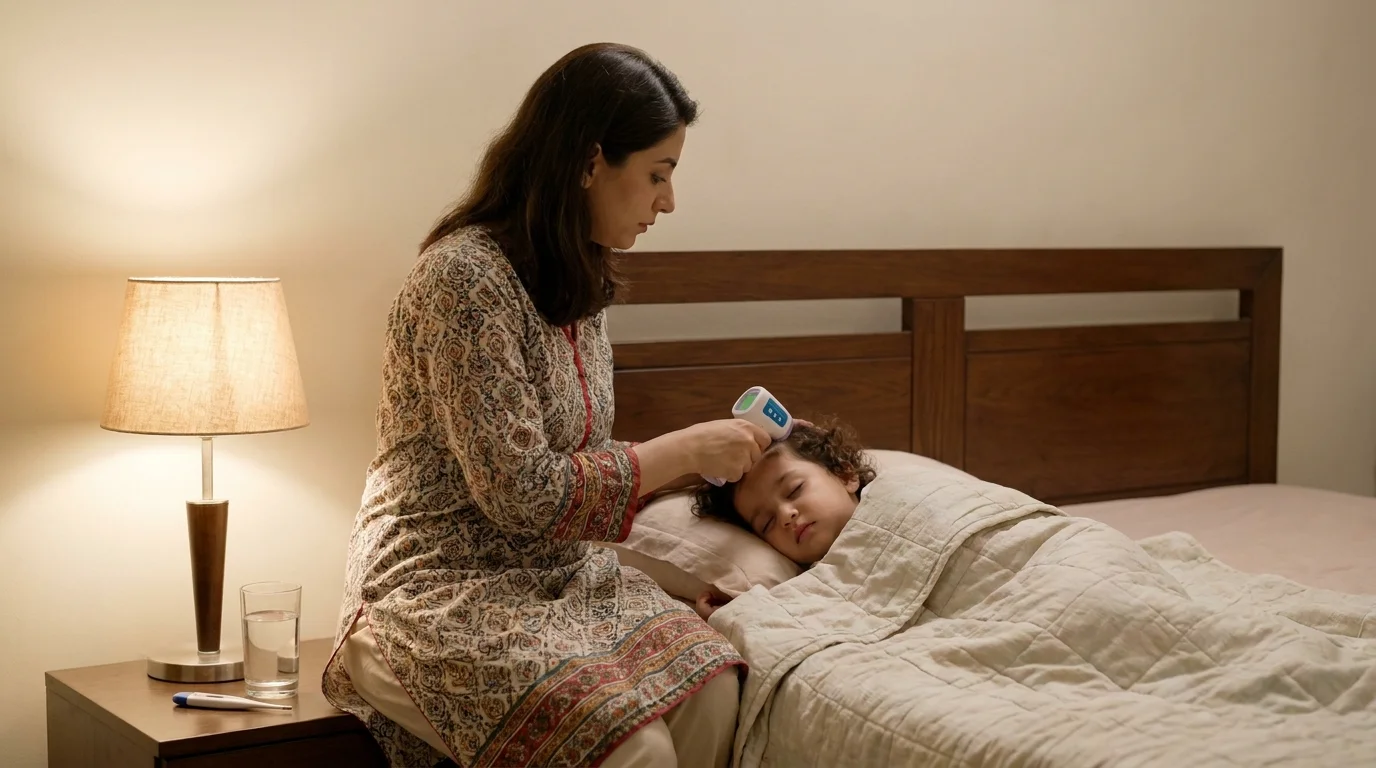
A digital stick thermometer, used under the tongue, in the armpit or rectally, is the more accurate of the two for deciding whether someone has a fever. It is tested to ±0.1°C against the ASTM standard, while infrared ear and forehead thermometers are tested to ±0.2°C, and in real use the gap is wider than the specifications suggest: a 2024 meta-analysis found that forehead and non-contact infrared thermometers detected only about 77% of fevers in children and 48% in adults, which means they miss roughly 1 in 4 childhood fevers and 1 in 2 adult fevers. An infrared thermometer is faster, touch-free and ideal for a quick check on a sleeping child or for screening several people, but a low or borderline forehead reading in a child who feels hot should be confirmed with a digital stick thermometer, and for a baby under 3 months the American Academy of Pediatrics is clear that a rectal digital reading is the one that counts. Both types are only as accurate as the way they are used, and most “wrong” readings in Pakistani homes come from a cold or sweaty forehead, a dupatta or cap just removed, a hot room, or an oral reading taken minutes after chai.
Every pharmacy counter in Pakistan now offers the same choice: a digital stick thermometer for under a thousand rupees, or an infrared gun or ear thermometer for several thousand. The infrared ones sold in enormous numbers during COVID, and many households now rely on them for everything, pointing the gun at a child’s forehead from across the bed and deciding on the basis of a two-second beep whether the child needs medicine, a doctor or nothing at all. That convenience is real, and the device is not a toy, but the reading it gives is an estimate of skin temperature converted to a core estimate by a formula, and the formula is easily fooled.
The digital stick thermometer, by contrast, measures the temperature of a body cavity directly, which is why it remains the reference in paediatric clinics and the device that every guideline falls back on when the number matters. Its weaknesses are different: it has to be held in place for several seconds, a toddler will not keep it under the tongue, and an armpit reading is reliably lower than the true core temperature. This guide sets out the actual accuracy of each type with the evidence behind it, which thermometer suits which age and situation, how ear, forehead, oral and armpit readings compare, what distorts an infrared reading, and how to use each one so the number you act on is right. For the step-by-step method with a stick thermometer, see our guide on how to use a digital thermometer correctly.
How Each Type Measures Temperature
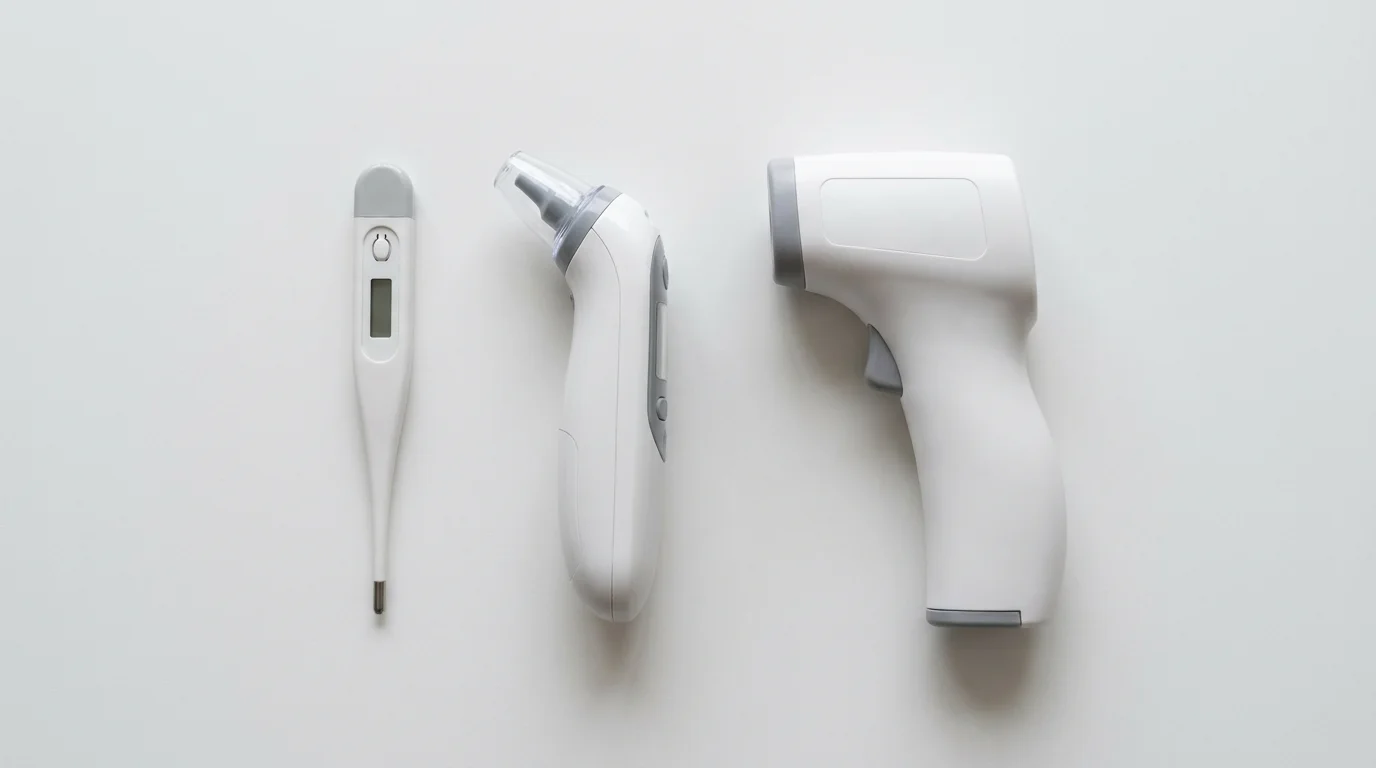
| Feature | Digital stick thermometer | Infrared thermometer (forehead or ear) |
| What it measures | Actual temperature of the tissue it touches: mouth, armpit or rectum | Infrared heat radiating from the skin of the forehead or the eardrum, converted to an estimated body temperature by a built-in formula |
| Sensor | Thermistor in the metal tip | Infrared sensor behind a lens |
| Time to read | About 10 seconds for most models; older or cheaper models 30 to 60 seconds; wait for the beep | 1 to 3 seconds |
| Contact | Yes; needs cleaning between people | Forehead models are non-contact; ear models touch the ear canal and use disposable covers |
| Laboratory accuracy (ASTM standards) | ±0.1°C | ±0.2°C between 35 and 42°C; ±0.3°C outside that range |
| Real-world fever detection | Reference method; rectal is the gold standard in infants | Pooled sensitivity about 77% in children and 48% in adults (2024 meta-analysis) |
| Affected by the room | Very little | Yes: must sit in the room 10 to 30 minutes first; room ideally 16 to 40°C |
| Affected by sweat, hair, cap, sun, AC | No | Yes, all of them |
| Battery | Button cell lasts 1 to 2 years | AA or AAA cells; a low battery gives erratic readings |
| Price on our store (October 2026) | Rs 900 to 1,050 | Rs 4,500 to 8,500 |
The two tools answer slightly different questions. A stick thermometer under the tongue reads the temperature of blood flowing under the tongue, which tracks the body’s core closely. An infrared forehead thermometer reads the skin over the temporal artery, and skin temperature depends not only on core temperature but on how warm or cold the room is, whether the person was sweating, whether they were just outside, and whether a cap, scarf or dupatta was covering the forehead a moment earlier. The device applies a correction to estimate the core temperature, but no correction can know that a child was wrapped in a blanket until thirty seconds ago. An ear thermometer avoids some of this because the eardrum shares its blood supply with the brain’s temperature centre, but it needs a straight view down the ear canal, which is why it fails in babies under 6 months, whose canals are too small, and why the two ears can legitimately differ by up to 0.2°C.
What the Evidence Actually Shows
The specifications on the box are measured in a laboratory against a stable heat source. The clinical studies measure what matters: whether the device catches a fever in a real patient. In a Danish study of 995 children attending hospital, with a rectal reading of 38.0°C as the reference, forehead thermometers detected between 72% and 92% of fevers depending on age group, and ear thermometers between 67% and 93%; only the ear thermometer exceeded 90%, and only in children aged 6 months to 5 years. The authors concluded that forehead and ear readings cannot replace rectal measurement except for screening. An older Belgian study found forehead readings that differed from the rectal reading by anywhere from 1.3°C below to 1.3°C above, and detected only 41% of fevers. A study of infants in Thailand found that forehead readings were at least 0.5°C away from the rectal reading in a third of children, and at least 1°C away in more than a fifth, while ear readings were a full degree off in only 1%.
The pooled picture comes from a 2024 systematic review and meta-analysis in BMC Infectious Diseases, which combined studies of temporal artery and non-contact infrared thermometers and found a sensitivity for fever of 0.77 in children and 0.48 in adults. The adult figure is the surprising one: an adult with a true fever has roughly a coin-flip chance of being told by a forehead gun that they are normal. The likely reasons are that adults are more often measured in hot or cold rooms, after activity, with make-up, sweat or hair in the way, and that adult skin blood flow varies more. None of this makes the infrared thermometer useless. It means the infrared thermometer is a fast screening tool whose high readings can be trusted more than its normal ones, and a low reading in someone who feels feverish is a reason to pick up the stick thermometer, not a reason to relax.
| Study | Reference | Forehead or non-contact result | Ear result |
| Meta-analysis, BMC Infectious Diseases 2024 | Core reference across studies | Sensitivity 77% in children, 48% in adults | Not pooled separately |
| Denmark, 995 children, BMC Pediatrics 2018 | Rectal 38.0°C | Sensitivity 72 to 92% by age | Sensitivity 67 to 93%; above 90% only at 6 months to 5 years |
| Belgium, children (cited in the Danish paper) | Rectal | Readings −1.32 to +1.33°C from rectal; sensitivity 41% | Not reported |
| Thailand, infants and young children | Rectal | 33% of readings off by 0.5°C or more; 22% off by 1°C or more | 23.5% off by 0.5°C; only 1% off by 1°C |
| Korea, forehead non-contact | Core | Sensitivity 0 to 69% in adults, 60% in children | Not reported |
| NICE evidence review | Core | Chemical forehead strips underestimate by about 1.2°C; not recommended | Not reported |
Which Thermometer for Which Age
| Age | Best method | Acceptable alternatives | Avoid |
| Under 3 months | Rectal digital stick thermometer (AAP) | Forehead infrared for a first screen, confirmed rectally; armpit for a rough screen | Ear thermometers (canal too small); oral; mercury |
| 3 months to 4 years | Rectal digital for an exact reading; forehead infrared or armpit digital for screening | Ear infrared from 6 months, with careful probe placement | Oral (child cannot hold the tip under the tongue with the mouth closed) |
| 4 years and over | Oral digital stick thermometer | Ear or forehead infrared for screening; armpit if the child will not cooperate | Oral reading within 30 minutes of a hot or cold drink |
| Adults | Oral digital stick thermometer | Ear infrared; forehead infrared only as a quick screen | Relying on a normal forehead reading when the person feels feverish |
| Elderly or bedridden | Oral digital if able; armpit digital with the arm held firmly down for the full time | Ear infrared | Forehead readings in an air-conditioned or very hot room without acclimatisation |
| Several people quickly, such as a school gate or clinic entrance | Non-contact infrared | None needed; confirm any raised reading with a stick thermometer | Treating a normal forehead reading as proof of no fever |
The rule for babies is the one most often broken in Pakistan and the one with the most consequences. A fever of 38.0°C or more in a baby under 3 months is a reason to see a doctor the same day according to the American Academy of Pediatrics, because serious infection in that age group can present with little else. A forehead gun that reads 37.4°C on a baby who feels hot can delay that visit by a day. The rectal method sounds unpleasant but takes ten seconds with a lubricated digital tip inserted about 1 to 2 cm, and it is the measurement the doctor will trust. Keep that thermometer for rectal use only and label it.
Ear vs Forehead vs Oral vs Armpit: Thresholds and Offsets
Each site has its own normal range and its own fever threshold, and comparing a forehead reading today with an oral reading yesterday is one of the commonest reasons families think the fever is “going up and down.” Use one site consistently and record which one.
| Site | Fever threshold | Typical relationship to core | Notes |
| Rectal | 38.0°C (100.4°F) or above | Closest to core; the reference in infants | Under 3 months this is the reading that decides |
| Oral (under the tongue, mouth closed) | 37.8°C (100°F) or above | About 0.3 to 0.5°C below rectal | Nothing hot or cold to eat or drink for 30 minutes; no talking during the reading |
| Ear (tympanic) | 37.8°C or above as a screening cut-off | Close to core when placed well; reads low with poor placement | Not under 6 months; same ear each time; wait 15 minutes after coming indoors |
| Forehead (temporal, non-contact) | Follow the device manual; most flag 37.5 to 38.0°C | Reads low when the skin is cool, sweaty or just uncovered | Screening only; confirm a borderline or unexpected result |
| Armpit (axillary) | 37.2°C (99°F) or above | About 0.5 to 0.6°C below oral; the least accurate site | Arm held firmly against the body for the full reading time; useful screen at any age |
Normal body temperature itself is a range rather than a single number, roughly 36.1 to 37.2°C in the FDA’s description of non-contact thermometer use, and it is lower in the early morning and higher in the evening. Our guide to the normal body temperature range sets this out by age and time of day, and it is worth reading before deciding that a reading of 37.3°C at 6 pm is a fever.
What Makes an Infrared Thermometer Read Wrong
The FDA’s guidance on non-contact thermometers lists the conditions these devices need, and almost every one of them is routinely broken in a Pakistani home. The thermometer should sit in the room where it will be used for 10 to 30 minutes before the first reading, so that its own sensor is at room temperature. The room should be between roughly 16 and 40°C with no draught, no direct sunlight and no radiant heat such as a heater or a sunlit window. The forehead must be clean, dry and uncovered, with hair pushed back, and the thermometer must be held straight on, perpendicular to the skin, at the exact distance the manual states, which is usually 1 to 5 cm; too far and the reading drops, too close on some models and it rises.
| Situation | Effect on a forehead reading | What to do |
| Child just woke from under a blanket or razai | Reads high | Uncover the forehead and wait 5 to 10 minutes |
| Child just came in from outside, or sat in front of the AC or a fan | Reads low | Wait 15 to 30 minutes indoors at normal room temperature |
| Sweaty forehead | Reads low, because sweat cools the skin | Dry the forehead gently and wait a few minutes |
| Dupatta, cap, hijab or headband just removed | Reads high | Wait several minutes with the forehead uncovered |
| Hair, fringe or make-up over the forehead | Reads low or erratic | Push hair back; measure on bare skin |
| Thermometer stored in a cold or hot place, such as a car or near a window | Erratic | Leave in the room 30 minutes before use |
| Held at the wrong distance or at an angle | Usually reads low | Hold perpendicular at the manual’s distance |
| Direct sunlight or a heater in the room | Reads high | Move to a shaded, draught-free spot |
| Low batteries | Erratic or failed readings | Replace batteries first when readings become inconsistent |
| Ear thermometer in a child under 6 months | Reads low | Use a rectal or armpit digital reading instead |
| Ear thermometer with the probe not aimed at the eardrum | Reads low | Pull the ear gently up and back in a child over 1 and in adults, down and back in a baby; aim at the opposite eye |
| Comparing left and right ear | Can differ by up to 0.2°C | Always use the same ear |
The digital stick thermometer has its own short list. An oral reading is wrong if the mouth was open, if the person was talking, or if they had chai, cold water or ice cream within 30 minutes. An armpit reading is wrong if the arm was loose, the tip was not in the centre of the armpit against dry skin, or the thermometer was removed before the beep. Those are the only common errors, which is the reason the stick thermometer remains the reference.
Thermometers We Stock
Three digital stick thermometers for exact readings, including the one every baby under 3 months needs, and three infrared models for quick screening at night. The price gap buys speed, not accuracy; if you can afford only one, buy a digital stick thermometer.
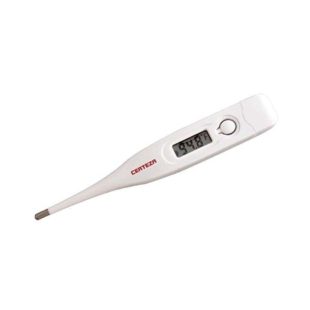
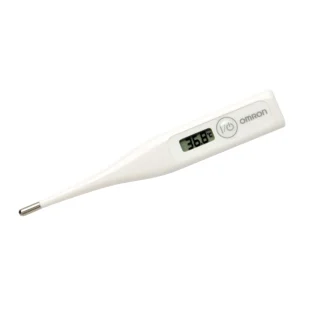
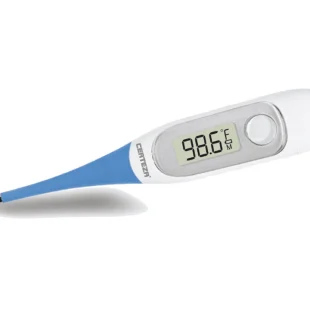
Digital stick, flexible tip for children
Certeza FT 709 Digital Thermometer (Flexible Tip)
₨ 1,050
Add to cart
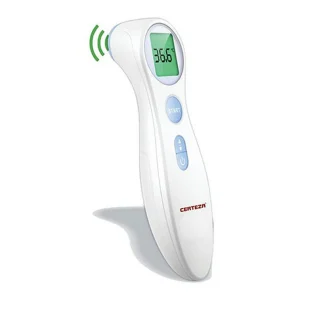
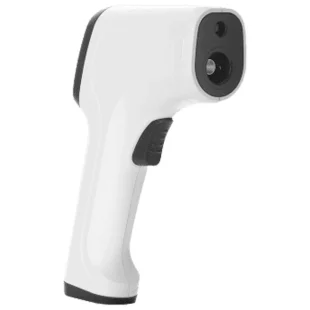
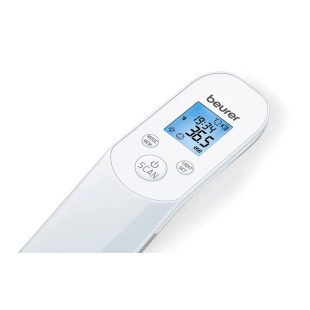
Infrared, non-contact, Germany
Beurer FT 85 Non-Contact Infrared Thermometer (Germany)
₨ 8,500
Add to cart
Cost in Pakistan and What You Are Paying For
On our own store at the time of writing, digital stick thermometers from Certeza and Omron are priced between Rs 900 and Rs 1,050, and infrared thermometers between Rs 4,500 for a Certeza FT 710 non-contact model and Rs 8,500 for the Beurer FT 85 from Germany, with a Contec non-contact model at Rs 6,500. The difference in price buys speed and the ability to check a sleeping child without waking them; it does not buy accuracy. The sensible setup for a family with children is both: a digital stick thermometer kept for exact readings and for every baby under 3 months, and an infrared thermometer for quick screening at night and for the days when a toddler will not stay still. A family on a tight budget that can afford only one should buy the stick thermometer. Our full digital thermometer range lists both types, and our digital thermometer price guide compares the models in more detail.
Whatever you buy, retire any mercury thermometer still in the house. Manufacture and trade of mercury thermometers has been phased out under the Minamata Convention since 2020, the WHO has published guidance to health ministries on replacing them, and a broken mercury thermometer in a child’s bedroom is a genuine poisoning hazard. A digital stick thermometer is as accurate, faster, and cannot shatter.
Frequently Asked Questions
Is an infrared thermometer as accurate as a digital thermometer?
No. A digital stick thermometer is tested to ±0.1°C and an infrared thermometer to ±0.2°C, and in clinical studies forehead and non-contact infrared thermometers missed about 1 in 4 fevers in children and 1 in 2 in adults. Use the infrared for quick screening and confirm an unexpected or borderline result with a digital stick thermometer.
Which thermometer is best for a newborn baby?
A digital stick thermometer used rectally, according to the American Academy of Pediatrics. Ear thermometers are not accurate under 6 months because the ear canal is too small, and a forehead reading can miss a fever. A rectal reading of 38.0°C or more in a baby under 3 months needs a doctor the same day.
Why does my forehead thermometer give a different reading each time?
Because skin temperature changes with the room, sweat, a cap or dupatta, hair, how far away you hold it and whether the child was just under a blanket or in front of a fan. Let the thermometer sit in the room for 10 to 30 minutes, measure on a dry, uncovered forehead at the distance in the manual, and repeat once; if the two readings differ by more than 0.3°C, use a stick thermometer.
Is an ear thermometer better than a forehead thermometer?
Usually, yes, for children over 6 months and adults, because the eardrum tracks core temperature more closely than forehead skin, and ear readings were less often a full degree off in comparison studies. It needs correct placement, a clean probe cover and the same ear each time. It is not suitable under 6 months.
What is a fever on each type of thermometer? Rectal 38.0°C or above, oral 37.8°C or above, ear 37.8°C or above as a screening cut-off, and armpit 37.2°C or above. For a forehead thermometer, follow the threshold in its manual and confirm any reading near it with a stick thermometer. In a baby under 3 months, 38.0°C rectal is the number that matters.
