- Your cart is empty
- Continue Shopping




CPAP vs APAP: What Is the Difference, and Which One Suits You?
Quick Answer
CPAP gives one fixed pressure all night, set by a doctor after a sleep study. APAP, also called auto-CPAP, adjusts the pressure itself within a set range, raising it when it detects an apnea and easing off when the airway is stable. The AASM found no clinically significant difference between the two in sleepiness, quality of life or AHI reduction, so the choice depends on your pressure needs and comfort.
What CPAP Is: One Fixed Pressure All Night
CPAP stands for Continuous Positive Airway Pressure. It delivers one fixed pressure all night, set by a doctor after a titration study. The pressure acts like an air splint that holds the upper airway open so it does not repeatedly narrow or close.
CPAP is the therapy most studied and most often recommended for obstructive sleep apnea, according to Mayo Clinic. Fixed pressure CPAP is the standard option NICE recommends for moderate or severe sleep apnoea.
The fixed pressure is chosen to cover the worst part of your night. That means the pressure is high enough for REM sleep and for sleeping on your back, even when you are in deep sleep on your side and need much less. The machine does not know or care which stage you are in. It gives the same pressure from the moment you fall asleep to the moment you wake up.
What APAP Is: Pressure That Adjusts While You Sleep
APAP stands for Automatic Positive Airway Pressure, also called auto-CPAP, auto-titrating CPAP, auto-adjusting CPAP or AutoSet, which is the ResMed brand name. It is technically a type of CPAP machine with auto-adjust technology added. Traditional machines without it are called fixed-level CPAP devices.
APAP automatically adjusts pressure within a prescribed minimum and maximum range, raising pressure when it detects flow limitation, snoring or an apnea, and easing off when the airway is stable. Its sensors assess breathing and raise pressure when someone rolls onto their back and starts having breathing lapses.
The NHS leaflet from University Hospitals Sussex says CPAP gives one continuous pressure level, while APAP automatically titrates, which means measures and adjusts, to meet breathing needs, which often change through the night as a person moves in and out of different sleep stages.
APAP pressure range is typically 4 to 20 cm H2O, and fixed CPAP pressures are typically 6 to 15 cm H2O. Those are example ranges, not prescriptions. Your doctor sets your range or your fixed pressure after your sleep study.
CPAP vs APAP Side by Side: How Each One Works Through the Night
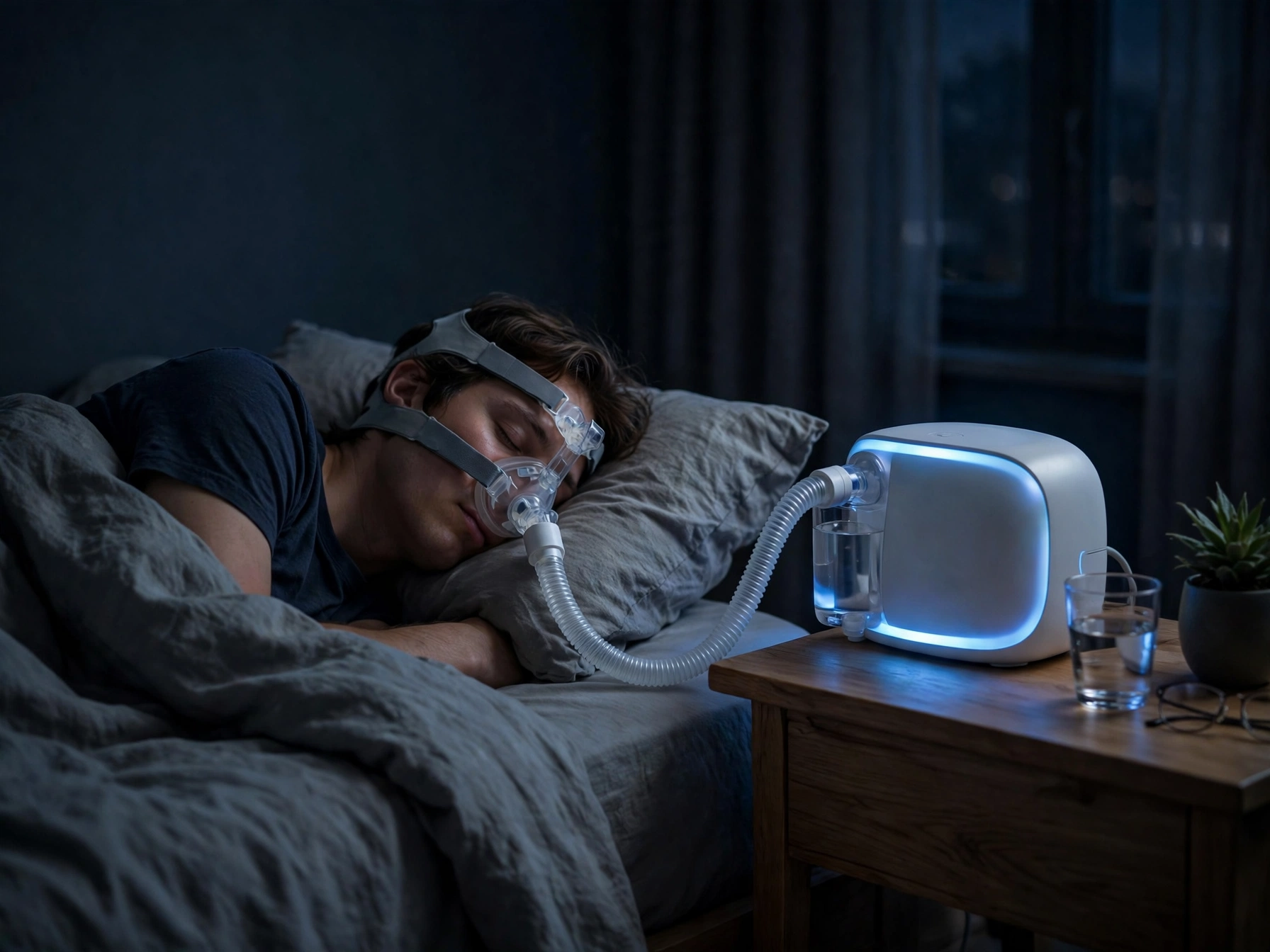
The difference is easiest to see across one night. Fixed CPAP holds one pressure from lights out to morning. APAP starts low, rises when you need it, and falls back when you do not. Both keep the airway open. They just do it in different ways.
| Feature | Fixed CPAP | APAP |
| Pressure delivery | One fixed pressure all night | Pressure adjusts within a set range |
| How pressure is set | Sleep specialist sets it after a lab titration study | Doctor sets a minimum and maximum, the machine finds the level |
| Comfort | Same pressure even when less would do | Only the lowest effective pressure at each moment |
| Who it suits | People whose optimal pressure is known and stable | People whose pressure needs vary through the night |
| Price | Usually slightly cheaper than an equivalent APAP | Usually slightly more expensive, because of the auto algorithm |
| Data recorded | Hours used, leaks, AHI | Hours used, leaks, AHI, plus pressure changes through the night |
| Part of the night | Fixed CPAP | APAP |
| Bedtime, falling asleep | Full prescribed pressure at once | Starts at the low end of the range |
| Deep sleep, on your side | Same full pressure | Pressure stays low, because the airway is stable |
| REM sleep | Same full pressure | Pressure rises, because the airway narrows in REM |
| On your back | Same full pressure | Pressure rises to cover the extra collapse |
| After a drink or a cold | Same full pressure | Pressure rises to cover the extra narrowing |
| Morning | Same full pressure until switch off | Pressure eases back down before waking |
How the Pressure Is Set: Sleep Study Titration vs Auto Range
Fixed CPAP pressure is set by a sleep specialist after an overnight sleep study in a lab. A technician watches your sleep, raises the pressure step by step, and finds the lowest pressure that stops your apneas. That number becomes your prescription.
APAP setup can usually happen at home using the machine itself, because the machine finds the pressure range from real sleep data. By contrast, fixed CPAP setup needs either an overnight lab study or temporary use of an APAP machine at home.
The AASM 2019 guideline strongly recommends starting PAP therapy with either home APAP or in-lab titration in adults with OSA and no significant comorbidities, based on 10 high quality randomised controlled trials showing equivalent outcomes. A doctor still has to diagnose sleep apnea first. APAP does not replace the diagnosis.
Who Suits Fixed CPAP and Who Suits APAP
APAP suits people whose pressure needs vary: different sleep positions, REM sleep, alcohol use, nasal congestion, weight changes, and positional OSA. If your pressure need changes through the night, APAP follows it.
Fixed CPAP suits people whose optimal pressure is already known and stable after lab titration. If your pressure need is steady and you sleep well on it, there is no reason to change.
APAP is not suitable for people whose OSA coexists with certain other health conditions, including central sleep apnea or complex sleep apnea. NICE notes APAP is used in selected people, sometimes to help find the right fixed pressure. Your sleep doctor decides.
| Patient situation | Recommended option | Reason |
| Stable pressure known from a lab study | Fixed CPAP | The pressure is already proven for you |
| Pressure needs change through the night | APAP | The machine follows the changes |
| Positional apnea, worse on the back | APAP | Pressure rises only when you roll onto your back |
| REM related apnea | APAP | Pressure rises in REM and falls in deep sleep |
| Weight changing | APAP | The range adapts as the pressure need changes |
| Central sleep apnea | Neither without specialist advice | APAP is not suitable here, a specialist decides |
| First time user, no lab study yet | APAP | Setup can happen at home from real sleep data |
Comfort and Side Effects: What to Expect From Each
Common CPAP side effects are dry mouth, nasal congestion, runny nose, nosebleeds, mask leak, skin irritation or pressure marks, headaches or eye dryness from leaks, abdominal bloating from swallowed air, claustrophobia, and difficulty breathing out against the pressure. Both machines share these, because both push air through a mask.
Heated humidification reduces dryness, congestion, sore throat, nosebleeds and related side effects. Both machines on our store have integrated heated humidifiers.
APAP is often more comfortable because it delivers only the lowest effective pressure at each moment, which reduces pressure discomfort, air swallowing and leaks. Some people find fixed pressure hard to breathe out against, and APAP eases that by dropping the pressure when less is needed.
Comfort is personal. Some people prefer the steady, predictable feel of fixed CPAP. Others prefer APAP because the pressure is lower for much of the night. The AHI target is the same for both: below 5 events per hour is the usual treatment goal.
Two comfort features are worth asking about. The ramp feature starts the machine at a low pressure and raises it slowly over 20 to 45 minutes, so you fall asleep before the full pressure arrives. The Yuwell YH 550 has a ramp of 0 to 45 minutes. Exhalation relief, called FPS on the Yuwell with 4 levels, drops the pressure slightly when you breathe out, so breathing out against the machine feels easier. Both features are set by the clinician, not by the user.
One 2025 cloud-based study reported 1-year adherence significantly higher for CPAP, at 87.55 percent, than for APAP, at 67.81 percent. That is a single study result reported by a retailer, not a guideline finding, so use it only with that caution. The AASM guideline, based on 26 trials, found no difference in adherence between the two.

| Side effect | More common with | What helps |
| Dry mouth and nose | Both | Heated humidifier, chin strap for mouth breathing |
| Nasal congestion | Both | Heated humidifier, saline spray, check the filter |
| Mask leak | Both, worse at high pressure | Refit the mask, check the cushion size, do not over tighten |
| Bloating from swallowed air | Fixed CPAP at high pressure | APAP at lower average pressure, or a lower fixed pressure if the doctor agrees |
| Difficulty breathing out | Fixed CPAP at high pressure | APAP, or a machine with exhalation relief |
| Claustrophobia | Both | Nasal pillow mask, ramp feature, gradual use |
Stopping treatment is common with both machines. 8 percent of people stop CPAP after the first night and 50 percent within the first year, according to Wikipedia citing a Cochrane review. Mask leak problems and feelings of claustrophobia are listed among the adverse effects. A well fitted mask and a follow up visit matter more than the choice between CPAP and APAP.
Can an APAP Machine Be Used as a Fixed CPAP?
Yes. Almost every modern APAP machine can be configured to run in fixed pressure, or CPAP, mode if the doctor prescribes a specific pressure instead of a range. ResMed AirSense 10 AutoSet and AirSense 11 AutoSet can run in AutoSet mode or in fixed CPAP mode. The Elite models are fixed-pressure only and cannot auto-adjust.
Changing mode yourself is not advised. The prescription decides the mode. If your doctor wants you on a fixed pressure, they will set the machine to that pressure. If they want auto mode, they will set the range. Do not switch modes to experiment.
This flexibility is useful in practice. A doctor may start you on APAP to find your pressure range at home, then set the machine to the fixed pressure that worked best. Or they may leave you on APAP for good. Either way, the same machine does both jobs.
CPAP vs APAP Price in Pakistan and Which One to Ask Your Doctor About
US prices quoted by one medical guide are USD 500 to 3,000 depending on features, such as fixed versus APAP, humidification and telemonitoring. That is US pricing, not Pakistan pricing. APAP machines are typically slightly more expensive than an equivalent fixed-pressure CPAP because of the auto-adjusting algorithm.
On our store, only two auto CPAP, or APAP, machines are verified live, and no fixed-pressure CPAP machine is sold on the store, so no Pakistan fixed-CPAP price could be verified. Any Pakistan price comparison between fixed CPAP and APAP would be invented, so this article does not give one. The two APAP prices below are live and verified.
| Machine | Type | Price in Pakistan | Key features |
| Auto CPAP Machine YH 550 YUWELL | APAP | Rs 75,000 | Integrated humidifier, exhalation assist, ramp 0 to 45 min, leak alarm, 28 dBA |
| Auto CPAP machine YEL Series Foras Turkey | APAP | Rs 90,000 | Integrated heater humidifier, touchscreen, patient track software, SD card |
| Fixed pressure CPAP machine | Fixed CPAP | Not sold on this store | No Pakistan price could be verified, do not compare on price alone |
There is no single first choice in the guidelines. The AASM says use either CPAP or APAP for ongoing treatment. NICE standard practice is fixed-pressure CPAP for moderate or severe sleep apnoea, with APAP for selected people. Some US guides say APAP is the most commonly prescribed first-line device because it self-titrates, but that is a market claim, not a guideline. Present all three honestly and let your doctor decide.
When you see your doctor, ask these questions. Do I need a lab sleep study, or can I start with APAP at home? What pressure or pressure range are you prescribing, and why? Which mask type suits my breathing and my sleeping position? How often will you review my machine data, and what AHI should I aim for? What should I do if the mask leaks or the pressure feels too high? The answers will tell you which machine fits your life, not just your sleep study.
The AASM 2019 guideline, based on 26 randomized controlled trials, found no clinically significant difference between APAP and CPAP in adherence, sleepiness, quality of life, or AHI reduction. A 2004 meta-analysis of 282 patients found APAP reduced mean applied pressure by 2.2 cm H2O but gave no advantage in eliminating respiratory events or improving sleepiness. A 2018 multicentre trial found identical Epworth Sleepiness Scale changes over 2 years: minus 6.3 for APAP versus minus 6.2 for CPAP. The AASM recommends tailoring the choice to individual patient tolerance and symptom response rather than routinely preferring one over the other.
Auto CPAP Machines and Masks We Stock
Two APAP machines with integrated humidifiers, plus two full face masks. No fixed-pressure CPAP machine is currently stocked on this store.


If you are still deciding, read what is CPAP first, then our comparison of CPAP vs BiPAP, and sleep apnea treatment without CPAP for the options beyond machines. For the wider picture, see oxygen concentrator vs CPAP vs BiPAP.
Frequently Asked Questions
Is APAP better than CPAP?
No, not in general. The AASM 2019 guideline, based on 26 randomized controlled trials, found no clinically significant difference between APAP and CPAP in adherence, sleepiness, quality of life, or AHI reduction.
Can an APAP machine be used as a fixed CPAP machine?
Yes. Almost every modern APAP machine, including ResMed AirSense AutoSet models, can be set to fixed CPAP mode by a clinician.
Does APAP need a sleep study?
Not always. APAP can usually be set up at home because the machine finds the pressure range from real sleep data, while fixed CPAP usually needs an overnight lab titration study. A doctor still has to diagnose sleep apnea first.
Why does my pressure need change during the night?
Pressure needs rise in REM sleep, when sleeping on your back, with nasal congestion, after alcohol, and when weight changes. APAP adjusts for these changes. Fixed CPAP stays at the one pressure chosen to cover the worst part of the night.
Who should not use APAP?
People with central sleep apnea or complex sleep apnea, and people with certain other health conditions alongside OSA, should not use APAP without specialist advice. A sleep doctor decides.
