- Your cart is empty
- Continue Shopping


What Is Sleep Apnea? Symptoms, Causes, Diagnosis and Treatment
Quick Answer
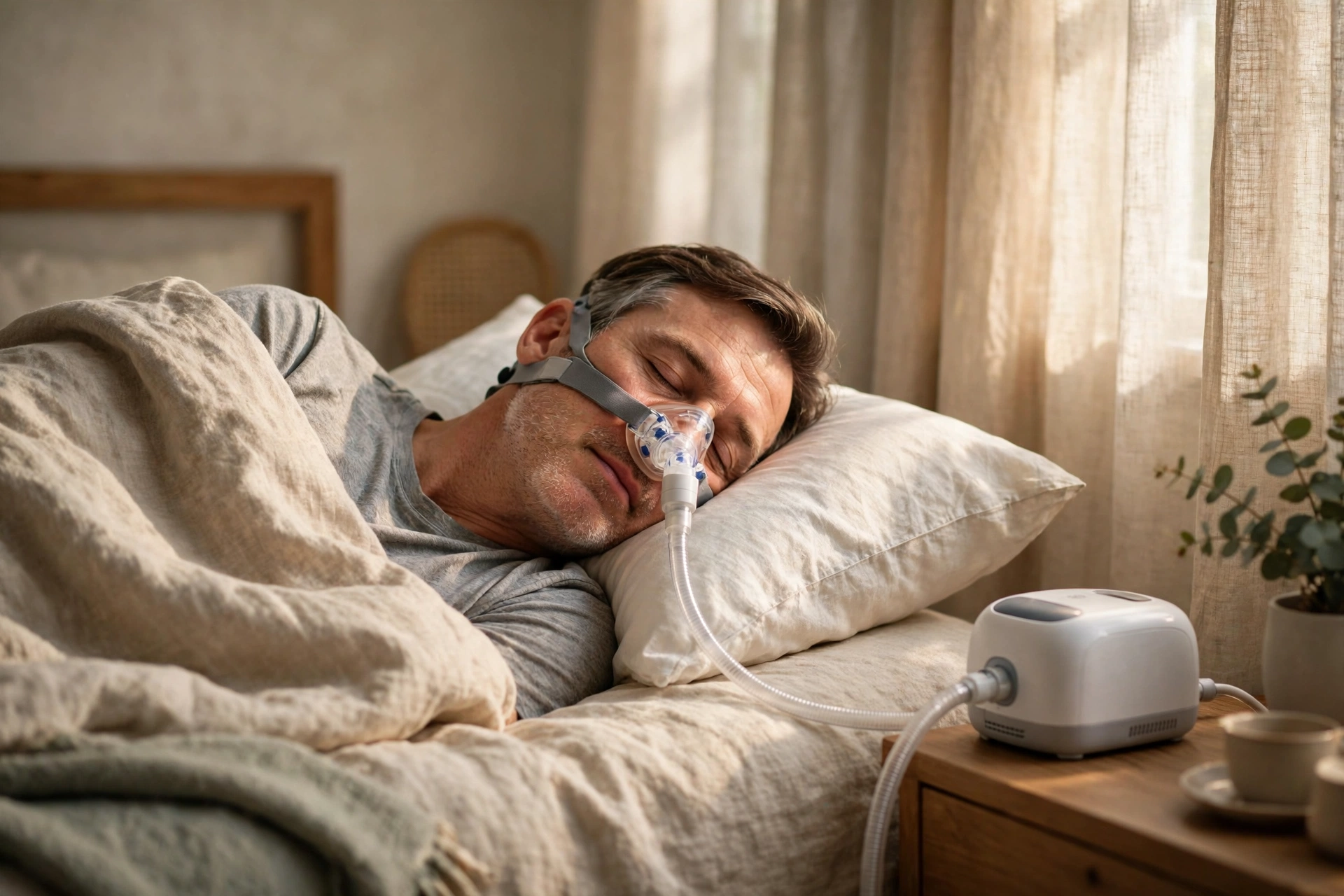
Sleep apnea is when breathing repeatedly stops and starts during sleep. The airway narrows or closes, oxygen in the blood falls, and the brain briefly wakes you to reopen it. Loud snoring, gasping, morning headaches and daytime sleepiness are the main symptoms. A sleep study diagnoses it, and CPAP is the main treatment for moderate to severe cases.
What Is Sleep Apnea?
Sleep apnea is a sleep related breathing disorder in which breathing repeatedly pauses, becomes shallow, or the upper airway collapses during sleep, which leads to poor ventilation and broken sleep. The NHS defines it the same way: sleep apnoea happens when the airways become too narrow while you sleep, which stops you breathing properly. Mayo Clinic calls it a potentially serious condition that causes breathing to stop and start several times during sleep.
About 1 in 10 people have sleep apnea, and it affects 936 million to 1 billion people aged 30 to 69 globally, according to a large 2019 analysis. Up to 30 percent of elderly people are affected. Men are affected about twice as often as women.
Nearly 30 million American adults have obstructive sleep apnea, and about 23.5 million Americans have it without a diagnosis, according to the American Academy of Sleep Medicine. Most people with sleep apnea do not know they have it. Their partner notices the snoring and the pauses first.
The Three Types: Obstructive, Central and Mixed
Obstructive sleep apnea, or OSA, is the most common form. The throat muscles relax during sleep and soft tissue collapses and blocks the airway. The person keeps trying to breathe, but no air gets through until the brain wakes them briefly.
Central sleep apnea, or CSA, happens when the brain stops sending the signal to breathe. The airway is not blocked. It is linked to heart failure, stroke, atrial fibrillation, older age, spinal cord injury and opioid medicines. Primary central sleep apnea is rare and accounts for only 3.8 percent of all diagnosed CSA cases.
Complex or mixed sleep apnea is a combination of OSA and CSA. It is also called treatment emergent central sleep apnea because it often appears when OSA is treated with CPAP and central events emerge. Mixed apnea prevalence ranges from 0.56 percent to 18 percent.
| Type | What causes it | What happens during sleep | Who it affects most |
| Obstructive (OSA) | Throat muscles relax and soft tissue blocks the airway | Breathing stops though the chest keeps trying | Overweight adults, older men, snorers |
| Central (CSA) | Brain stops sending the signal to breathe | Breathing stops and the chest does not try | People with heart failure, stroke or opioid use |
| Complex or mixed | A mix of blocked airway and missing signal | Both kinds of pauses in one night | People whose central events appear during CPAP treatment |
What Happens During an Apnea Episode
In OSA the airway narrows or closes, breathing stops, oxygen in the blood falls and carbon dioxide builds up. The brain then briefly wakes the person to reopen the airway, often with a gasp or snort, and the person falls asleep again. The cycle can repeat many times a night.
The American Academy of Sleep Medicine defines an apnea as a reduction in airflow of 90 percent or more lasting at least 10 seconds. A hypopnea is a reduction in airflow of 30 percent or more lasting at least 10 seconds, plus a 4 percent drop in blood oxygen, or a 3 percent drop, or an arousal from sleep. The NHS uses a simpler wording: an apnoea is a total blockage of the airway for 10 seconds or more, and a hypopnoea is a partial blockage that reduces airflow by more than 50 percent for 10 seconds or more. The two definitions differ slightly, so this article uses the AASM wording and names it.
Each pause can last a few seconds to a few minutes and often occurs many times a night. Repeated drops in oxygen and broken sleep reduce time in deep slow wave sleep and REM sleep. That is why a person with sleep apnea can sleep for eight hours and still wake up exhausted.
| AHI score | Severity | What it means |
| Under 5 | Normal | Fewer than 5 pauses per hour of sleep |
| 5 to 14 | Mild | Mild sleep apnea, treatment may be lifestyle changes |
| 15 to 30 | Moderate | Moderate sleep apnea, CPAP is usually recommended |
| Over 30 | Severe | Severe sleep apnea, treatment is important and urgent |
Severity is graded with the apnea hypopnea index, or AHI, which counts apneas plus hypopneas per hour of sleep. The bands above follow the NHS. Wikipedia gives the same bands except mild is 5 to 15, so this article follows the NHS bands and does not mix them.
Symptoms at Night
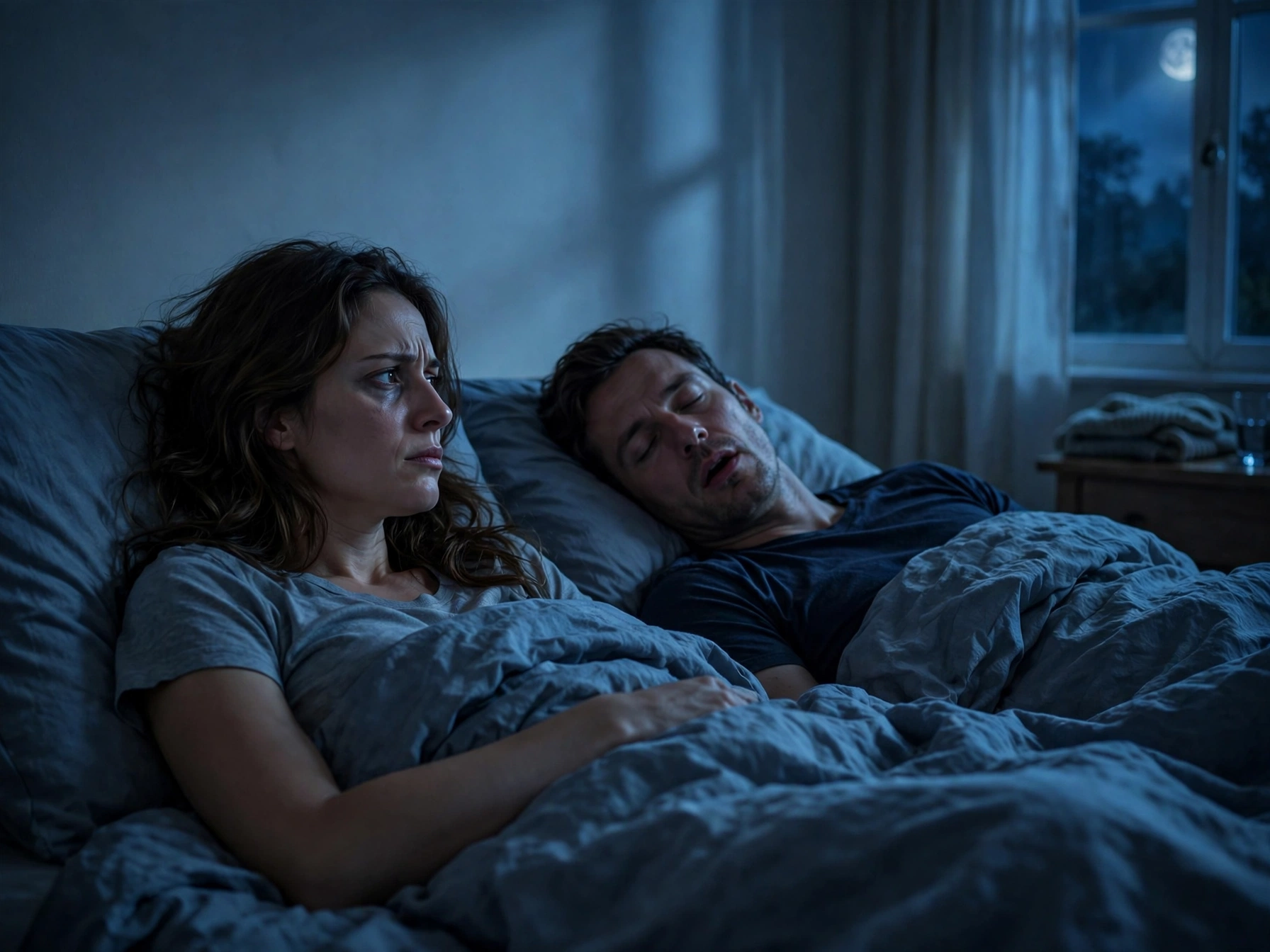
Loud snoring is the best known symptom, but snoring alone does not mean sleep apnea. Many people snore without it. The warning sign is loud snoring together with pauses in breathing, gasping, or daytime sleepiness.
Breathing stopping and starting during sleep is usually noticed by a partner. Gasping, snorting or choking noises, and waking up suddenly feeling short of breath, are also common. The person often does not remember these episodes in the morning.
Waking up a lot during the night, restless sleep and trouble staying asleep are common too. Waking up to pass urine at night, called nocturia, is another symptom. Waking with a dry mouth or sore throat happens because the mouth stays open most of the night.
| When | Symptom | What it looks like |
| Night | Loud snoring | Snoring loud enough to be heard in another room |
| Night | Pauses in breathing | Partner sees breathing stop for 10 seconds or more |
| Night | Gasping or choking | Sudden gasp or snort that wakes the person briefly |
| Night | Waking up a lot | Restless sleep and trouble staying asleep |
| Night | Dry mouth or sore throat | Mouth open all night, throat dry in the morning |
| Night | Nocturia | Waking to pass urine more than once a night |
| Day | Daytime sleepiness | Falling asleep at work, while watching TV, or while driving |
| Day | Morning headache | Dull headache that fades during the morning |
| Day | Poor concentration | Trouble focusing, poor memory, difficulty paying attention |
| Day | Irritability | Mood swings that can become depression over time |
Symptoms During the Day
Excessive daytime sleepiness is the symptom that causes the most harm. A person with sleep apnea can fall asleep at work, while watching TV, or while driving. Untreated OSA raises the risk of car accidents, and that risk alone is a reason to get tested.
Morning headache is common and usually fades during the morning. Trouble concentrating, poor memory and difficulty paying attention follow from broken sleep. Irritability and mood swings can become depression over time.
High blood pressure is both a symptom and a risk. The AASM warns that untreated severe OSA raises the risk of heart failure, elevated blood pressure, atrial fibrillation, resistant hypertension, type 2 diabetes and stroke. Left untreated, moderate and severe obstructive sleep apnea can more than double the risk of dying from heart disease.
Untreated sleep apnea also raises the risk of complications after general anesthesia, so tell your surgeon and anesthetist if you have it, or if you think you might have it, before any operation.
Who Is Most at Risk
Excess weight and obesity are the biggest risk factors. Fat deposits around the neck and throat narrow the upper airway, and fat around the chest makes the lungs work harder. Older age is another factor, and being male, or a postmenopausal woman. Mayo Clinic lists age over 50 as a risk factor.
A large neck matters. The STOP-BANG screening tool uses a neck circumference of more than 40 cm, or 16 inches. Family history of sleep apnea matters too. Smoking and drinking alcohol, especially shortly before bed, make it worse, because alcohol relaxes the throat muscles.
Sedative medicines and sleeping pills can make sleep apnea worse. Large tonsils or adenoids, a narrow airway, a small lower jaw or a narrow upper jaw also raise the risk. Nasal congestion, COPD, hypothyroidism and sleeping on the back add to it.
For central sleep apnea specifically, the risks are different: heart failure, atrial fibrillation, stroke, older age, and opioid medicines, especially long acting ones such as methadone. More than half of people with OSA have some degree of positional OSA, meaning it gets worse when they sleep on their backs.
How Sleep Apnea Is Diagnosed
A GP takes a sleep history and may ask the bed partner for what they have seen, then refers to a specialist sleep clinic. The partner’s account matters, because the patient is asleep during the symptoms.
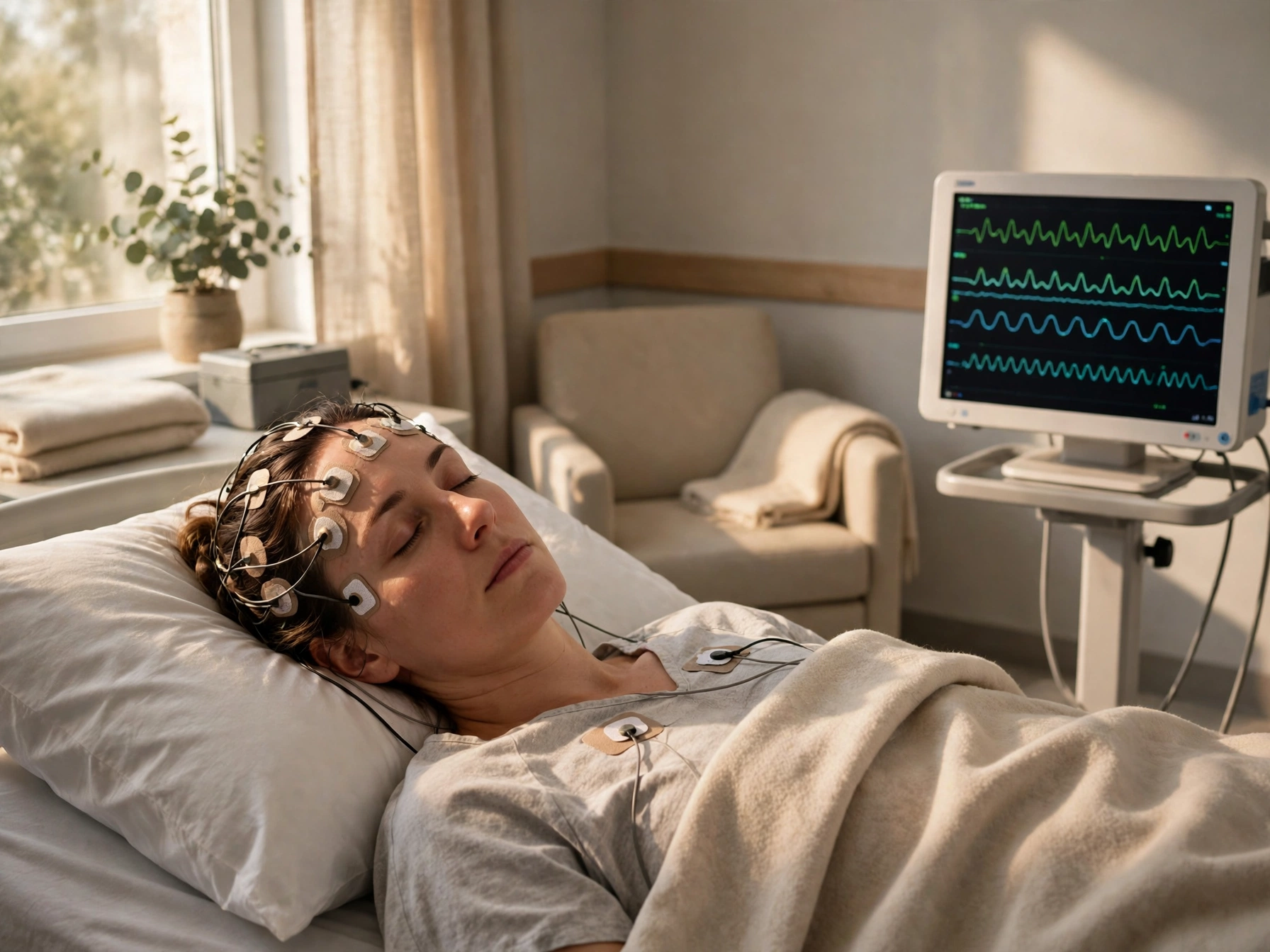
The overnight sleep study, called polysomnography, is the gold standard test. It records brain waves, breathing, airflow, chest and abdomen movement, heart activity, leg movements and blood oxygen. A home sleep apnea test is possible for many people. It usually records breathing rate and airflow, oxygen levels and heart rate.
Before the sleep study, doctors often use a screening tool. STOP-BANG has 8 yes or no questions. Each yes is 1 point, and the total runs from 0 to 8. A score of 3 or more usually leads a doctor to recommend a sleep study. STOP-BANG is a screening tool, not a diagnosis. It can miss sleep apnea in women, younger adults and lean adults.
In the original STOP-BANG validation, a cutoff score of 3 had a sensitivity of 83.6 percent for an AHI above 5, 92.9 percent for an AHI above 15, and 100 percent for an AHI above 30. Those figures come from a secondary report of the original validation study, so treat them as a guide to how the tool performs, not as a diagnosis. Around 1.5 million UK adults have sleep apnoea, and a further 85 percent of cases remain undiagnosed, according to Asthma and Lung UK as reported by restless.co.uk.
| Letter | Question | Yes is 1 point |
| S | Do you snore loudly? | Yes is 1 point |
| T | Do you feel tired during the daytime? | Yes is 1 point |
| O | Has anyone seen you stop breathing in sleep? | Yes is 1 point |
| P | Do you have high blood pressure or treatment for it? | Yes is 1 point |
| B | Is your BMI over 35? | Yes is 1 point |
| A | Are you over 50 years old? | Yes is 1 point |
| N | Is your neck circumference over 40 cm? | Yes is 1 point |
| G | Are you male? | Yes is 1 point |
| Score 0 to 2 | Low risk | Sleep apnea is unlikely |
| Score 3 to 4 | Intermediate risk | A sleep study is usually advised |
| Score 5 to 8 | High risk | A sleep study is strongly advised |
Treatment: CPAP, BiPAP and What Else Helps
Lifestyle changes can help, and may be enough for mild sleep apnea: lose weight if overweight, exercise regularly, stop smoking, drink less alcohol, especially before bed, keep regular sleep times, and sleep on your side. Sleeping pills should not be taken unless a doctor recommends them, because they can make sleep apnea worse.
CPAP is the main treatment for moderate to severe OSA. The machine gently pumps air through a mask over the nose, or nose and mouth, to hold the airway open. It improves breathing, sleep quality and tiredness, and reduces the risk of problems such as high blood pressure. It works best if used every night. NICE guideline NG202 recommends CPAP as first line treatment for moderate to severe OSA.
For moderate to severe sleep apnea, the most common treatment is CPAP or automatic positive airway pressure, or APAP. These splint the airway open with pressurized air. BiPAP, or bilevel positive airway pressure, gives a higher pressure when breathing in and a lower pressure when breathing out. It is used when CPAP is not tolerated or not enough.
A mandibular advancement device, like a gum shield, holds the airway open and is an alternative for milder cases or CPAP intolerance. Surgery is usually a third line option for people who reject CPAP or are not helped by it, for example removing large tonsils. Mouth and facial muscle exercises and hypoglossal nerve stimulation are other options listed by the NHS.
If CPAP does not work for you, do not give up on treatment. The first step is usually the mask: a different type or size, a chin strap, or a heated humidifier can fix most comfort problems. If the pressure feels too high to breathe out against, the doctor may switch you to BiPAP, which gives a higher pressure when breathing in and a lower pressure when breathing out. A follow up sleep study can check whether the pressure is right, and positional therapy, such as a device that stops you rolling onto your back, helps the many people whose apnea is worse on their backs.
| Treatment | How it works | Best for | Limits |
| CPAP | One steady pressure holds the airway open | Moderate to severe OSA | Needs nightly use, mask comfort matters |
| APAP | Pressure adjusts itself through the night | Pressure needs that change | Not for central sleep apnea |
| BiPAP | Higher pressure on inhale, lower on exhale | People who cannot tolerate CPAP | More complex, usually specialist prescribed |
| Lifestyle changes | Weight loss, side sleeping, no alcohol before bed | Mild OSA | May not be enough alone for moderate or severe OSA |
| Mouth device | Holds the jaw forward to keep the airway open | Mild OSA or CPAP intolerance | Less effective than CPAP for severe OSA |
| Surgery | Removes tissue or moves the jaw to open the airway | People who reject CPAP | Last option, recovery and risks |
In 2017, only 15 percent of potential patients in developed countries used CPAP machines, and well under 1 percent in developing countries. More than half of people do not use the device appropriately in the long term. That is why mask fit, comfort and follow up matter as much as the machine itself.
If you want to know more about the treatment itself, read what is CPAP, our comparison of CPAP vs BiPAP, and sleep apnea treatment without CPAP. For the wider picture, see oxygen concentrator vs CPAP vs BiPAP.
CPAP and BiPAP Machines We Stock
Auto CPAP and BiPAP machines for sleep apnea, all with integrated heated humidifiers.


Frequently Asked Questions
Is loud snoring always sleep apnea?
No. Many people snore without sleep apnea, but loud persistent snoring plus pauses in breathing, gasping, or daytime sleepiness points to sleep apnea and should be checked with a sleep study.
How is sleep apnea diagnosed?
A doctor takes a sleep history and may refer you to a sleep clinic. The overnight sleep study, called polysomnography, is the gold standard test, and a home sleep test is possible for many people. Severity is graded by the AHI score.
What is a good AHI score?
Under 5 is normal. The NHS grades 5 to 14 as mild, 15 to 30 as moderate, and over 30 as severe sleep apnea.
Can sleep apnea be treated without a CPAP machine?
Mild sleep apnea may improve with weight loss, side sleeping, regular exercise, no smoking, and less alcohol. Moderate to severe sleep apnea usually needs a CPAP machine, and NICE recommends CPAP as first line treatment for moderate to severe OSA. A mouth device is an alternative for milder cases or CPAP intolerance.
Is untreated sleep apnea dangerous?
Yes. Without treatment it can lead to high blood pressure, stroke, type 2 diabetes, heart disease, depression, and a higher chance of a serious accident caused by tiredness, such as a car accident. The AASM says untreated moderate and severe OSA can more than double the risk of dying from heart disease.
