- Your cart is empty
- Continue Shopping




What Is a Commode Chair? Types, Who Needs One and How to Use It Safely at Home

Quick Answer
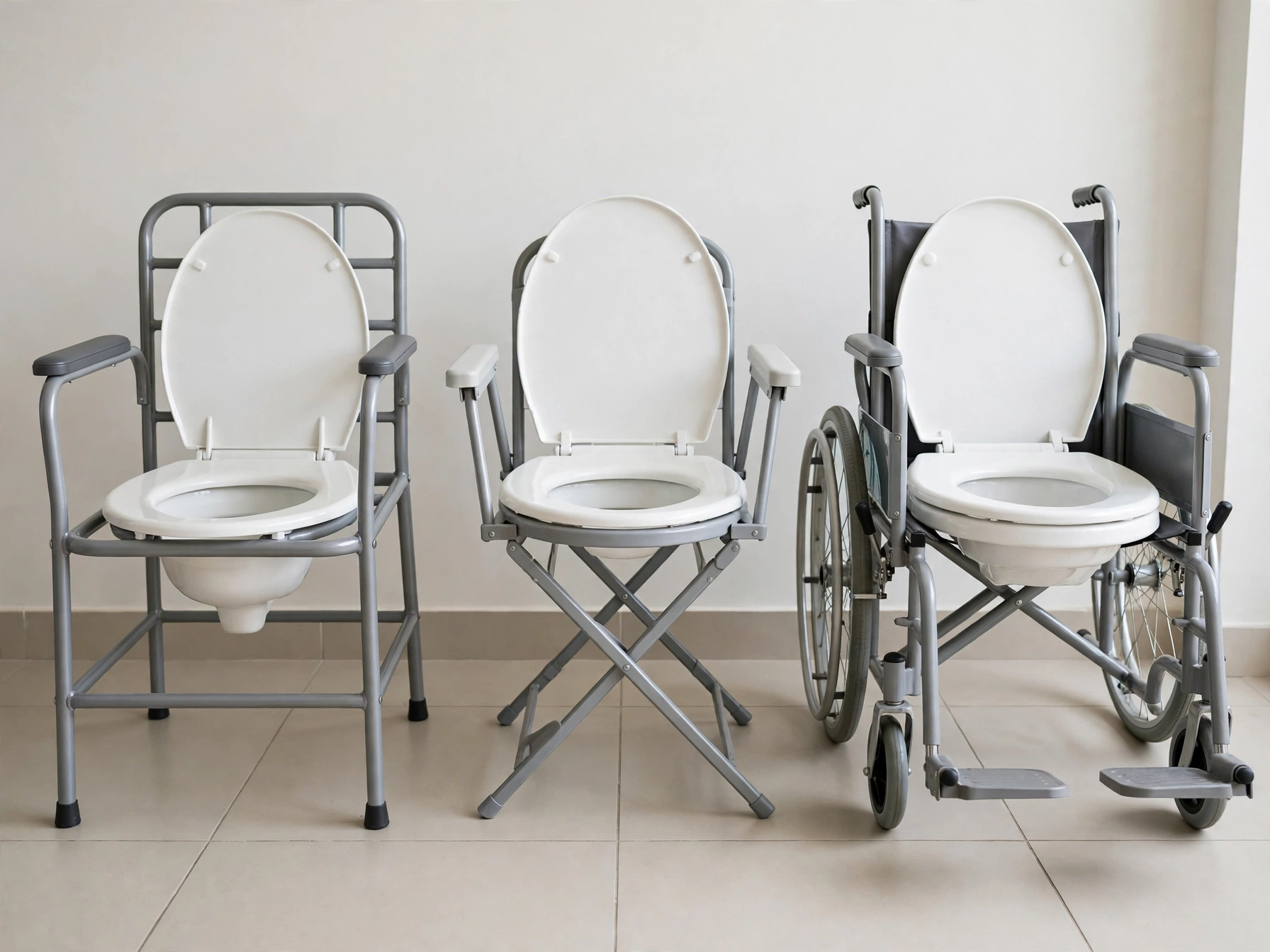
A commode chair is a sturdy chair with a toilet seat opening and a removable bucket underneath, so a person who cannot safely reach the bathroom can pass urine or open the bowels next to the bed, then be helped back without a long walk. It is used at home by elderly people at risk of falling at night, patients recovering from a hip or knee replacement, a fracture or other surgery, people after a stroke or living with Parkinson’s disease, and anyone who is weak, disabled or mostly bedridden. The main types are a fixed or static frame, a folding commode that packs away, a wheeled commode (often called a commode wheelchair or shower commode) that can be pushed to the bathroom, a 3-in-1 bedside commode that also works as a raised seat over a western toilet, a drop-arm commode for sideways transfers, and a wide bariatric model for heavier users. Choose by the user’s weight, a seat height that lets their feet rest flat, the width of your doorways, and whether they need armrests, a backrest and brakes. Always lock the wheels before any transfer, keep the floor dry, and clean the bucket with gloves after every use.
In most Pakistani homes the bathroom is not next to the bedroom. It may be across a courtyard, down a corridor, up a step, or fitted with an Indian-style squat toilet that an elderly or post-operative patient cannot use. At night, in the dark or during load shedding, that short walk becomes the riskiest part of the day. According to the World Health Organization, falls are the second leading cause of unintentional injury deaths worldwide, about 684,000 people die from falls each year, over 80% of those deaths happen in low and middle income countries, and adults older than 60 suffer the most fatal falls. A commode chair beside the bed removes the walk entirely.
This guide explains what a commode chair is, the types and how they differ, who needs which type, what to measure before you buy, a safe way to move a patient from bed to commode, how to keep it clean, and the mistakes families most often make. You can see the commodes, walkers and wheelchairs we carry in our physiotherapy and rehabilitation range.
What a Commode Chair Is and How It Works
A commode chair is a portable toilet in the shape of a chair. The frame is usually chrome plated or coated steel, or aluminium, on four legs or four wheels. The seat has a toilet-shaped opening, and a plastic bucket with a lid slides in underneath. Many chairs also have a solid cover that drops over the opening, so the commode works as an ordinary chair between uses. Armrests give the user something to push on when sitting and standing, and a backrest stops a weak patient from slumping.
It needs no plumbing. Parkinson’s UK describes a commode simply as a moveable toilet that does not use running water, which is why it suits homes where the bathroom is far away or unsuitable. After use, the bucket is lifted out, emptied into the toilet, cleaned and put back.
A commode is not the same as a bedpan. A bedpan is used lying down, which is uncomfortable, messy, and works against the body’s natural position for emptying the bowel. A commode lets the patient sit upright with feet on the floor, which is more natural and more dignified, and getting out of bed helps recovery. Bedpans are kept for patients who cannot sit up at all.
Types of Commode Chair Compared
There is no single best commode chair. The right type depends on how much the patient can do, the layout of your home, and whether the commode stays in one room or moves around.
|
Type |
What it looks like |
Best for |
Limits |
|
Static or fixed commode |
Four fixed legs, seat with opening, bucket, arms and backrest |
Patients who can stand and pivot with a little help |
Cannot be moved with the patient on it |
|
Folding commode |
Like the static type, but the frame folds flat; often height adjustable |
Small rooms, temporary use after surgery, storage |
Must lock firmly when open |
|
Wheeled commode (commode wheelchair or shower commode) |
Wheelchair-style frame with castors or large rear wheels and a commode seat |
Patients who cannot walk; pushed to the bathroom, over a western toilet or into a shower |
Heavier and wider; needs working brakes and wide doors |
|
3-in-1 bedside commode |
Frame whose bucket comes out so it can stand over a toilet as a raised seat with arms |
Hip or knee replacement patients who must not sit low |
Does not fit over a floor-level squat toilet |
|
Drop-arm commode |
One or both armrests swing down or lift away |
Sideways transfers with a slide board or two carers |
Arms must click back firmly |
|
Bariatric commode |
Wider seat, heavier frame |
Users above a standard chair’s weight limit |
Large and harder to fit in small bathrooms |
Always read the weight limit on the actual chair. As a guide from the international market, many standard steel drop-arm commodes sold in the United States are rated for 300 pounds, about 136 kg, and AliMed, an American hospital equipment supplier, states that most bariatric commodes are rated between 400 and 1,000 pounds, about 180 to 450 kg. An overloaded chair can bend or tip during a transfer, the moment the patient is least stable.
The Pakistani bathroom problem: squat and western toilets
Many homes in Pakistan have a floor-level squat toilet, sometimes with one western toilet in the main bathroom. A patient after a hip replacement, stroke or fracture often cannot squat and should not try. There are three practical answers. Use a static or folding commode with its bucket in the bedroom and empty the bucket into the squat toilet, which works in any home. Where there is a western toilet, place a 3-in-1 commode over it without the bucket so the patient sits higher with arms to push on. Or push a wheeled commode over the western toilet so no second transfer is needed. A commode frame standing over a floor-level squat pan is not stable, so the bucket method is safer.
Who Needs a Commode Chair?
Families often buy one only after the first fall. It is better to think about it as soon as the walk to the bathroom becomes slow, unsteady or painful, especially at night.
Elderly people who get up at night. Passing urine at night, called nocturia, is common in older age and is linked with falls. A 2017 study of more than 92,000 Korean men published in PLoS ONE found that the odds of a slip or fall rose with the number of times a man got up at night, to about double for those who got up three or more times, compared with men who did not get up at all.
After hip or knee replacement and fractures. After a total hip replacement, NHS hospital leaflets such as the one from Alder Hey advise patients not to bend the hip past 90 degrees for about 12 weeks, because the new joint can dislocate, and note that a raised toilet seat may be needed. A low or squat toilet breaks that rule every time; a 3-in-1 or height-adjustable commode solves it. Follow your own surgeon’s and physiotherapist’s instructions.
After a stroke. Continence New Zealand, a national continence charity, says difficulty with bladder control is common after a stroke and suggests keeping a commode or portable urinal beside the bed at night, with a physiotherapist teaching the patient how to get on and off safely.
Parkinson’s disease. Parkinson’s UK explains that many people with Parkinson’s need to pass urine more than once or twice at night, may have sudden urgency, and may find it harder to reach the toilet in time when medication has worn off overnight.
Bedridden, weak or disabled patients, and doctor-advised bed rest. People recovering from long illness, breathless heart or lung patients, cancer patients during treatment, and people with long-term disability can use a commode to stay off a bedpan. Where a doctor has told a pregnant woman or a post-operative patient to stay mostly in bed, a commode keeps toileting close, but how much a person should get up is the doctor’s decision.
The decision table below is a starting point, not a substitute for advice from the treating doctor or physiotherapist.
|
Patient situation |
What they can do |
Type that usually suits |
Extra to consider |
|
Elderly, slow walker, up at night |
Stands and walks a few steps |
Static or folding commode beside the bed |
Night light, lid on bucket |
|
After hip replacement |
Stands with a walker, must not bend low |
3-in-1 or height-adjustable folding commode |
Seat high enough that hips stay above knees |
|
After knee replacement or leg fracture |
Stands on one leg with support |
Static commode with firm arms |
Walker beside the commode |
|
After stroke with one-sided weakness |
Stands and pivots with one helper |
Static commode, or drop-arm on the weak side |
Place commode on the strong side |
|
Cannot stand at all |
Moved by carers |
Wheeled commode with brakes, or drop-arm with slide board |
Two carers until trained |
|
Needs to shower too |
Sits but cannot stand in the shower |
Wheeled shower commode |
Rust-resistant frame |
How to Choose a Commode Chair: What to Measure Before You Buy
A commode that is too low, too narrow or too wide for your doors ends up unused in a corner. Measure before you buy, ideally with the patient seated in a normal chair.
|
What to check |
How to measure or test |
What you want |
|
Weight capacity |
Weigh the patient or use a recent hospital weight |
Rated capacity comfortably above their weight |
|
Seat height |
Seated, measure from the back of the knee to the floor, with shoes on |
Feet flat and knees roughly level with hips; higher after hip surgery |
|
Seat width |
Measure across the hips when seated and add a few centimetres |
Patient sits between the arms without pressing on them |
|
Doorways |
Measure every door the commode must pass and the gap beside the bed |
Commode narrower than the narrowest door |
|
Armrests and backrest |
Watch the patient push up from a chair and sit for 10 minutes |
Firm arms to push on; backrest if they slump |
|
Brakes |
Push the chair with brakes on |
No movement at all |
|
Bucket and lid |
Lift the bucket out and in |
Tight lid, smooth inside, handle, one-hand removal |
|
Frame and seat |
Check welds, folding lock and seat surface |
Rust-resistant frame that locks open; wipeable seat without cracks |
The Royal Marsden Manual of Clinical Nursing Procedures, a standard UK nursing reference, says a seated patient’s feet should be directly under the knees, flat on the floor or footplates, using a footstool or pillows if needed. That is the simplest test of seat height. Dangling feet make the patient slide forward; knees far above the hips make standing up hard.
Commode chairs on our store
On our own store at the time of writing (October 2026), we carry two commode chairs with listed prices. The KY 894 Folding Commode Chair is Rs 10,500, with a chrome plated steel frame, fixed armrests, detachable seat, adjustable height and folding frame, which suits a small room, temporary use after surgery, or a patient whose seat height needs setting. The Commode Wheel Chair KY 608 is Rs 30,000: a wheelchair with a commode seat, chrome plated steel frame, fixed armrests and leg rests, front PVC castors and 24 inch solid spoke rear wheels, for patients who cannot walk and need moving around the house. Both are listed as made in China. Our rehabilitation range also has patient walkers from Rs 5,500 and wheelchairs from Rs 18,500, which many families buy alongside a commode after hospital discharge. Check the listing for current stock and price.
Commode Chairs We Stock
Two commode chairs for home use: a folding commode for a small room or temporary use after surgery, and a wheeled commode for patients who cannot walk.


Safe Transfer: Moving a Patient from Bed to Commode
Most injuries around a commode happen during the transfer, not while sitting. The Royal Marsden Manual’s procedure starts by checking the patient’s weight is within the commode’s limit, explaining what will happen, washing hands and putting on gloves and an apron, ensuring privacy, removing the commode cover and putting the brakes on before the patient moves. The table below adapts this for a family carer, for a patient who can stand and pivot with help.
|
Step |
What to do |
Why it matters |
|
1. Position |
Commode right beside the bed, on the patient’s stronger side, angled slightly toward the head of the bed |
A short pivot is safer than a long step |
|
2. Lock and prepare |
Brakes on, seat cover and bucket lid off, bucket in place |
An unlocked wheel can roll away as they sit |
|
3. Sit up |
Help them sit on the edge of the bed, feet flat; wait a minute |
Dizziness on sitting up is common |
|
4. Stand |
Feet apart, hands pushing on the bed; stand on a count of three while you steady the hips |
Pulling on arms or neck injures both of you |
|
5. Turn |
Small steps until the backs of the legs touch the seat |
Avoids twisting the hip or knee |
|
6. Sit |
Reach back for both armrests and lower slowly |
Controls the descent |
|
7. Settle |
Feet under knees, knees covered with a sheet, tissue and a bell or phone within reach |
Privacy helps the bladder and bowel relax |
|
8. Stay close |
Wait outside the curtain if stable; stay with them if not |
An unstable patient can tip forward |
|
9. Return |
Help wipe front to back, wash hands, reverse the steps |
Prevents infection and falls on the way back |

If the patient cannot bear weight, do not lift them alone. Use a drop-arm commode with a slide board or a second carer, and ask the hospital physiotherapist to show you a safe method before discharge. Lifting alone can injure the carer as well as the patient.
Privacy and dignity. Using a commode in a shared bedroom is hard for many people, and some elderly parents may avoid drinking water in the evening to avoid it, which risks dehydration and urine infection. Use a curtain or screen, close the door, cover the knees, and step out if safe. In joint family homes, cover or remove the commode after each use and air the room. Keep a night light or rechargeable lamp on for load shedding, and a walker within reach.
Cleaning the Commode and Caring for the Skin
A commode handled carelessly spreads germs that cause diarrhoea and urine infections. Commode cleaning guidance for home care staff from Infection Prevention Control, a UK infection prevention service, uses two steps: clean with a neutral detergent and warm water, then disinfect with a chlorine-based disinfectant at 1,000 parts per million or the manufacturer’s stated strength, using disposable cloths, gloves and an apron. Work from the top down: backrest and arms, both sides of the lid, both sides of the seat, then frame, legs and wheels. In Pakistan, household bleach diluted as the label says is the usual chlorine disinfectant; never mix it with acid toilet cleaners.
|
When |
Task |
How |
|
After every use |
Empty and clean the bucket |
Gloves on; empty into the toilet, rinse, detergent, then disinfectant; lid back on |
|
After every use |
Wipe the seat and wash hands |
Detergent then disinfectant, including under the seat edge; soap and water for patient and carer |
|
Daily |
Full wipe of the chair |
Top to bottom: back, arms, lid, seat, frame, legs, wheels |
|
Weekly |
Safety check |
Loose bolts, rust, cracked seat, slipping brakes, scratched bucket |
|
During diarrhoea or infection |
Clean more often |
Commode for that patient only; disinfect after every use |
The same guidance says to replace a commode pan that is scratched, stained or has a rusted handle, because scratches hold germs that cleaning cannot reach.
Skin care. After each use, clean the skin gently from front to back and dry it well. The Royal Marsden Manual suggests a little barrier cream where appropriate and advises against talcum powder. A commode seat is not made for long sitting, so keep each sitting to the time needed. Patients who need a commode often spend long hours in bed and are at risk of pressure sores; if you see redness that does not fade or broken skin, speak to a doctor or nurse, and read our guide to choosing an air mattress for bed sores. For leaks between commode visits, adult diapers from our diaper and pants range can keep the bed dry at night, but they should not replace the commode when the patient can manage it.
Common Mistakes to Avoid
|
Mistake |
What can happen |
Do this instead |
|
Wheels not locked |
Commode rolls back and the patient falls |
Brakes on every time; push to test first |
|
Wet floor, loose rugs, chappals |
Feet slide during the turn |
Dry floor, no loose rugs, closed shoes or non-slip socks |
|
Commode too far from the bed |
Extra unsteady steps in the dark |
Right beside the bed on the strong side, with a night light |
|
Seat too low after hip surgery |
Hip bends past the safe angle |
Higher seat as advised by the surgeon or physiotherapist |
|
Leaving an unsteady patient alone |
Patient tips forward or stands unaided |
Stay within reach until they are proven safe alone |
|
Lifting the patient by the arms |
Shoulder injury for them, back injury for you |
Patient pushes up from the bed; you steady the hips |
|
Ignoring the weight limit |
Frame bends or tips |
Rated well above the patient’s weight; bariatric if needed |
|
Poor bucket cleaning |
Smell, germs, urine and stomach infections |
Detergent then disinfectant after every use, with gloves |
Some problems need a doctor, not a better commode. New confusion, sudden weakness of the face, arm or leg, or new trouble speaking can mean a stroke and need emergency care; call Rescue 1122 where the service operates. Burning on passing urine, fever, blood in the urine, or suddenly needing to go far more often can be a urine infection, which is common in older patients and needs treatment.
Frequently Asked Questions
What is a commode chair used for?
A commode chair is used as a toilet next to the bed, or over an existing toilet, by people who cannot safely walk to the bathroom or use a low or squat toilet. It has a seat with an opening and a removable bucket, so the patient can sit upright to pass urine or open the bowels, then be helped back to bed.
Who needs a commode chair at home?
Elderly people who get up at night and risk falling, patients after hip or knee replacement or a fracture, people after a stroke or with Parkinson’s disease, and anyone weak, disabled or mostly bedridden. If the walk to the bathroom is slow, painful or unsteady, especially at night, a commode is worth considering before the first fall.
What is the difference between a commode chair and a commode wheelchair?
A standard commode chair has fixed legs and stays beside the bed. A commode wheelchair has wheels and brakes, so a patient who cannot walk can be pushed to the bathroom, over a western toilet or into a shower while seated. It is heavier and wider, so measure your door widths before buying one.
Can a commode chair be used with an Indian-style squat toilet?
Not directly over the squat pan, because the frame will not stand stably over a floor-level toilet. Use the commode with its bucket in the bedroom and empty the bucket into the squat toilet. Where the home has a western toilet, a 3-in-1 or wheeled commode can be placed over it instead.
How do I clean a commode chair bucket?
Wear disposable gloves, empty the bucket into the toilet and rinse it. Wash it with detergent and warm water, then disinfect it with a chlorine-based disinfectant such as diluted bleach, following the label. Wipe the seat the same way, wash your hands with soap, and replace the bucket if it becomes scratched or stained.
