- Your cart is empty
- Continue Shopping


What Is a Defibrillator Used For? AED vs Manual Defibrillator Explained
Quick Answer
A defibrillator is used to treat sudden cardiac arrest caused by two specific electrical rhythms, ventricular fibrillation and pulseless ventricular tachycardia, in which the heart quivers or races uselessly instead of pumping. It delivers a controlled electric shock through pads on the chest that stops the chaotic electrical activity for an instant so the heart’s own pacemaker can restart a normal beat. It does not “restart a stopped heart”: a heart with no electrical activity at all (asystole) or with organised electrical activity but no pulse (PEA) cannot be shocked, and is treated with CPR and drugs instead. Speed is everything, because the chance of survival falls by roughly 7 to 10% for every minute that passes without defibrillation. An automated external defibrillator (AED) analyses the rhythm itself, decides whether a shock is needed, and talks the rescuer through every step, so a bystander with no medical training can use one; a manual defibrillator shows the ECG and leaves the diagnosis, the energy setting and the timing to a trained clinician, and adds synchronised cardioversion and external pacing for the hospital setting. For a school, office, mosque, factory, gym or ambulance, the AED is the right device; for an emergency department, ICU or cardiac unit, the manual defibrillator is.
Most people in Pakistan have seen a defibrillator only in films, where a doctor shouts “clear,” the patient’s body jolts, and the flat line on the monitor springs back to life. Almost everything in that scene is wrong, and the misunderstanding matters, because it leads institutions to think of a defibrillator as a hospital machine for doctors rather than as a first aid device that belongs next to the fire extinguisher. Sudden cardiac arrest kills within minutes, usually before an ambulance can arrive, and in the countries that have placed AEDs in public spaces and taught ordinary people to use them, survival in those spaces has risen from under 10% to as high as 49 to 75%.
This guide explains what a defibrillator actually does and the rhythms it can and cannot treat, the difference between a cardiac arrest and a heart attack, how an AED works and how to use one together with CPR, how an AED differs from the manual defibrillators used in hospitals, the rules for children, what maintenance a defibrillator needs so that it works on the day, and the prices of the units on our store. If you are responsible for safety at a school, workplace or clinic, this is written for you.
What Defibrillation Does, and What It Cannot Do
The heart beats because an electrical signal spreads through its muscle in an orderly wave about once a second. In ventricular fibrillation, the commonest rhythm at the moment of collapse in adults, that signal breaks into hundreds of tiny uncoordinated wavelets and the heart muscle quivers like a bag of worms, pumping nothing. In pulseless ventricular tachycardia, the lower chambers beat so fast that they never fill, and again nothing is pumped. In both, the person collapses, stops breathing normally and has no pulse within seconds. A defibrillator shock passes a large current across the heart for a few milliseconds, depolarising all the muscle cells at once; the chaos stops, and in the brief silence that follows, the heart’s natural pacemaker has the chance to take over and restore a coordinated beat. That is the entire mechanism, and it only works while the heart is still electrically active in one of those two ways.
| Rhythm at collapse | What the heart is doing | Shockable? | Treatment |
| Ventricular fibrillation (VF) | Quivering chaotically, no pumping | Yes | Immediate defibrillation plus CPR |
| Pulseless ventricular tachycardia (pVT) | Beating far too fast to fill or pump | Yes | Immediate defibrillation plus CPR |
| Asystole (“flat line”) | No electrical activity at all | No | CPR, adrenaline, treat the cause; a shock does nothing |
| Pulseless electrical activity (PEA) | Organised electrical signal but the muscle is not pumping | No | CPR, adrenaline, treat the cause |
The share of people in a shockable rhythm falls with every minute after collapse, as VF degenerates into asystole, which is the second reason speed matters: a defibrillator that arrives at twelve minutes often finds nothing left to shock. CPR, chest compressions at 100 to 120 per minute pressed 5 to 6 cm deep, keeps some blood flowing to the heart and brain and keeps the rhythm shockable for longer, which is why CPR and the AED are always taught together and never as alternatives. The European Resuscitation Council and Resuscitation Council UK state that bystander CPR with an AED increases the chance of survival two to four fold.
A cardiac arrest is not a heart attack, although a heart attack can cause one. A heart attack is a blocked coronary artery; the person is usually conscious, in pain, and needs a hospital urgently but is not dead. A cardiac arrest is the heart stopping as an effective pump; the person is unconscious, not breathing normally, and will die within minutes without CPR and, if the rhythm is shockable, a shock. The defibrillator is for the second, not the first; a conscious person with chest pain needs an ambulance and, ideally, a 12-lead ECG, which is a different machine covered in our ECG machine range.
Why Minutes Decide Survival
| Time from collapse to first shock | Approximate chance of survival | Context |
| Within 1 to 3 minutes | Up to 70% or more in witnessed VF arrests with bystander CPR | Achieved in casinos, airports and aircraft with trained staff and AEDs on site |
| 3 to 5 minutes | Roughly 50 to 70% | Public access AED programmes in ideal settings report 49 to 75% survival |
| Each additional minute without a shock | Survival falls by 7 to 10% | American Heart Association and European Resuscitation Council figures |
| 10 minutes or more | Under 10% | Typical when only the ambulance service treats the arrest; average adult survival is 10 to 12% |
| Overall, all settings | Under 10% | More than 350,000 out-of-hospital arrests a year in North America and 300,000 in Europe |
In Pakistan the ambulance that arrives is Rescue 1122 in Punjab, Khyber Pakhtunkhwa and several other provinces, or Edhi, Chhipa and Aman in Karachi, and response times in dense traffic are rarely under ten minutes. That arithmetic is the whole argument for having a defibrillator on site and people who know where it is: in the first ten minutes, the only rescuer who can reach a collapsed person is someone already in the building.
How an AED Works
An automated external defibrillator is built so that the decision is taken out of the rescuer’s hands. Two adhesive pads with built-in electrodes are stuck to the bare chest, one below the right collarbone and one on the left side below the armpit. Through those pads the AED records the heart’s electrical rhythm and its software compares it to the shockable patterns. If it recognises VF or pVT, it charges and tells the rescuer to press the flashing shock button, or on a fully automatic model delivers the shock itself after a countdown; if it finds a non-shockable rhythm, it refuses to charge and tells the rescuer to continue CPR. The device cannot shock a person who does not need it, and it cannot shock someone with a normal rhythm, which is why it is safe in the hands of a passer-by. Voice prompts, and on many models a screen with pictures, walk the rescuer through every step, including a metronome for compression rate. Modern AEDs deliver a biphasic waveform, current that flows one way and then reverses, which achieves defibrillation at lower energy than the old monophasic machines, typically 120 to 200 joules for an adult depending on the manufacturer, with a fixed or escalating sequence set by the device.
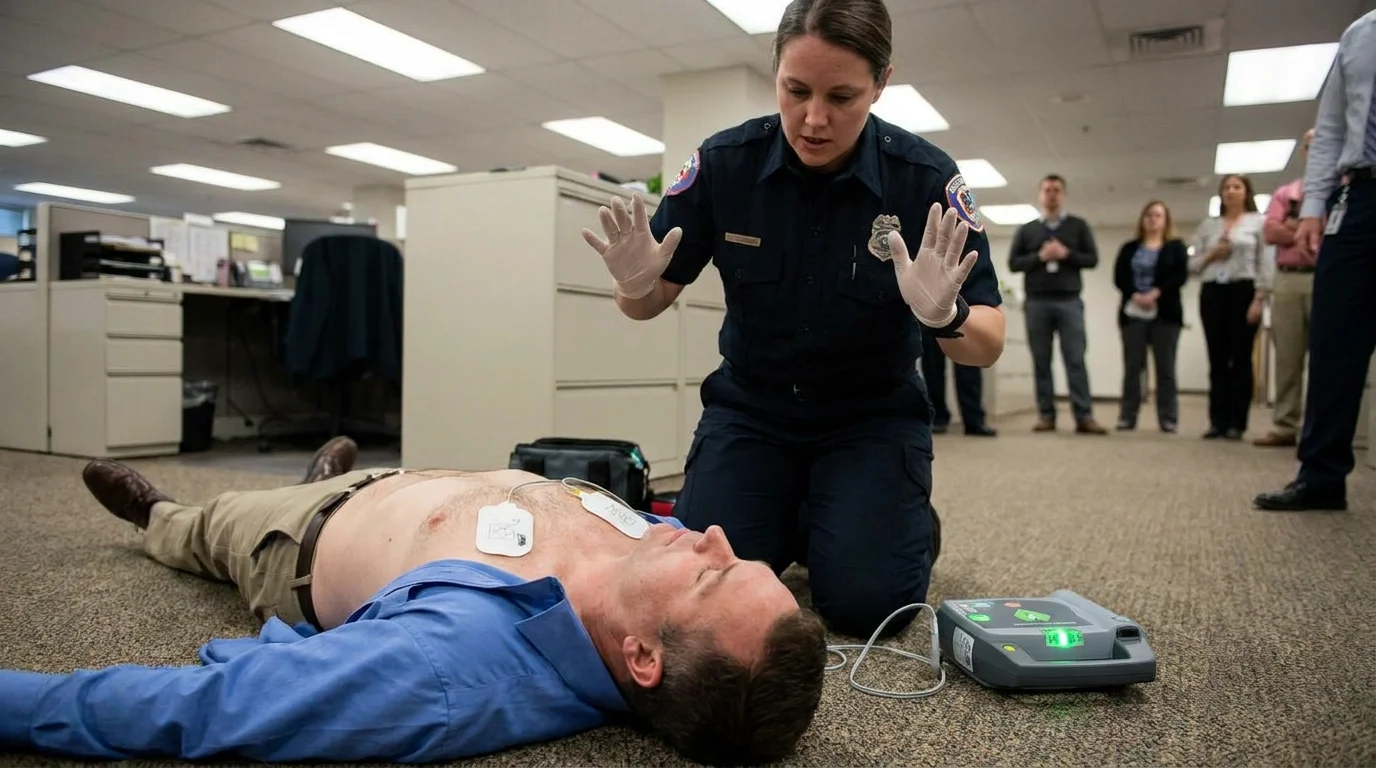
| Step | What to do | Why |
| 1. Check | Shake the shoulders and shout. If unresponsive and not breathing normally (gasping counts as not breathing), this is a cardiac arrest | Agonal gasps are mistaken for breathing in many arrests and delay CPR |
| 2. Call | Shout for help; have someone call 1122 (or Edhi 115 in Karachi) and fetch the AED. If alone, call on speaker and start CPR | Help and the AED must be on their way while you work |
| 3. CPR | Heel of the hand on the centre of the chest, other hand on top, arms straight; press 5 to 6 cm deep at 100 to 120 per minute; let the chest fully recoil; 30 compressions then 2 breaths if trained and willing, otherwise compressions only | Keeps blood moving to the brain and heart and keeps the rhythm shockable |
| 4. Switch on the AED | Open the lid or press the power button; follow the voice prompts | The device starts talking immediately |
| 5. Expose and prepare the chest | Remove or cut clothing; dry a wet chest; shave very thick hair if a razor is in the kit; remove any medicine patch; move pads at least 8 cm from a pacemaker bump | Pads must contact bare dry skin; water or a patch can burn or divert current |
| 6. Apply the pads | Peel and press firmly: one below the right collarbone, one on the left side of the chest below the armpit, as the pictures on the pads show. Plug in the connector if not pre-connected | Current must pass across the heart |
| 7. Analyse | “Stand clear”: nobody touches the patient while the AED analyses | Movement confuses the analysis |
| 8. Shock if advised | Check nobody is touching, say “clear,” press the shock button when it flashes (automatic models shock themselves) | A rescuer touching the patient will receive part of the shock |
| 9. Resume CPR at once | Start compressions immediately after the shock, without checking for a pulse, for 2 minutes until the AED analyses again | The heart often needs CPR for a minute or two after a shock before it pumps well |
| 10. Continue | Keep cycling until the person moves, breathes normally, or the ambulance crew takes over. Leave the pads on | The rhythm can recur; the AED will advise again if needed |
AED vs Manual Defibrillator
| Feature | AED (automated external defibrillator) | Manual defibrillator |
| Who uses it | Anyone: bystanders, teachers, security guards, office staff, with or without training | Doctors, nurses and paramedics trained in advanced life support |
| Rhythm analysis | The device analyses and decides; the user cannot override it | The clinician reads the ECG on the screen and decides |
| Energy setting | Fixed or escalating, preset by the manufacturer; typically 120 to 200 J biphasic for adults | Selected by the operator from about 2 J to 360 J, including weight-based paediatric doses |
| Shock delivery | Semi-automatic (press the button when told) or fully automatic | Operator charges and discharges; paddles or hands-free pads |
| Synchronised cardioversion (timed shock for a patient with a pulse but a dangerous fast rhythm) | No | Yes |
| External pacing (electrical pacing of a dangerously slow heart) | No | Yes, on most models |
| Monitoring | Rhythm analysis only; some record the event for later download | Continuous ECG display, often with SpO2, blood pressure and end-tidal CO2 |
| Speed in untrained hands | Fastest; the device gives the instructions | Dangerous; the user must know rhythms |
| Where it belongs | Public places, schools, offices, mosques, gyms, factories, clinics, ambulances, homes of high-risk patients | Emergency departments, ICUs, cardiac units, operating theatres, advanced ambulances |
| Maintenance | Self-tests daily; battery and pads replaced on schedule; a status indicator shows readiness | Regular biomedical servicing, battery checks, calibration, paddle gel or pad stock |
| Price on our store (October 2026) | Rs 250,000 to 475,000 | Rs 1,250,000 to 1,750,000 |
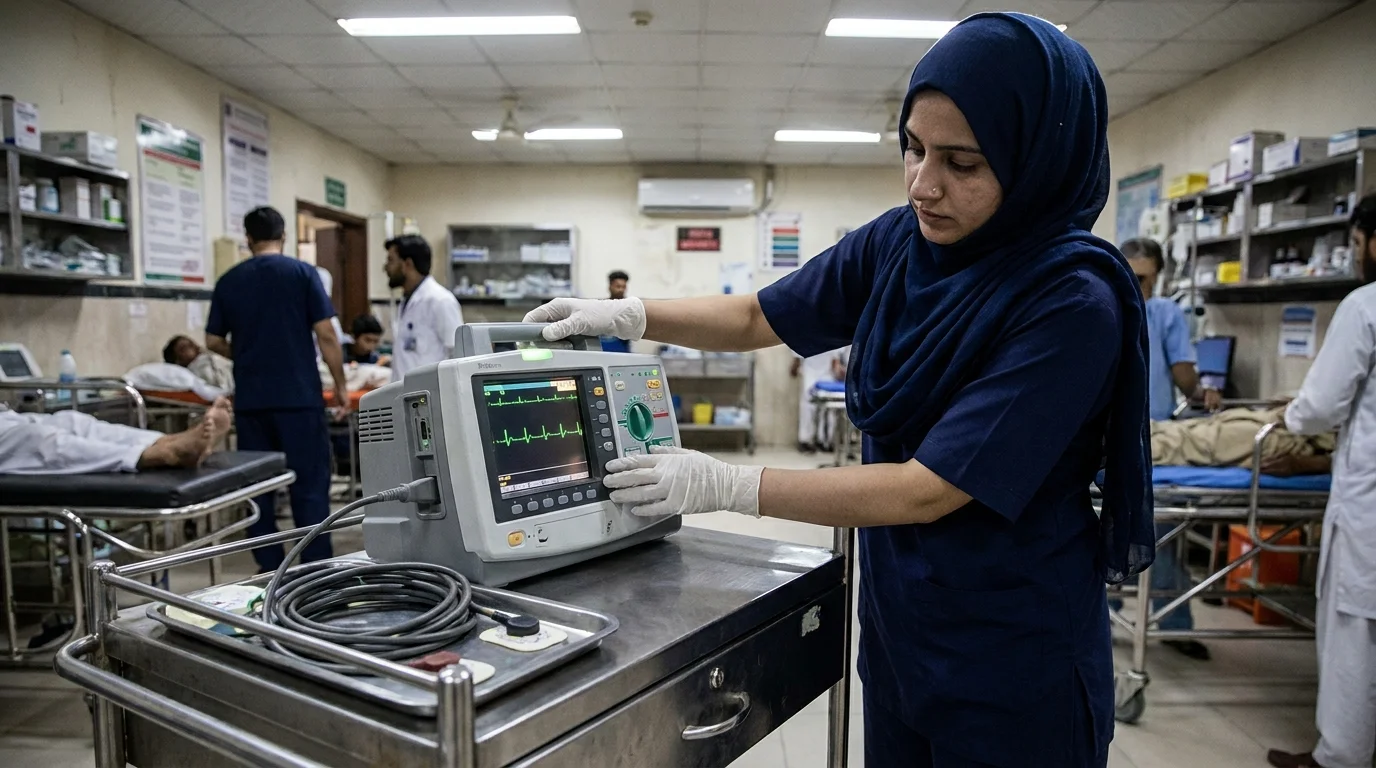
Hospitals increasingly want both. A manual defibrillator with monitoring sits on the crash trolley in the emergency department, while AEDs are mounted in the outpatient waiting area, the car park and the administrative block, where a collapse is just as likely and a trained team may be minutes away. Many manual defibrillators, including the Schiller units we stock, also have an AED mode so that a junior nurse or a ward attendant can use the same machine safely until the doctor arrives.
Children and Infants
Cardiac arrest in children is less often caused by a shockable rhythm, because children’s arrests usually follow breathing problems or drowning rather than a primary heart rhythm disturbance, so CPR with rescue breaths matters even more in a child than in an adult. When the rhythm is shockable, the energy must be lower. The American Heart Association’s rules are these: a child over 8 years, or over about 25 kg, is treated with a standard adult AED and adult pads; a child aged 1 to 8 should have paediatric pads or a paediatric attenuator key, which reduces the energy to around 50 J, and if neither is available the rescuer should use the adult AED and adult pads rather than do nothing, placing one pad on the front of the chest and one on the back so they do not touch; for an infant under 1 year, a manual defibrillator operated by a clinician is preferred, with an AED and paediatric attenuator as the next choice and an adult AED as the last resort. In Pakistani schools, an AED should be bought with a set of paediatric pads and they should be stored in the same case; a Resuscitation Council UK rule worth copying is that compressions in a child are at least one third of the chest depth and never more than 6 cm.
Keeping a Defibrillator Ready
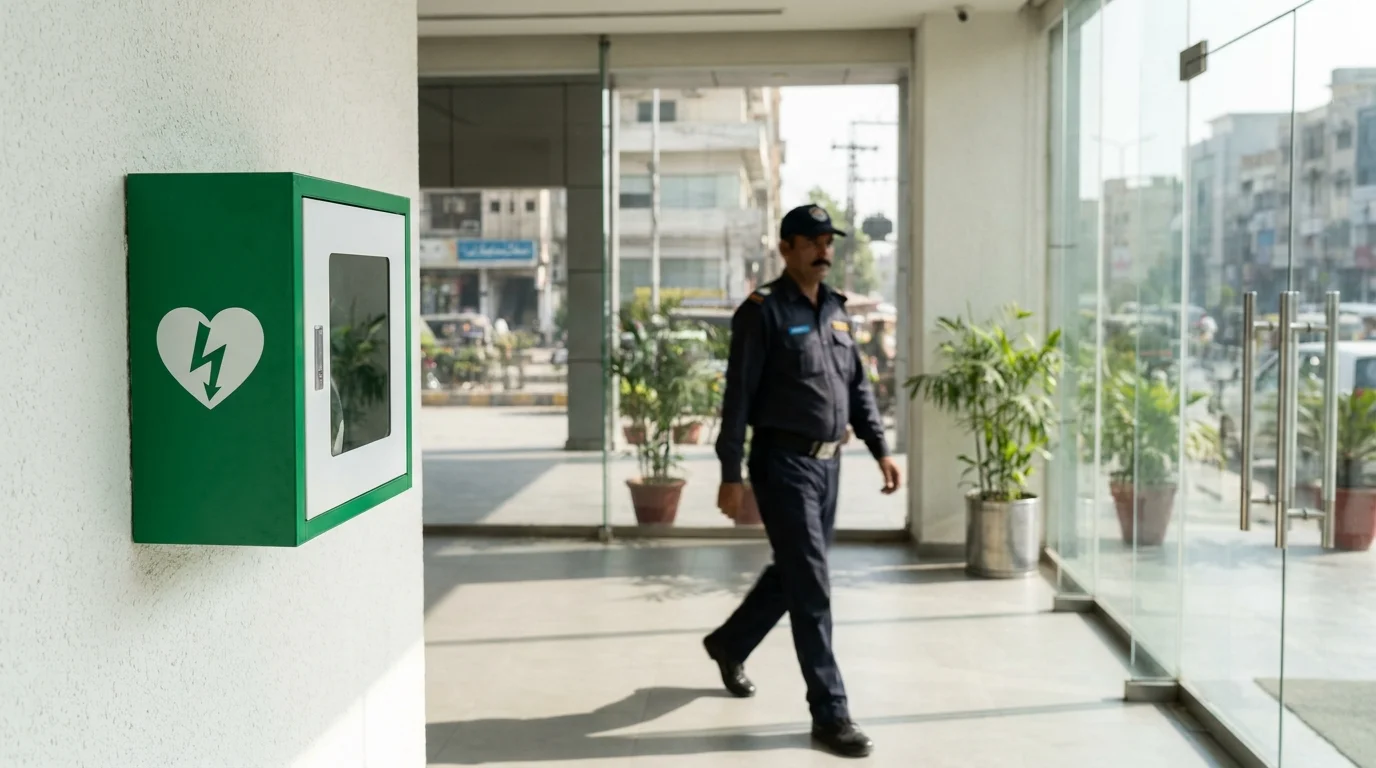
A defibrillator that has sat in a cupboard for five years with a flat battery has saved nobody. Every AED runs a daily self-test and shows the result on a status indicator, usually a green tick or a flashing light; the single most important maintenance task is for one named person to look at that indicator once a week and write it down. AED batteries are non-rechargeable lithium cells with a stated life of about two to five years on standby depending on the model, and they must be replaced at the date on the label whether or not the device has been used. Pads have a gel that dries out, and they carry an expiry date typically two to four years from manufacture; expired pads may fail to stick or to conduct. After any use, both pads and often the battery are replaced. Store the unit between roughly 0 and 50°C, which in Pakistan means not in a car in summer and not in a glass cabinet in direct sun, and keep a small kit with it: a razor, scissors, a towel, gloves and a face shield. Register the location with the building’s security desk and, where the service exists, with the local ambulance control, and put a sign at the door. An AED is also part of a wider first aid provision; our emergency and first aid range covers the rest of the kit.
Defibrillator Prices in Pakistan
On our own store at the time of writing, AEDs are priced from Rs 250,000 for the LE Medical AED 100 to Rs 375,000 for the Mediana AED from Korea and Rs 475,000 for the Schiller PA1 from Switzerland. Manual defibrillators with monitoring start at Rs 1,250,000, and the Schiller Defigard HD 7 is Rs 1,750,000. The gap between the entry and premium AEDs buys a longer-lasting battery, a sturdier case, a louder speaker for noisy environments, event recording, and a brand with a service network in Pakistan, which matters when pads and batteries need replacing in year three. For an institution buying its first unit, the honest advice is to choose the model whose consumables you are sure you can buy locally, place it where it can be reached within three minutes from anywhere in the building, train at least ten staff in CPR and AED use, and check the indicator weekly. The machine is the smaller part of the system.
Defibrillators We Stock
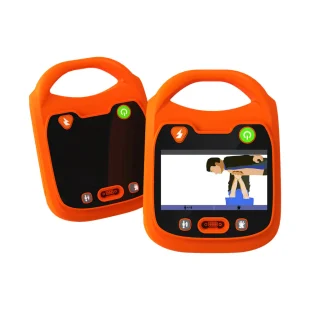
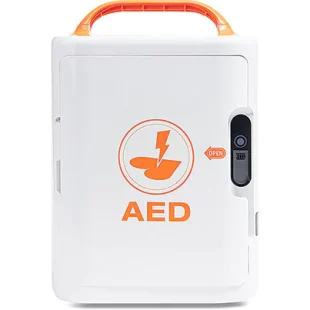
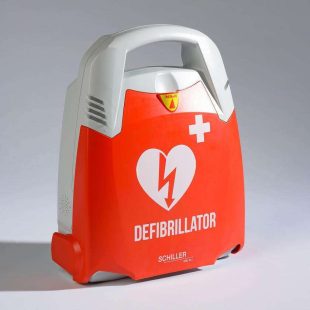
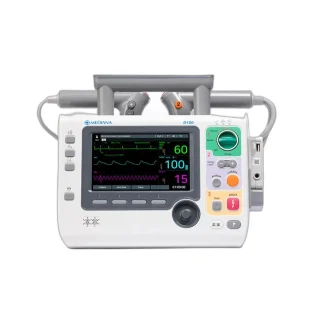
Three AEDs for schools, offices, mosques, factories and clinics, and two manual defibrillators with monitoring for emergency departments and ICUs. Buy a CPR pocket mask to keep in the AED case, and budget for replacement pads every two to four years and a battery every two to five years.
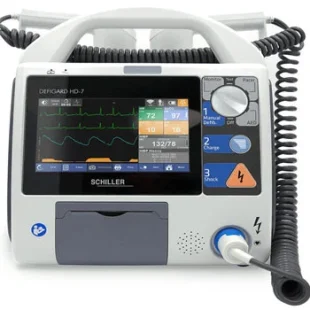
Manual with AED mode, Switzerland
Schiller Defigard HD 7 Defibrillator (Switzerland)
₨ 1,750,000
Add to cart
Frequently Asked Questions
What is a defibrillator used for?
To treat sudden cardiac arrest caused by ventricular fibrillation or pulseless ventricular tachycardia, two rhythms in which the heart quivers or races without pumping. The shock stops the chaotic electrical activity so the heart’s own pacemaker can restart a normal beat. It cannot restart a heart with no electrical activity (asystole), which is treated with CPR and drugs.
What is the difference between an AED and a manual defibrillator?
An AED analyses the rhythm itself, decides whether a shock is needed, and gives voice instructions, so anyone can use it. A manual defibrillator shows the ECG and leaves the diagnosis, energy and timing to a trained clinician, and adds synchronised cardioversion, pacing and monitoring. AEDs belong in public places and clinics; manual units in emergency departments and ICUs.
Can an AED hurt someone who does not need a shock?
No. An AED will only charge if it detects a shockable rhythm; on a normal or non-shockable rhythm it refuses and tells you to continue CPR. The only person at risk is a rescuer touching the patient during a shock, which is why you say “clear” and check before pressing the button.
Can you use an AED on a child?
Yes. Over 8 years or about 25 kg, use the adult pads. From 1 to 8 years, use paediatric pads or an attenuator if available; if not, use the adult AED anyway with one pad on the chest and one on the back. For a baby under 1 year, a manual defibrillator is preferred, then an AED with an attenuator, then an adult AED as a last resort.
How much does a defibrillator cost in Pakistan? On our store, AEDs are Rs 250,000 to 475,000 and manual defibrillators with monitoring Rs 1,250,000 to 1,750,000 at the time of writing. Budget as well for replacement pads every two to four years and a battery every two to five years, and for CPR and AED training for staff, without which the device is far less likely to be used in time.
