- Your cart is empty
- Continue Shopping


Holter Monitor Test: What It Records, How Long You Wear It and What the Results Mean

Quick Answer
A Holter monitor test is a portable ECG that records every heartbeat while you go about your normal life, usually for 24 to 48 hours, and in some cases for up to 7 days according to the NHS. A few sticky electrodes on the chest connect by thin wires to a small recorder about the size of a deck of cards, worn on a belt or a strap. Doctors order it when symptoms come and go, such as palpitations, a fluttering or skipped beat, dizziness or fainting with no clear cause, because a normal ECG in the clinic lasts only a few minutes and often misses them. It can show atrial fibrillation, a heart rate that is too slow or too fast, extra beats and pauses, and it is also used to check whether heart medicines or a pacemaker are working. You keep a diary of what you do and feel so the doctor can match your symptoms to the recording. You must not shower, bathe or swim while wearing a wired monitor, and you should keep away from magnets, metal detectors and electric blankets. Nobody watches the recording live, so chest pain, fainting or severe breathlessness during the test is an emergency.
Many people in Pakistan are told by their doctor, “Aap ko Holter lagwana hai,” and leave the clinic unsure what it is or whether they can bathe, pray, sleep or work with wires on their chest. That confusion can waste a test the family has paid and waited for: electrodes that peel off in the August heat, a blank diary, or a quiet day at home when the symptoms usually come at work. A little preparation makes the result far more useful.
This guide explains what the monitor records and why doctors order it, how it differs from a resting ECG, a patch monitor, an event monitor and an implanted loop recorder, how long you wear it, what happens on the day, how to keep the diary, what you can and cannot do, and how the report is read. A standard resting ECG is a different machine, covered in our ECG machine range, and at the end we describe the Holter systems on our store for clinics and cardiologists.
What a Holter Monitor Test Records and Why Doctors Order It
Your heart beats because an electrical signal travels through its muscle in an orderly wave. A standard ECG draws that signal as a line on paper, but the NHS describes it as lying still for only a few minutes while the machine records. If your palpitations come twice a day, or only when you climb stairs, the chance that one happens during those few minutes is small. The Holter solves this by doing the same job for a whole day and night or longer. Johns Hopkins Medicine notes that the monitor records every heartbeat and reports the minimum, maximum and average heart rate across the recording.
The common reasons a doctor orders a Holter monitor test are set out below. All come from the patient guides of Mayo Clinic, Cleveland Clinic and Johns Hopkins Medicine.
|
Reason for the test |
What the doctor is trying to find out |
|
Palpitations: pounding, fluttering, racing or skipped beats |
Whether the feeling matches a real rhythm problem such as atrial fibrillation, extra beats or a fast rhythm, or whether the rhythm is normal at that moment |
|
Fainting with no known cause |
Whether the heart slows down too much, pauses or races just before the faint |
|
Dizziness or light-headedness that comes and goes |
Whether a slow or fast rhythm is cutting blood flow to the brain |
|
Chest pain or breathlessness that may be rhythm related |
Whether the symptom lines up with a rhythm change or with changes that suggest the heart muscle is short of oxygen |
|
A normal resting ECG that does not explain the symptoms |
Rhythm problems that only appear now and then, or only with activity and stress |
|
Checking heart medicines |
Whether rate or rhythm medicines are controlling the heart through a normal day |
|
Checking a pacemaker |
Whether the pacemaker is pacing and sensing properly |
|
Assessing future risk in certain conditions |
Johns Hopkins lists hypertrophic cardiomyopathy, a weak heart after a heart attack, and Wolff-Parkinson-White syndrome |
Our guide to the normal pulse rate for adults explains how to count your own resting heart rate, which helps you describe symptoms to the doctor.
Holter vs ECG, Patch Monitor, Event Monitor and Loop Recorder
The Holter is one of a family of heart rhythm tests. They differ in how long they record, whether they record all the time or only around a symptom, and whether they sit on the skin or under it. The 2017 expert consensus statement on ambulatory ECG from the International Society for Holter and Noninvasive Electrocardiology and the Heart Rhythm Society puts the rule simply: the frequency of symptoms should decide the type of recording. A standard 24 to 48 hour Holter suits people with palpitations every day, while loop recorders suit people whose symptoms are rare and unpredictable.
|
Test |
How long it records |
How it works |
Best for |
|
Resting ECG |
A few minutes |
Electrodes on the chest, arms and legs while you lie still in the clinic |
Spotting a problem that is present right now, and as the first heart test |
|
Holter monitor |
Usually 24 to 48 hours; the NHS says up to 7 days |
Wired electrodes connected to a small recorder; records every beat continuously |
Symptoms that happen most days, checking medicines or a pacemaker |
|
Patch monitor |
Up to 14 days, according to UCSF Health and the Merck Manual |
A single wire-free adhesive patch on the chest that records continuously |
Symptoms every few days, people who find wires difficult |
|
Event monitor or external loop recorder |
Up to about 30 days, according to UCSF Health |
Worn for weeks; saves the ECG when you press a button during a symptom, and some models save abnormal rhythms automatically |
Symptoms once or twice a week or less |
|
Implantable loop recorder |
Three years or more, according to UCSF Health |
A tiny device placed under the skin of the chest in a minor procedure |
Rare symptoms such as an unexplained faint that happens a few times a year |
The trade-off is detail against time. A Holter captures every beat through a day and night but covers only a day or two; an event monitor or loop recorder covers weeks or years but keeps only short strips. Mayo Clinic notes that if a Holter misses the irregular beat, the next step may be a wireless Holter or an event recorder worn longer.
How Long Do You Wear a Holter Monitor?
For most people the answer is 24 to 48 hours. That is the period given by Cleveland Clinic, MedlinePlus and Johns Hopkins Medicine, and Mayo Clinic describes it as usually one to two days. The NHS adds that it can be up to 7 days, and the Merck Manual says newer patch-style or wire-free Holter devices may be worn for anywhere from 24 hours to 14 days. Your doctor chooses the length based on how often your symptoms happen: daily symptoms suit 24 hours, less frequent ones a longer recording.
The monitor must stay on the whole time, including while you sleep, according to Mayo Clinic. The night matters, because a very slow rate or a pause often happens during sleep. If you wear it for more than 24 hours, the NHS says you may be shown how to disconnect and reconnect it. You will be given a date and time to return it, and analysis starts only once the device is back with the clinic.
On the Day: How the Monitor Is Fitted, Step by Step
The fitting is quick and painless. Here is what usually happens, based on Johns Hopkins Medicine, Mayo Clinic, Cleveland Clinic and MedlinePlus.
|
Step |
What happens |
Why it matters |
|
1. Bathe at home first |
Have a full bath or shower on the morning of the test |
You cannot wet a wired monitor once it is on |
|
2. Wear a loose top and remove jewellery |
A loose kurta or front-opening shirt is easiest; you undress to the waist under a gown |
Loose clothes hide the wires; metal can interfere with the signal |
|
3. Clean the skin |
The technician cleans the spots on the chest and upper belly where the electrodes go |
Oil and sweat stop the electrodes holding firmly |
|
4. Shave or clip chest hair |
Small patches of hair are shaved or clipped under each electrode |
Hair lifts the electrode and causes a noisy recording |
|
5. Attach the electrodes |
Several sticky electrodes, each about the size of a large coin, are placed on the chest and belly and connected by wires to the recorder |
The number and position depend on how many channels the machine records |
|
6. Clip on the recorder |
The recorder goes on a belt, in a pouch around the neck or waist, or on a shoulder strap |
It must stay close to your body |
|
7. Learn the basics |
You are shown how to change the batteries, press down a loose electrode, and fill in the diary |
A loose electrode or flat battery can spoil hours of recording |
|
8. Go back to normal life |
Work, chores, walking and, if your doctor agrees, exercise |
The test is meant to capture your usual day |
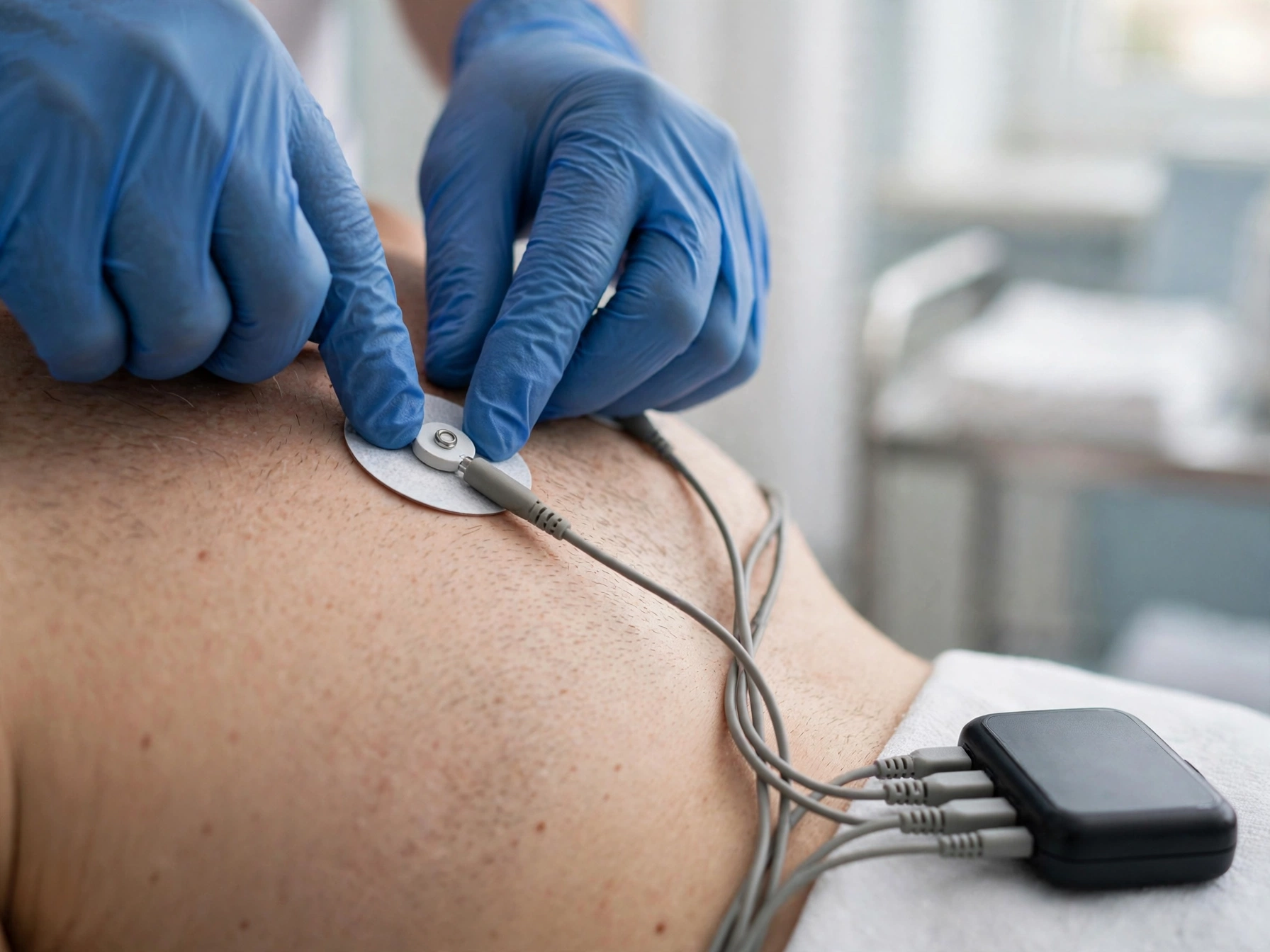
Tell the technician if you are allergic to tape or adhesives, as MedlinePlus and Cleveland Clinic advise, and ask for a few spare electrodes.
The diary is the part most patients take lightly and most doctors care about. Cleveland Clinic and Mayo Clinic both ask you to write down every symptom, the exact time it started, and what you were doing: pounding, fluttering or skipped beats, light-headedness, breathlessness or chest pain. Johns Hopkins Medicine adds the times of ordinary activities too. The recording shows what the heart did; the diary shows what you felt. If you write “4:15 pm, climbing stairs at office, heart racing and dizzy,” the cardiologist can go straight to 4:15 pm. If the rhythm was normal then, that is also useful, because it suggests the symptom is not coming from the heart rhythm. Also note when you slept, woke, ate, took medicines and felt stressed. If your recorder has an event button, press it when a symptom starts and write the time down as well.
Living With the Monitor: What You Can and Cannot Do
The recorder is sensitive to water and to strong electrical or magnetic fields. This table combines advice from Cleveland Clinic, Mayo Clinic, Johns Hopkins Medicine and MedlinePlus.
|
Activity or item |
Allowed? |
Why |
|
Bathing, showering or swimming |
No |
Water damages the recorder and loosens electrodes; Mayo Clinic notes some wireless models may be disconnected for a shower only if you are told how |
|
Wudu and namaz |
Yes, with care |
Pray normally; keep water away from the chest, wires and recorder, and ask your doctor or imam about any doubts |
|
Normal work, walking, stairs and chores |
Yes |
The test should capture your usual day, including the activities that bring on symptoms |
|
Exercise |
Only if your doctor agrees |
Johns Hopkins notes that heavy sweating can loosen the leads |
|
Sleeping |
Yes, with the monitor on |
Night-time rhythm is part of the test; keep the recorder close to your body |
|
Mobile phone |
Yes, but not right next to the recorder |
Mayo Clinic and Johns Hopkins advise keeping phones at least 6 inches, about 15 cm, away |
|
Magnets, electric blankets, electric razors and toothbrushes, microwave ovens |
Avoid |
Listed by Cleveland Clinic, Mayo Clinic and Johns Hopkins as sources of interference |
|
Metal detector gates |
Avoid walking through |
Malls, airports, hospitals and many offices in Pakistan have them; show your monitor to security and ask for a hand search |
|
High-voltage areas and power lines |
Avoid |
Listed by Cleveland Clinic, Johns Hopkins and MedlinePlus |
|
X-rays |
Avoid during the test |
Cleveland Clinic lists them; tell any other doctor that you are wearing a monitor |
Pakistan’s summer brings one problem foreign guides rarely mention: sweat. In the heat, electrodes peel at the edges and a loose one produces hours of unreadable “noise.” Stay in a cool room where you can, press loose edges back down, and replace a fallen electrode with a spare as you were shown. Load shedding does not affect the test, because the recorder runs on its own batteries. Johns Hopkins notes that long wear can irritate or blister the skin; this settles after the electrodes come off, but tell the clinic if it is severe.
Red flags: do not wait for the report. Cleveland Clinic points out that no one watches a Holter recording live; the doctor sees it only days later. If you develop chest pain or pressure, faint or nearly faint, become severely short of breath, feel a racing heartbeat that will not settle, or have new weakness on one side of the body, numbness or slurred speech, treat it as an emergency. Call Rescue 1122, or Edhi on 115 in Karachi, or go to the nearest emergency department straight away, and keep the monitor on so the event is recorded. If someone collapses and is not breathing normally, start CPR; our guide to what a defibrillator is used for explains how an AED helps.
Reading the Report: What Holter Monitor Test Results Show
Once the recorder is returned, software sorts the tens of thousands of beats and flags anything unusual, and a cardiologist or trained technician reviews those sections against your diary and writes the report. Cleveland Clinic says results usually come within a week or two, and the NHS says timing varies and can take a few weeks; if you have not heard after a few weeks, contact the doctor who referred you.
The report uses terms that can look frightening. Here they are in plain words.
|
Term on the report |
What it means in simple words |
Is it usually worrying? |
|
Minimum, maximum and average heart rate |
The slowest, fastest and average rate across the whole recording |
Usually not; MedlinePlus notes that heart rate normally rises with activity and falls with rest and sleep |
|
Sinus rhythm |
The normal rhythm, started by the heart’s own natural pacemaker |
No, this is what you want to see |
|
Sinus bradycardia |
A normal rhythm that is slow |
Often normal during sleep and in fit people; the ISHNE and HRS statement treats a rate below 40 per minute as a possible cause when a patient has symptoms |
|
Ectopic beats (PACs, PVCs, “extra beats”) |
Early beats from the upper (PAC) or lower (PVC) chambers, often felt as a skipped or thumping beat |
Usually not; Cleveland Clinic says PVCs are common, up to 75% of people have them, and they usually are not dangerous; very frequent ones need follow-up |
|
Pauses |
A gap before the next beat |
Depends on how long, when and whether you felt it; the doctor decides |
|
Atrial fibrillation (AF) |
A fast, irregular rhythm from the upper chambers |
Needs medical follow-up, mainly because of stroke risk and heart strain |
|
AF burden |
The share of the recording time spent in AF |
Helps the doctor judge how much AF you have and whether treatment is working |
|
Ventricular tachycardia (VT) runs |
A string of fast beats from the lower chambers |
Needs prompt review by a cardiologist |
|
ST changes |
Changes in one part of the ECG wave |
MedlinePlus notes some changes may mean the heart muscle is not getting enough oxygen; needs review |
|
Artefact or noise |
Unreadable sections caused by loose electrodes or movement |
Not a heart problem, but too much of it can spoil the test |

The computer analysis is only a first draft, and a doctor must check it, because software can mislabel noise as a rhythm problem. A single line on the report also means little on its own: a pause during deep sleep in a fit young person may be normal, while the same pause in someone who faints is important. Only your doctor can put the findings together with your symptoms, diary and examination. According to Cleveland Clinic, next steps can include more tests, medicines, cardioversion, ablation or a pacemaker. Do not start, stop or change any heart medicine because of the report until your doctor has gone through it with you.
Holter Monitors for Clinics and Cardiologists in Pakistan
A Holter system is a clinic tool, not a home gadget. It has two parts: the recorders patients wear, and the analysis software that turns tens of thousands of beats into a report a cardiologist can sign. Fitting, checking and interpreting all need trained staff, so these systems are meant for cardiologists, hospitals and diagnostic centres, not for self-diagnosis at home. Our wider electro-medical equipment range covers the other machines a cardiac clinic needs.
We stock two Contec Medical Holter systems. The details below come from the product pages on our own store at the time of writing (October 2026).
|
Feature |
Contec TLC 9803 |
Contec TLC 5000 |
|
Recording |
3-channel recorder |
12-lead dynamic ECG system |
|
Recording time |
24 hours |
24 hours |
|
Data transfer |
USB 2.0 |
Analysed by PC software |
|
Power |
2 AA batteries |
Not stated on the product page |
|
Analysis highlights |
Standard ambulatory rhythm recording |
Arrhythmia templates including atrial fibrillation, pacemaker analysis for AAI, VVI and DDD pacing, ST segment analysis, heart rate variability |
|
Suited to |
Clinics starting a Holter service, rhythm-focused work |
Cardiology practices that want full 12-lead review and advanced reports |
|
Price on our own store (October 2026) |
Rs 150,000 |
Rs 225,000 |
The Contec TLC 9803 Holter monitor is the simpler 3-channel system. The ISHNE and HRS consensus statement notes that 2-channel and 3-channel formats are standard for rhythm monitoring and that few ambulatory monitors offer full 12-lead capability. The Contec TLC 5000 Holter monitor records 12 leads and its software, according to the product page, adds atrial fibrillation analysis, pacemaker analysis, ST segment analysis and heart rate variability. Before buying, a clinic should check how many recorders its patient load needs, whether the software runs on its computers, the local supply of electrodes, and who will be trained to fit the device and review recordings. Prices can change, so confirm the current figure on the product page when you order.
Holter Monitors We Stock
Two Contec Holter systems for clinics and cardiologists: a simpler 3-channel recorder for starting a rhythm service, and a full 12-lead system with advanced analysis.


Frequently Asked Questions
How long do you wear a Holter monitor?
Usually 24 to 48 hours, according to Cleveland Clinic, MedlinePlus and Mayo Clinic. The NHS says it can be up to 7 days, and patch-style devices may be worn for up to 14 days. You keep it on the whole time, including during sleep, and return it on the date the clinic gives you so the recording can be analysed.
Holter test kya hota hai, and is it painful?
A Holter test is a portable ECG. A few sticky electrodes on the chest connect to a small recorder that records every heartbeat for a day or longer while you live normally. It is not painful. The only common problem is itching or redness under the electrodes, and some people find removing the tape uncomfortable.
Can I shower or take a bath with a Holter monitor?
No. Cleveland Clinic, Mayo Clinic, MedlinePlus and the NHS all say you cannot bathe, shower or swim while wearing a wired monitor, because water damages it. Bathe just before the appointment. Some wireless models can be disconnected for a shower, but only if the clinic shows you how. Keep water away from the chest during wudu.
Can I use my mobile phone during a Holter monitor test?
Yes. Mayo Clinic and Johns Hopkins Medicine advise keeping phones and similar devices at least 6 inches, about 15 cm, away from the recorder, so do not carry the phone in the same pocket or pouch. Avoid magnets, metal detector gates, electric blankets, electric razors and toothbrushes, and standing close to a microwave.
What if my Holter results are normal but I still have symptoms?
A normal result is useful, because it shows the heart rhythm was normal during the time you wore it. But if no symptoms happened while you wore it, the cause may simply have been missed. Mayo Clinic notes your doctor may then suggest a longer wireless Holter, a patch or an event monitor. Report any new or worse symptoms.
