- Your cart is empty
- Continue Shopping


How to Use a Digital BP Apparatus Correctly: Posture, Timing and Mistakes
Quick Answer
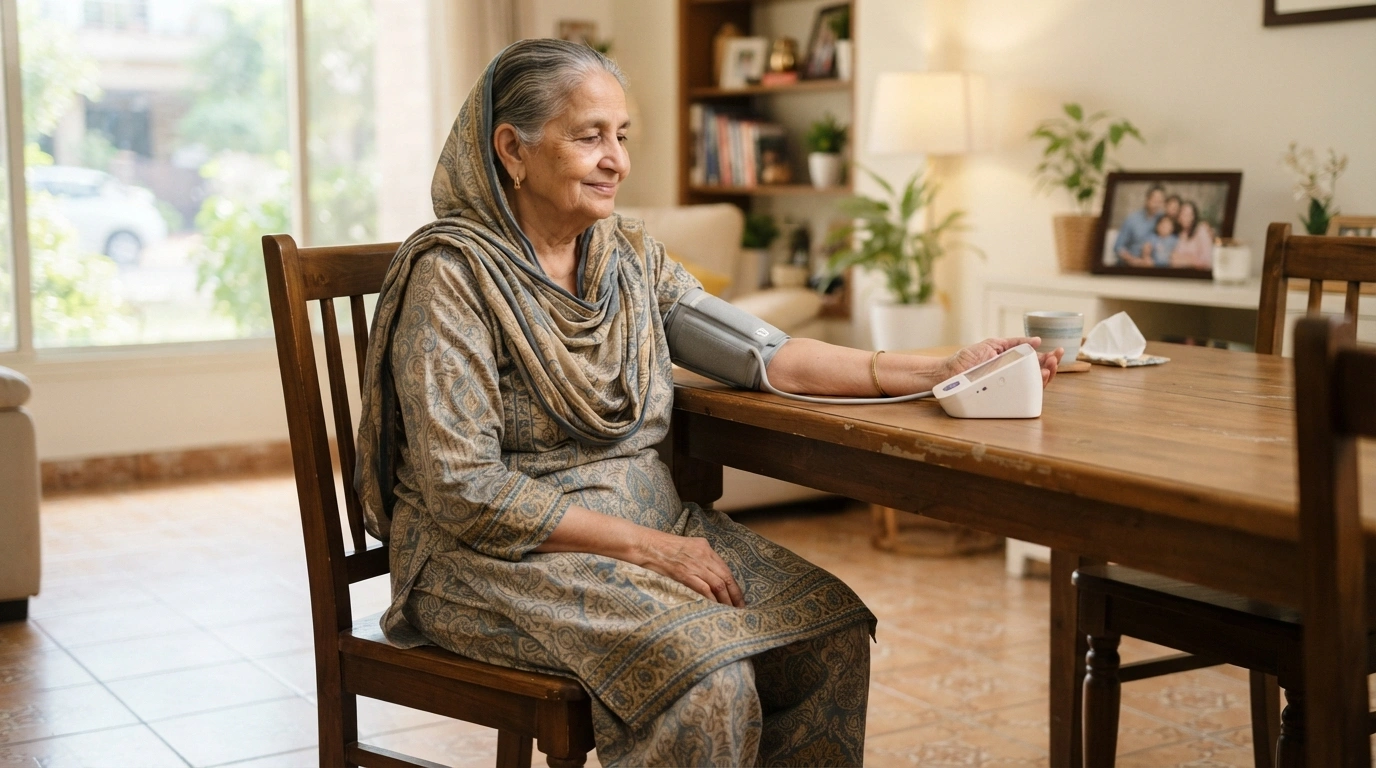
To use a digital BP apparatus correctly, sit quietly for five minutes in a chair with your back supported, both feet flat on the floor, legs uncrossed, and your bare upper arm resting on a table so the cuff sits at the level of your heart. Wrap the cuff snugly on the bare arm with its lower edge 2 to 3 cm above the elbow crease and the tube running down the inside of the arm, press start, and stay still and silent until the reading finishes. Take two readings a minute apart and record the average with the time. The best times are in the morning before medicines, breakfast and tea, and again in the evening before dinner, at the same times each day for at least a week before drawing any conclusion. Almost every “wrong” reading from a digital monitor comes from the person, not the machine: an unsupported arm, a full bladder, talking, crossed legs or a cuff over a sleeve each shift the result, by anything from 2 mmHg to, in the case of a cuff over clothing, as much as 50 mmHg according to the American Heart Association.
Digital blood pressure monitors have made home measurement possible for anyone, and they have also made a particular kind of error universal. Because the machine does the measuring, people assume the only thing they need to do is wrap the cuff and press the button, and so readings are taken standing in the kitchen, sitting on the edge of a bed with the arm hanging down, straight after climbing the stairs, mid-conversation, with a cup of chai in the other hand. The monitor reports each of these with the same confident beep, and the family ends up with a logbook of numbers that swing by 20 mmHg from day to day and a doctor who cannot use any of them.
The monitor itself is rarely the problem. A validated upper-arm digital monitor, the kind stocked in our digital blood pressure monitor range, is accurate to within about 3 mmHg when it is used under the conditions it was tested in, and those conditions are precisely the posture and timing rules that this guide sets out. The technique is not complicated, but it is specific, and each rule exists because breaking it moves the number by a known amount. This guide covers the preparation, the exact posture, cuff placement, the step-by-step measurement, the best time of day, the number of readings needed, and the common mistakes, so that the numbers you bring to your doctor are worth reading.
Before You Press Start
| Preparation | Why it matters | Effect if skipped |
| Rest seated for 5 minutes | Pressure falls to its resting level after activity | Reads high by 5 to 10 mmHg or more |
| Empty your bladder first | A full bladder raises pressure through the nervous system | Reads high by 10 to 15 mmHg |
| No chai, coffee, cigarette, sheesha or naswar for 30 minutes | Caffeine and nicotine constrict vessels | Reads high by 5 to 15 mmHg for up to an hour |
| No exercise, heavy meal or hot bath for 30 minutes | Circulation is still adjusting | Reads high or, after a heavy meal, sometimes low |
| Quiet room, television off, phone down | Noise and conversation raise pressure | Talking adds about 10 mmHg |
| Bare arm; remove or roll a loose sleeve fully off the upper arm | Cloth under the cuff dampens the signal; a rolled tight sleeve acts as a tourniquet | AHA: a cuff over clothing can add 5 to 50 mmHg |
| Right cuff size for your arm | Bladder length should be about 80% of the arm’s circumference and width about 40% (AHA) | A cuff that is too small reads 2 to 10 mmHg high; too large reads low |
| Same arm each time, usually the one that reads higher | Arms can differ by up to 10 mmHg | Inconsistent trend |
The five-minute rest is the rule most often broken and the one that matters most. It is not five minutes of walking to the drawer, finding the monitor and wrapping the cuff; it is five minutes of sitting still in the measuring position, doing nothing, before the button is pressed. In a busy Pakistani household this may be the hardest part of the whole procedure, and the practical solution is to keep the monitor on the table where you will sit, so that the rest and the measurement happen in the same place.
The Correct Posture
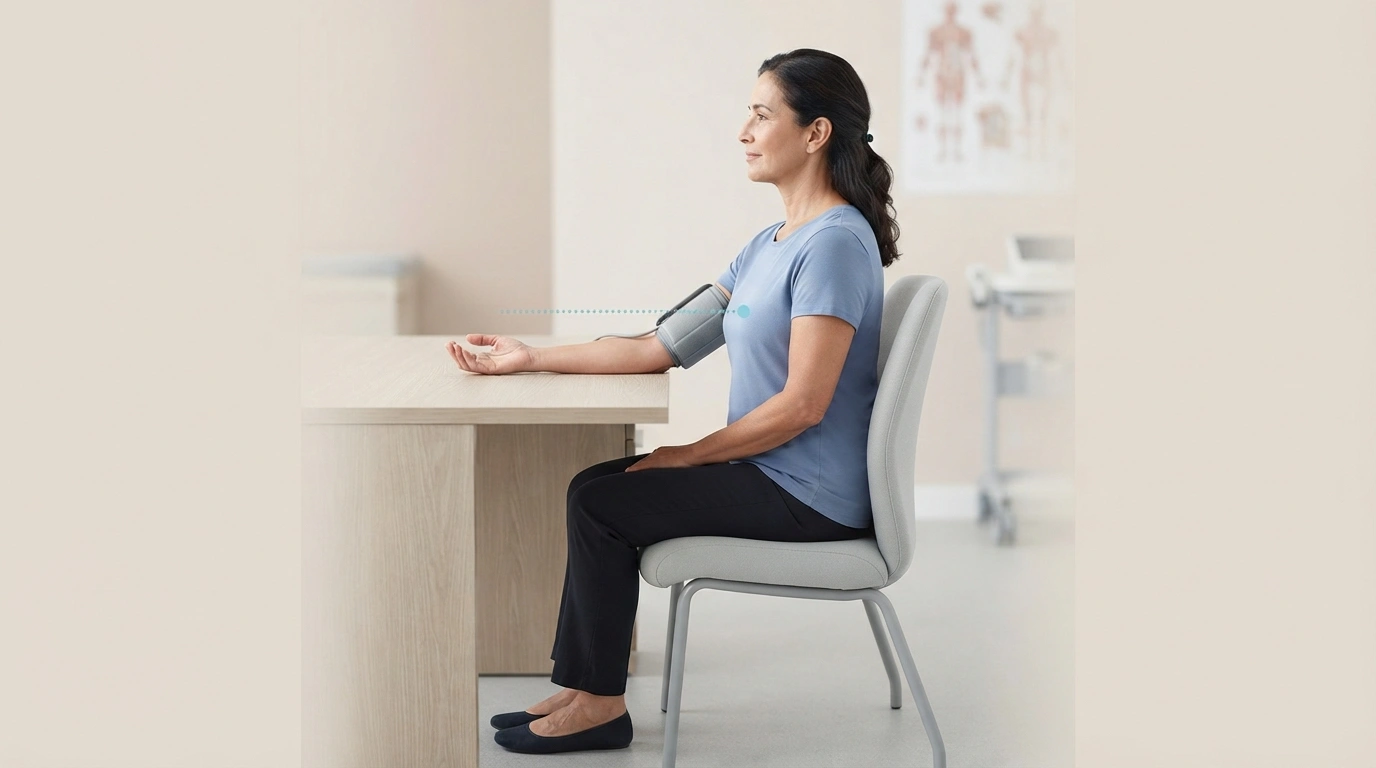
| Body part | Correct position | Error if wrong |
| Back | Against the back of a chair, upright, relaxed | Unsupported back or feet adds 6 to 10 mmHg (AHA) |
| Feet | Both flat on the floor | Dangling feet, as when sitting on a bed, adds a few mmHg |
| Legs | Uncrossed, knees apart | Crossed legs add 2 to 8 mmHg systolic |
| Arm | Resting on a table, palm up, muscles relaxed, elbow slightly bent | Holding the arm up unsupported adds about 10 mmHg |
| Cuff height | Middle of the cuff at the level of the heart (roughly the midpoint of the breastbone) | Arm below heart level reads high, by 4 mmHg up to 23 mmHg depending on how low it hangs (AMA); above heart level reads low |
| Head and body | Facing forward, not twisting to watch the screen | Twisting tenses the arm muscles |
| Mouth | Closed; no talking, eating, chewing or answering questions | Talking adds about 10 mmHg |
Sitting on the edge of a bed with the arm in the lap is the commonest posture in Pakistani homes and it breaks four of these rules at once: the back is unsupported, the feet often dangle, the arm is below heart level, and the hand is usually gripping the monitor. A dining chair pulled up to a table fixes all four. If the table is too low, rest the arm on a cushion or a folded towel so the cuff rises to heart level; if it is too high, sit on a cushion. The arm should feel heavy and lazy on the table, not held in place.
Placing the Cuff and Taking the Reading
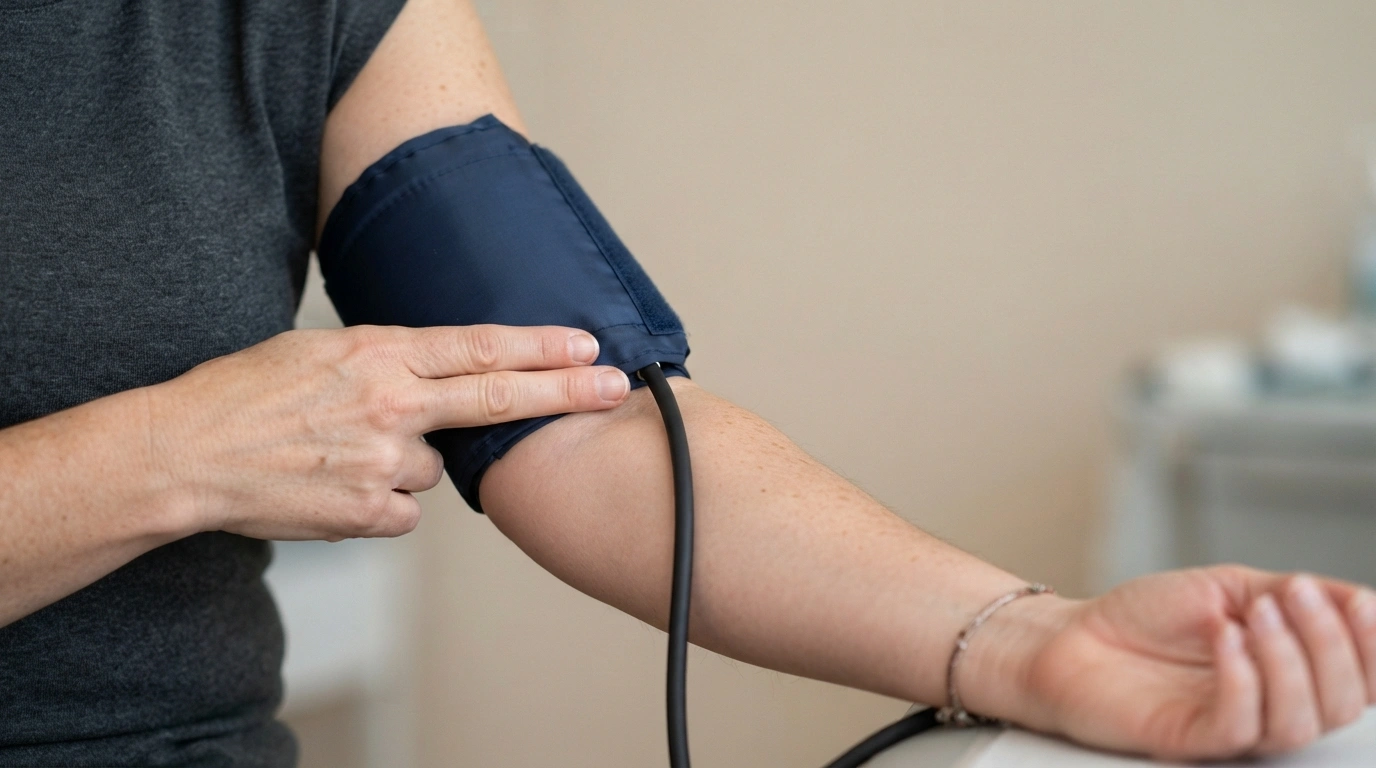
Slide the cuff onto the bare upper arm so that its lower edge sits 2 to 3 cm, about two finger widths, above the crease of the elbow. Most cuffs have an artery mark, a line or arrow that should point down the inside of the arm toward the palm; on the inside of the elbow you can usually feel the brachial pulse there, and the tube should run down over it. Wrap the cuff snugly so that you can slip one finger under the edge but not two; loose reads high, tight reads low. Check that the tube is not kinked and that it connects firmly to the monitor.
Sit in the position described, wait out the five minutes, then press start and let the cuff inflate and deflate without moving, talking or watching the numbers climb. When the reading appears, write down the systolic (upper) and diastolic (lower) numbers and the pulse, wait one full minute with the cuff still on, and take a second reading. If the two systolic values differ by more than 5 mmHg, take a third and use the average of the last two. Our guide to what the two blood pressure numbers mean explains how to read what you have written down. If the monitor shows an irregular heartbeat symbol on more than one occasion, note it and mention it to your doctor; it is one of the reasons a digital monitor sometimes disagrees with the manual apparatus at the clinic, a point covered in our comparison of manual vs digital BP apparatus.
The Best Time of Day to Check Blood Pressure
| Time | Why | What it tells you |
| Morning, within an hour of waking, after using the toilet, before medicines, breakfast and tea | Pressure surges naturally on waking; this catches it before medicine masks it | Whether the morning surge is controlled; the most important reading for people on treatment |
| Evening, before dinner or before bed, before evening medicines | Pressure is at its daily peak in late afternoon and early evening | Whether the morning medicine has lasted the day |
| Same two times every day for 7 days, two readings each time | Day-to-day variation is large; a week averages it out | 28 readings; discard the first day and average the rest |
| Occasionally 1 to 2 hours after a medicine dose | Shows how low the medicine takes the pressure | Useful if you feel dizzy after tablets |
| When you feel unwell, dizzy or have a headache | Checks for a dangerous high or low | A single event reading, kept separate from the trend |
| Not immediately after waking while still in bed, not after a meal, not after activity | These all distort the result | Readings taken at these times mislead more than they inform |
The pattern matters more than any single number. Blood pressure normally runs lowest during sleep, rises steeply in the hour after waking, peaks in the late afternoon and falls again in the evening, and a difference of 10 to 20 mmHg between the morning and afternoon readings of the same healthy person is entirely normal. That is why a reading taken at a different time each day, or only when you feel unwell, produces a logbook of noise. Two fixed times, morning and evening, for a week gives the doctor a genuine picture; international hypertension guidelines ask for exactly this before a diagnosis is made or a medicine changed.
Common Mistakes and How Much They Cost
| Mistake | Typical error | Correction |
| Arm hanging down or in the lap | Reads high by up to 10 mmHg | Arm on a table at heart level |
| Cuff over a shirt or kameez sleeve | 5 to 50 mmHg depending on the fabric (AHA) | Bare arm always |
| Cuff too loose, or worn below the elbow | Reads high | Snug fit, 2 to 3 cm above the elbow crease |
| Cuff too small for a heavy arm | Reads high by 2 to 10 mmHg (AHA) | Measure arm circumference; buy a large cuff if over 32 cm |
| Talking, laughing or answering the phone | Adds about 10 mmHg | Silence for the whole reading |
| Legs crossed | Adds 2 to 8 mmHg | Feet flat, knees apart |
| Full bladder | Adds 10 to 15 mmHg | Toilet first |
| Reading immediately after walking, stairs or housework | Adds 10 to 20 mmHg | Rest five minutes seated |
| Chai or cigarette within 30 minutes | Adds 5 to 15 mmHg | Wait 30 minutes |
| Taking one reading and acting on it | Random error either way | Two readings a minute apart; a week’s trend |
| Repeating the reading many times without a pause | Later readings drift low as the arm is compressed | Maximum three readings, one minute apart |
| Wrist monitor held at waist level | Reads high, often by a lot | Wrist must be at heart level; upper-arm monitors are more reliable |
| Low or flat batteries | Erratic or failed readings | Replace batteries when the indicator appears |
The last row is worth a word because Pakistani load-shedding means many people rely on batteries rather than the adapter, and a monitor running on nearly flat batteries can produce a reading that is simply wrong without an error message. Keep a spare set of batteries with the monitor, and if the readings suddenly become erratic, change the batteries before suspecting anything else.
What to Do With the Numbers
Write every reading in one place, with the date, time, arm and any note such as “after tablet” or “missed dose.” After a week, average the morning readings and the evening readings separately. A home average of 135/85 mmHg or above is generally taken as high, which is slightly lower than the 140/90 mmHg clinic threshold, because home readings run a little lower than clinic ones. Our normal blood pressure by age chart gives the ranges in detail. One reading above 180/120 mmHg with headache, chest pain, breathlessness, weakness on one side or vision change is an emergency; the same number with no symptoms should be rechecked after five minutes of rest and, if it holds, reported to a doctor the same day. Once a year, take the monitor to your doctor’s clinic and compare it against their apparatus on the same arm a minute apart; a monitor that reads within 5 mmHg of the clinic is doing its job.
Upper-Arm Digital BP Monitors We Stock
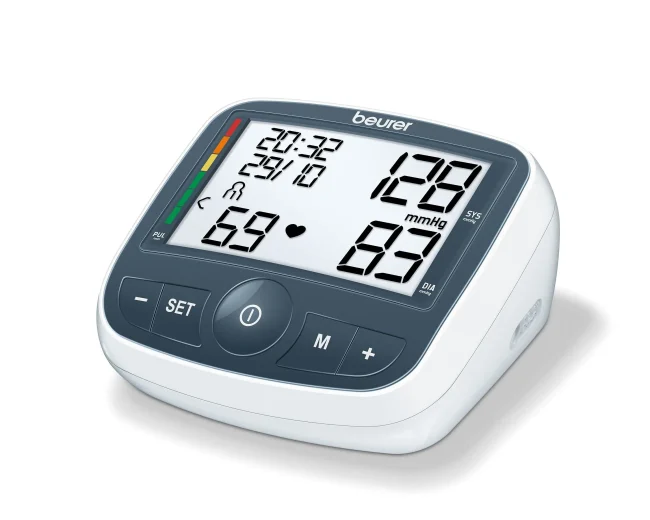
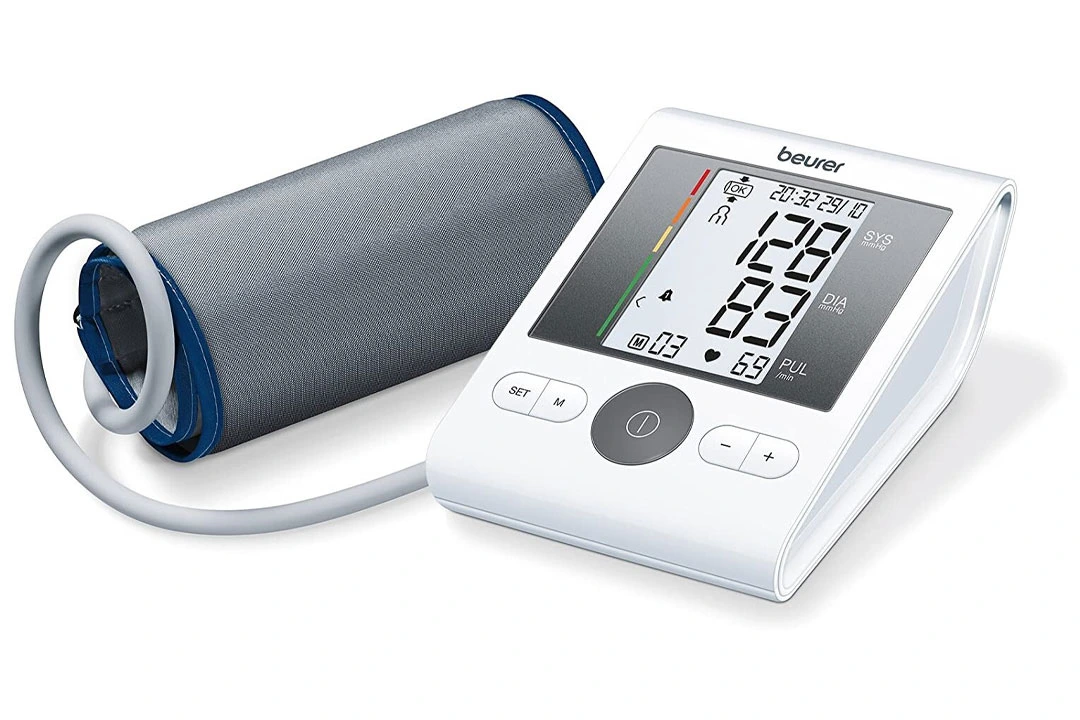
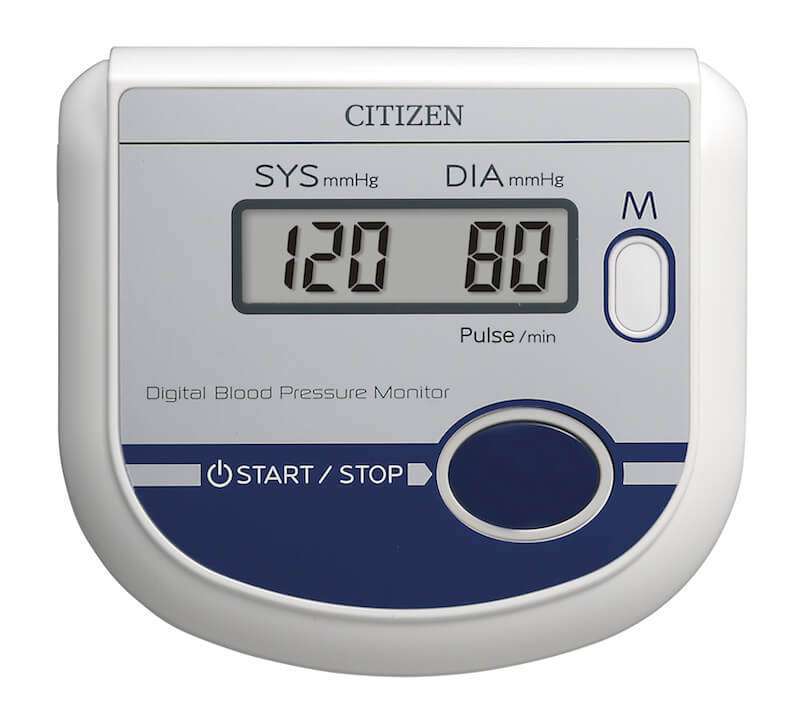
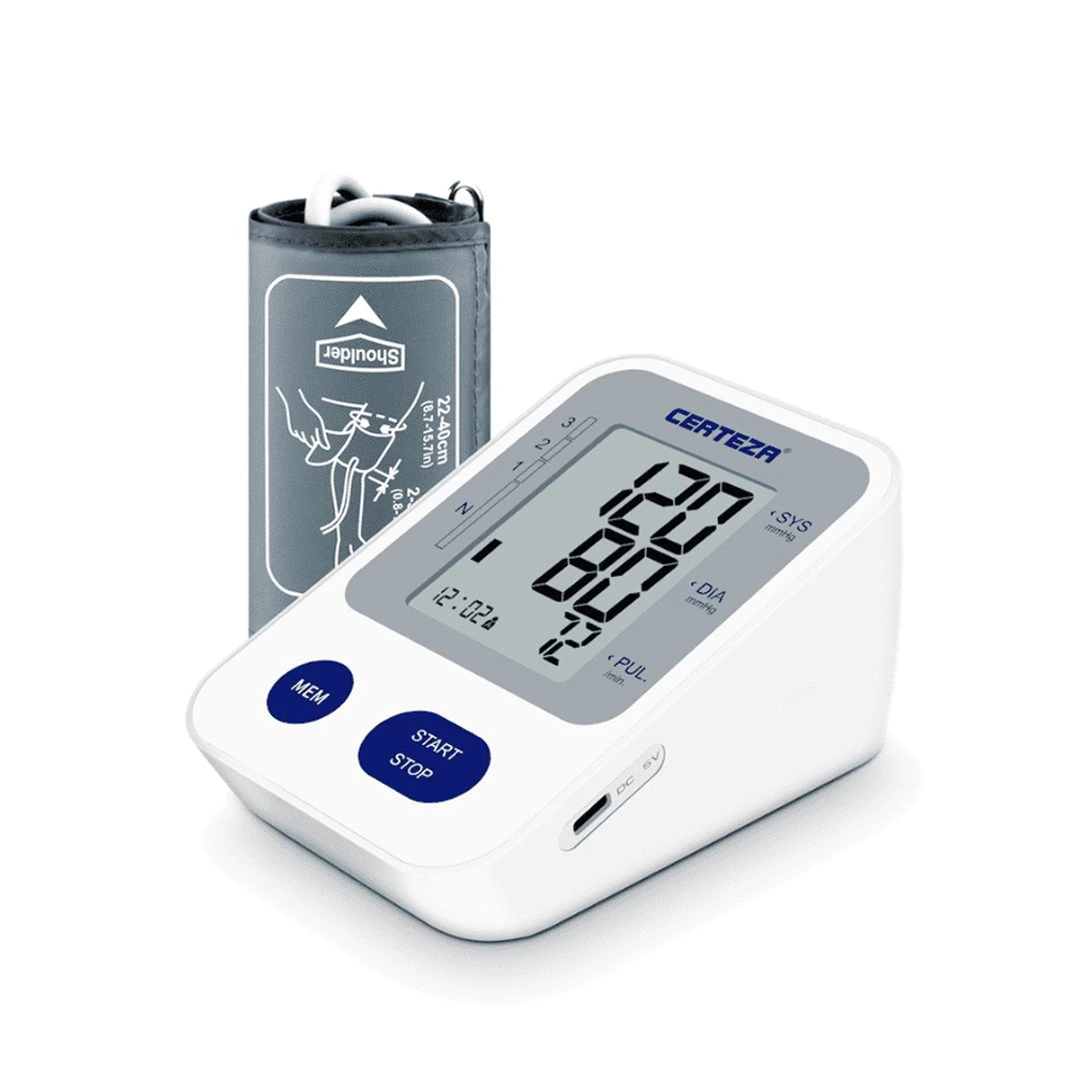
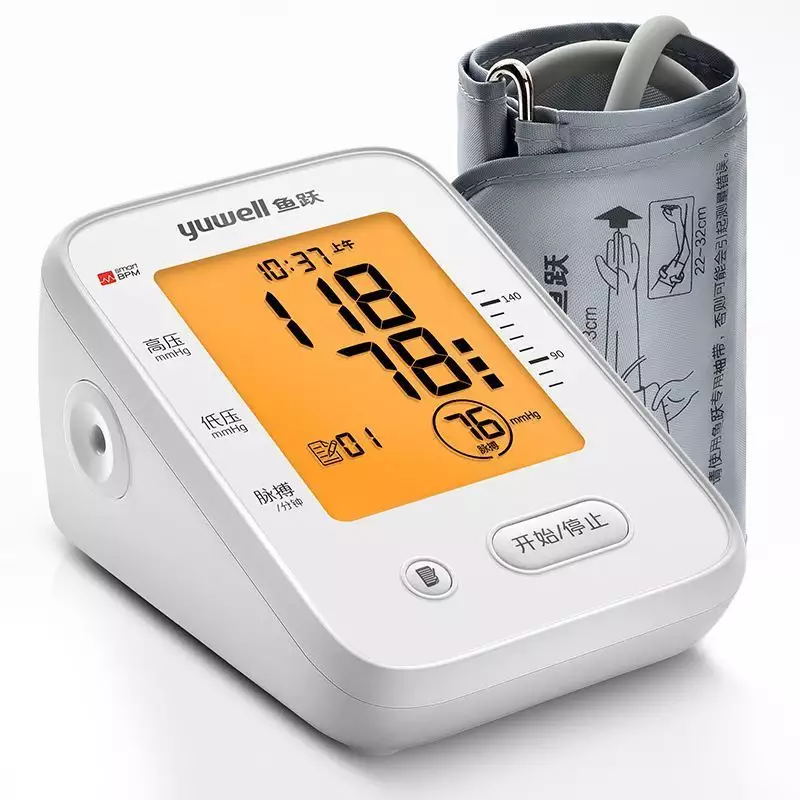
Every monitor below is an upper-arm model, the type this guide recommends over wrist monitors. Check your arm circumference before ordering; arms over 32 cm need a large cuff.

Frequently Asked Questions
What is the correct posture for checking blood pressure?
Sit in a chair with your back supported, both feet flat on the floor, legs uncrossed, and your bare upper arm resting on a table so that the middle of the cuff is at heart level. Stay still and silent for five minutes before and during the reading. Sitting on a bed with the arm in the lap is the commonest wrong posture and reads high.
What is the best time of day to check blood pressure?
In the morning within an hour of waking, after using the toilet and before medicines, breakfast or tea, and again in the evening before dinner or bed. Take two readings a minute apart at each time, every day for a week, and average them. Avoid readings straight after meals, activity or chai.
How many times should I check my BP with a digital machine?
Two readings one minute apart, twice a day, for seven days when you are assessing or adjusting treatment. Take a third reading if the first two differ by more than 5 mmHg and average the last two. Do not repeat more than three times in a row, as the arm becomes compressed and later readings drift low.
Why is my digital BP reading different each time?
Blood pressure naturally varies through the day by 10 to 20 mmHg, and posture, talking, a full bladder, recent chai or activity each add several mmHg, and a cuff over clothing can add far more. Standardise the time, rest and posture, take two readings and use the weekly average; the machine is rarely the cause unless the batteries are low or the cuff is the wrong size.
Should the cuff go on the left or right arm?
Either, but always the same arm. At the first check, measure both arms; if one is consistently 10 mmHg or more higher, use that arm and tell your doctor. Most people use the left arm because the monitor is easier to operate with the right hand.
