- Your cart is empty
- Continue Shopping


A defibrillator is one of those medical devices where there is genuinely no margin for error. When a patient goes into ventricular fibrillation or pulseless ventricular tachycardia, every second without defibrillation reduces survival chances by around 7 to 10 percent. After 10 minutes without a shock, resuscitation rarely works. That’s why the quality of a defibrillator — its reliability, speed of charge, accuracy of energy delivery — matters in a way that’s different from most other medical equipment.
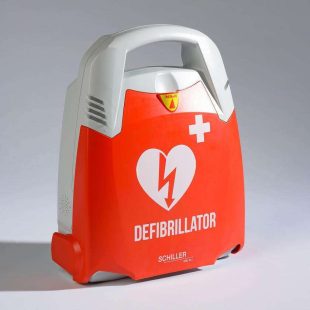
At Medical Supplies PK, we stock 4 defibrillators covering the full clinical range — from a portable AED for public access or clinic use, to a Swiss-made hospital-grade multi-mode device with monitoring, pacing, and intensive care capabilities. Brands include Le Medical, Mediana Korea, Medical Econet, and the industry benchmark Schiller Switzerland. All genuine, all in-stock, and available for delivery across Pakistan.
Other website does not stock defibrillators at all. This entire product category — from AEDs to hospital-grade manual defibrillators — belongs exclusively to Medical Supplies PK among the major online medical equipment retailers in Pakistan. If someone searches for “defibrillator price in Pakistan” online, there is no category competition from the biggest names. This is a significant SEO and sales opportunity.
A defibrillator delivers a controlled electric shock to the heart to interrupt a life-threatening arrhythmia — specifically ventricular fibrillation (VF) or pulseless ventricular tachycardia (pVT) — and allow the heart’s natural pacemaker to re-establish a normal rhythm. Without defibrillation, these rhythms are uniformly fatal.
In clinical settings, defibrillators are used in emergency departments, operating theatres, intensive care units, cardiac care units, and ambulances. In public settings, AEDs (Automated External Defibrillators) are installed in airports, shopping malls, sports facilities, and corporate buildings to allow bystanders to respond before emergency services arrive.
There are three broad categories of defibrillators used in Pakistan:
AED (Automated External Defibrillator): Designed for use by anyone — trained or untrained. The machine analyses the heart rhythm automatically and tells the user exactly what to do through voice instructions and visual prompts. Some AEDs are semi-automatic (user pushes a shock button when advised) while others are fully automatic (deliver the shock without requiring user action).
Manual Defibrillator: Used by trained medical staff who can interpret ECG rhythms and manually select the energy level before delivering a shock. Manual defibrillators give the clinician complete control and are standard equipment in hospitals and advanced life support settings.
Combination Defibrillator/Monitor: The most capable type — combines manual defibrillation, AED mode, external pacing, and full patient monitoring (ECG, SpO₂, NIBP, ETCO₂) in a single device. These are used in ICUs, emergency departments, OTs, and ambulances where multiple functions need to run simultaneously.
| Product | Type | Brand / Origin | Energy | Key Features | Price |
|---|---|---|---|---|---|
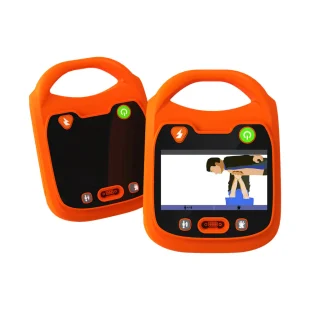
| AED 100 — Le Medical | AED (Portable) | Le Medical | Adult: 150J / 200J | Voice + LED prompts, pre-connected pads, 2.5kg | Rs. 250,000 |
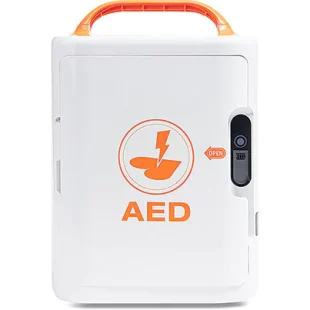
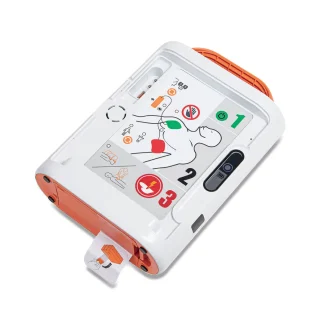
| AED — Mediana Korea | AED (Semi/Full Auto) | Mediana — Korea | 200J BTE | IP55 waterproof, CPR feedback, 1.97kg | Rs. 375,000 |
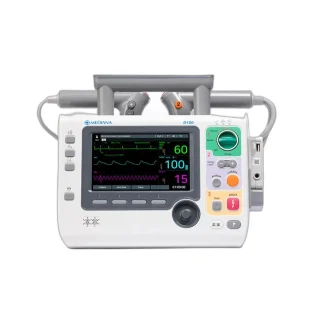
| Multi-Function Defibrillator/Monitor | Manual + AED + Pacer + Monitor | Medical Econet | Adult: 1–200J / Paediatric: 1–100J | 7″ LCD, ECG, SpO₂, Wi-Fi/3G, 5–10hr battery | Rs. 1,250,000 |
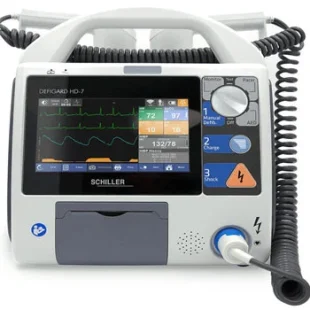
| DEFIGARD HD-7 — Schiller Switzerland | Manual + AED + Pacer + Monitor | Schiller — Switzerland | Manual + AED programmable | 7″ touchscreen, MASIMO SpO₂, ETCO₂, Wi-Fi, printer | Rs. 1,750,000 |
The AED 100 is the most accessible entry point into defibrillation — a portable, lightweight device built for scenarios where trained clinicians may not always be the first to respond. It uses biphasic truncated exponential waveform technology, which is the current clinical standard for AED energy delivery. The device walks the user through every step with voice instructions and LED visual prompts, so even a bystander with basic training can use it correctly under pressure.
What makes this device particularly practical is the pre-connected electrode pads — no fumbling with connections during a cardiac arrest. The built-in automatic self-test system continuously checks the device is ready to use, so it won’t fail when needed most. The adult/child mode selector and automatic energy adjustment mean it covers both adult and paediatric emergencies without requiring manual reconfiguration.
At 2.5kg and compact dimensions (280×209×80mm), it’s genuinely portable — suitable for clinics, small hospitals, first-aid stations, corporate settings, and ambulances.
| Specification | Detail |
|---|---|
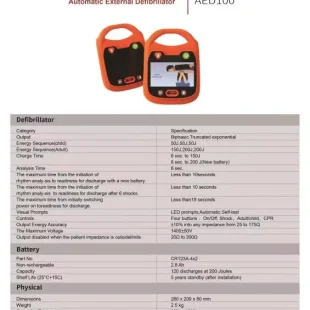
| Waveform | Biphasic Truncated Exponential |
| Energy — Adult | 150J, 200J sequence |
| Energy — Child | 50J, 50J, 50J sequence |
| Charge Time | 6 sec to 150J / 8 sec to 200J (new battery) |
| Analysis Time | 6 seconds |
| Ready-to-Shock (from rhythm analysis) | Under 10 seconds |
| Power-On to Ready | Under 18 seconds |
| Visual Prompts | LED automatic prompts |
| Controls | 4 buttons: On/Off, Shock, Adult/Child, CPR |
| Output Energy Accuracy | ±10% across 25–175Ω impedance |
| Max Voltage | 1,400 ± 50V |
| Battery | CR 123A × 4×2 (non-rechargeable, 2.8Ah) |
| Battery Capacity | 120 discharges at 200J |
| Battery Shelf Life | 5 years (at 25°C) |
| Dimensions | 280 × 209 × 80 mm |
| Weight | 2.5 kg |
| Operating Temperature | 0°C to 40°C |
| Operating Humidity | 30–95% (non-condensing) |
| Storage Temperature | -20°C to 55°C |
| Price | Rs. 250,000 |
The Mediana AED from Korea is a step up in both durability and clinical versatility from the basic AED category. The IP55 rating — dustproof and waterproof — is a significant practical advantage for ambulance use, outdoor emergency stations, sports facilities, and any environment where the device may be exposed to moisture or dust. At just 1.97kg it’s the lightest device in our defibrillator range.
It operates in both semi-automatic mode (user-initiated shock) and fully automatic mode (no shock button needed), which can be configured based on your deployment scenario. The CPR feedback function guides rescuers on chest compression quality in real time — this is a feature that directly improves resuscitation outcomes in published studies. Voice recording of on-site actions allows post-incident review, which is valuable in hospital QA processes.
The 200J impedance-compensated BTE (Biphasic Truncated Exponential) waveform automatically adjusts delivered energy based on the patient’s body impedance, which improves efficacy while reducing unnecessary energy delivery. Adult and paediatric modes switch automatically with energy adjustment.
| Specification | Detail |
|---|---|
| Waveform | 200J Impedance-Compensated BTE |
| Patient Impedance Range | 25–200 Ω |
| Operation Mode | Semi-automatic or Fully Automatic |
| Patient Modes | Adult / Paediatric (auto energy adjustment) |
| Waterproof / Dustproof Rating | IP55 |
| Weight | 1.97 kg |
| Voice Prompt | 3-language built-in (configurable) |
| Pace Pulse Detection | Standard (rejection function) |
| CPR Feedback | Yes — real-time guidance |
| Pads Quality Check | Yes — ensures readiness before use |
| Voice Recording | Yes — records on-site actions |
| LCD Indicators | Battery level, instrument status |
| Pads | Pre-connected for fast attachment |
| Price | Rs. 375,000 |
This is where you move from AED territory into full hospital-grade advanced life support equipment. The multi-function defibrillator/monitor combines four clinical functions in a single device: manual defibrillation, AED mode, external cardiac pacing, and continuous patient monitoring. It is the type of device you’d find in an emergency room, ICU, or well-equipped ambulance.
The 7-inch LCD display shows three simultaneous waveforms and the full set of monitored parameters. Manual defibrillation gives the clinician complete control over energy selection — adult energies range from 1 to 200J in programmable steps, and paediatric from 1 to 100J. The SpO₂ uses Nellcor OxiMax technology, which is one of the most reliable SpO₂ measurement platforms on the market.
Battery life is exceptional: 5 hours of continuous operation, extendable to 10 hours, with a minimum of 200 shocks at 200J per battery — significantly more than most devices in this category. Wi-Fi and 3G connectivity enables data transmission to hospital systems, which is increasingly important for emergency response workflows.
The 3/5 lead ECG monitoring means it can run as a continuous cardiac monitor during transport or in high-acuity settings, not just as a defibrillator on standby.
| Specification | Detail |
|---|---|
| Display | 7″ LCD |
| Waveforms Displayed | 3 simultaneous |
| Operating Modes | Manual Defibrillation / AED / External Pacing / Monitor |
| Adult Energy Range | 1–200J (programmable) |
| Paediatric Energy Range | 1–100J (programmable) |
| Min. Shocks Per Battery | 200 shocks at 200J |
| ECG Leads | 3-lead or 5-lead |
| SpO₂ Technology | Nellcor OxiMax |
| Battery Life | 5 hours (up to 10 hours) |
| Connectivity | Wi-Fi / 3G |
| Best Use | Emergency department, ICU, advanced ambulance |
| Price | Rs. 1,250,000 |
The Schiller DEFIGARD HD-7 is in a different class entirely. Schiller is a Swiss medical technology company with decades of clinical heritage in cardiology and emergency medicine, and the HD-7 represents the top of our defibrillator range — built for settings where equipment failure is genuinely not an option.
The 7-inch full touch screen with one-step mode selector and Touch’n Save interface is the most intuitive clinical interface in our entire range. Switching between manual defibrillation, AED mode, pacer, and monitoring happens with minimal steps — exactly what’s needed in a high-pressure emergency. Connectivity is enterprise-grade: Wi-Fi data transmission, remote software and configuration updates, and automatic self-test result transmission to management systems mean the device’s readiness is monitored continuously without manual checks.
The monitoring capability on the HD-7 is comprehensive: 6-lead ECG using Schiller’s own technology, NIBP using Schiller’s own technology, SpO₂ via MASIMO or Nellcor (both are the gold standard in SpO₂ measurement), and ETCO₂ via MASIMO sidestream — which is used for confirming correct intubation and monitoring ventilation in critical patients. The integrated 3-channel thermal printer allows immediate printing of rhythm strips and monitoring data.
The device works with both traditional defibrillation paddles and adhesive pads from a single connector, giving clinicians flexibility based on the clinical situation.
| Specification | Detail |
|---|---|
| Display | 7″ touch screen |
| Interface | Touch’n Save — one-step mode selector |
| Operating Modes | Manual Defibrillation / AED / Pacer / Monitoring |
| Electrode Options | Paddles or adhesive pads (single connector) |
| ECG | 6-lead — Schiller technology |
| NIBP | Schiller technology |
| SpO₂ | MASIMO or Nellcor technology |
| ETCO₂ | MASIMO sidestream technology |
| CPR Feedback | Yes |
| Connectivity | USB + Wi-Fi |
| Remote Updates | Yes — software and configuration via remote |
| Self-Test Transmission | Automatic transmission to management systems |
| Printer | Integrated 3-channel thermal printer |
| Brand Origin | Schiller — Switzerland |
| Price | Rs. 1,750,000 |
The answer depends entirely on who will be using it, where, and in what clinical context. Here’s a plain guide:
| Your Situation | Best Choice |
|---|---|
| Clinic, corporate office, school, first-aid station — public access AED | AED 100 Le Medical — Rs. 250,000 |
| Ambulance, outdoor emergency use, sports facility — needs waterproofing + CPR feedback | Mediana Korea AED — Rs. 375,000 |
| Emergency department or ICU — manual defibrillation + pacing + monitoring in one device | Multi-Function Defib/Monitor — Rs. 1,250,000 |
| High-acuity hospital / cardiac unit — Swiss-grade reliability, ETCO₂, full remote management | Schiller DEFIGARD HD-7 — Rs. 1,750,000 |
Not sure what your setup needs? Call or WhatsApp us at (+92) 340 4429747 — we can help you work through the clinical requirements before you purchase.
This is one of the most common questions we get on defibrillators, especially from hospital administrators and procurement teams who haven’t dealt with emergency equipment before.
| Feature | AED | Manual Defibrillator |
|---|---|---|
| Who can use it? | Anyone — trained or untrained | Trained medical staff only |
| Rhythm analysis | Automatic — machine decides | Clinician interprets ECG and decides |
| Energy selection | Fixed or auto-adjusted | Clinician selects manually |
| CPR guidance | Usually built-in | Varies by model |
| Best setting | Public spaces, clinics, first responders | Hospitals, ICUs, advanced ambulances |
| Monitoring capability | Basic or none | Full ECG + SpO₂ + NIBP + ETCO₂ |
| Pacing capability | None | Available in advanced models |
| Typical price (Pakistan) | Rs. 250,000–375,000 | Rs. 1,250,000–1,750,000 |
The short version: if you’re putting a defibrillator in a location where a non-clinician may need to use it, get an AED. If you’re equipping an emergency department, OT, or ICU where doctors and nurses will be managing cardiac emergencies, you need a manual defibrillator/monitor.
All four defibrillators we stock use biphasic waveform technology. It’s worth understanding why this matters.
Older defibrillators used monophasic waveforms — current flows in one direction. Modern devices use biphasic technology, where current flows in two phases (first one direction, then reverses). Biphasic delivers the same clinical result at lower energy levels, which means less myocardial damage and better outcomes. The BTE (Biphasic Truncated Exponential) waveform specifically — used in the Mediana and Le Medical AEDs — automatically compensates for the patient’s body impedance, so the delivered energy is consistent regardless of the patient’s size.
This is one reason to avoid very cheap, unverified defibrillators without clear waveform specifications.
If you’re equipping an emergency department, OT, or ICU, a defibrillator works as part of a broader resuscitation and monitoring setup:
What is the price of a defibrillator in Pakistan? Defibrillator prices in Pakistan range from Rs. 250,000 for a portable AED (Le Medical AED 100) to Rs. 1,750,000 for a premium hospital-grade Swiss device (Schiller DEFIGARD HD-7). The right option depends on where it will be used and who will operate it. Contact us at (+92) 340 4429747 for guidance.
Can an AED be used by someone without medical training? Yes — that’s exactly what AEDs are designed for. Both the Le Medical AED 100 and the Mediana Korea AED provide step-by-step voice instructions and visual prompts that guide any user through the process. That said, basic CPR and AED training significantly improves confidence and response speed in a real emergency.
What is the difference between AED and manual defibrillator? An AED analyses the heart rhythm automatically and advises when to shock — designed for use by non-medical personnel. A manual defibrillator requires the operator (a trained clinician) to read the ECG, decide when to shock, and select the energy level. Manual defibrillators in our range also add monitoring, pacing, SpO₂, and NIBP capabilities. See the comparison table above.
What does IP55 rating mean on the Mediana AED? IP55 means the device is protected against dust ingress and can withstand water jets from any direction — making it suitable for outdoor emergency stations, ambulances, and environments where the device may encounter moisture. It does not mean it can be submerged.
Do you deliver defibrillators outside Lahore? Yes — we deliver to Karachi, Islamabad, Rawalpindi, Faisalabad, Peshawar, Multan, Quetta, and all major cities across Pakistan. For bulk institutional orders or procurement by hospitals, contact us at (+92) 340 4429747 or medicalsuppliespk@gmail.com.
Are these defibrillators genuine with warranty? Yes. All products are 100% genuine. Warranty terms vary by brand — Schiller Switzerland carries international brand warranty support. Contact us before purchase and we’ll confirm warranty and after-sales terms for your chosen model.